
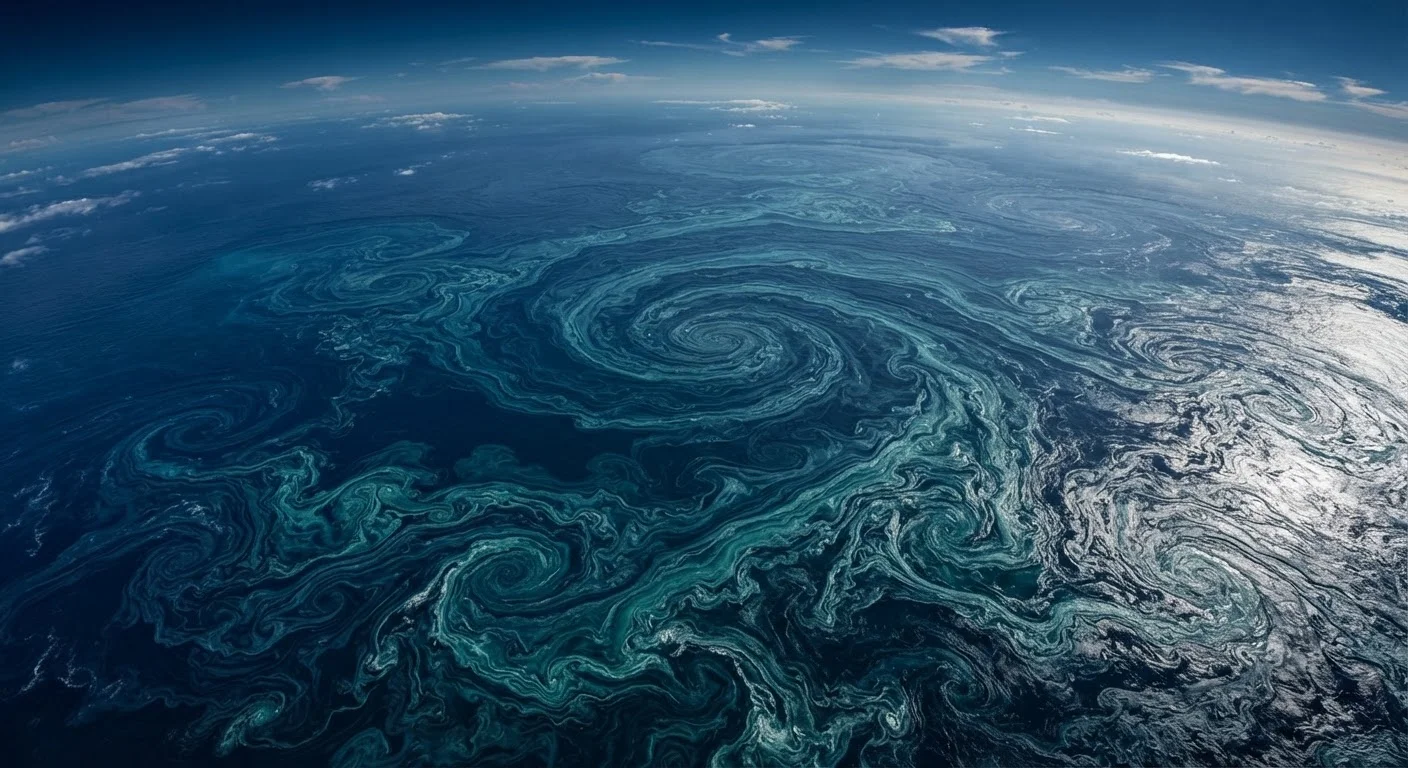
How the Ocean Moves Heat Around the Planet
The ocean covers roughly 71 percent of Earth's surface and absorbs about 90 percent of the excess heat accumulating in the climate system. But it does not hold that heat in place - it moves it, constantly and at scale. Surface currents, set in motion by prevailing winds and deflected by the Coriolis effect from Earth's rotation, form large rotating gyres in each ocean basin. These gyres carry warm tropical water toward higher latitudes and return cooler water toward the equator.
The result is a planetary heat-distribution system operating without pause. Western boundary currents - such as the Gulf Stream along North America's eastern seaboard and the Kuroshio Current in the Pacific - are among the most powerful rivers on Earth, transporting volumes of water that dwarf any river on land. The Gulf Stream alone carries roughly 30 million cubic meters of water per second as it flows northward, delivering heat that keeps much of Northwestern Europe significantly warmer than comparable latitudes in Canada or Russia.
Understanding this system requires seeing it alongside other Earth processes. Weather and climate operate on different timescales, but ocean circulation links them: currents set the baseline climate conditions that determine what weather patterns are possible in a given region.
The Global Conveyor Belt: Deep Ocean Circulation
Below the wind-driven surface layer lies a slower, more powerful circulation system - the thermohaline circulation. In the North Atlantic and around Antarctica, surface water cools and becomes denser as salt concentrates during sea-ice formation. Dense water sinks to the ocean floor and spreads toward lower latitudes along the deep ocean floor, eventually upwelling back to the surface and completing a circuit that takes centuries to millennia.
This system - often called the Atlantic Meridional Overturning Circulation, or AMOC, in the Atlantic basin - acts like a conveyor belt, continuously cycling water between the surface and the deep ocean while transferring heat poleward. It also plays a critical role in the carbon cycle: deep water carries dissolved carbon dioxide to the ocean floor, temporarily removing it from the atmosphere. For more on how carbon moves between ocean and atmosphere, see how carbon moves through air, land, and ocean.
90%
Excess heat absorbed by the ocean
According to estimates consistently cited in IPCC assessment reports, the ocean absorbs approximately 90 percent of the additional heat trapped by greenhouse gases.
~15%
Estimated AMOC weakening since mid-20th century
A widely cited 2021 study in Nature Climate Change, using ocean sediment proxies, estimated the Atlantic overturning circulation has weakened by roughly 15 percent compared to pre-industrial conditions.
1,000 years
Approximate time for one deep-ocean circulation cycle
Oceanographers estimate the full thermohaline circulation cycle - from surface sinking to deep ocean transit to upwelling - takes on the order of 500 to 2,000 years depending on the pathway.
Research published in peer-reviewed journals, including work using ocean sediment proxies, suggests AMOC is weaker today than at any point in at least the past millennium, with freshwater from melting Greenland ice reducing the salinity contrasts that drive sinking. The implications extend well beyond the North Atlantic.
When Circulation Falters: Real-World Consequences
Changes in ocean circulation ripple outward, affecting regions far from the ocean itself. A weakened AMOC would reduce the transport of warm water to the North Atlantic, potentially cooling Europe even as global average temperatures rise - a counterintuitive regional effect that paleoclimate records have documented in past disruption events. Ice cores and ocean sediments reveal that past AMOC disruptions coincided with rapid temperature swings of ten degrees or more across Greenland within decades.
On shorter timescales, the El Niño-Southern Oscillation (ENSO) illustrates how even temporary shifts in ocean surface temperatures reorganize global weather. During El Niño events, anomalously warm Pacific surface water suppresses the upwelling of cold water along South America's coast, shifting the jet stream, triggering droughts across Australia and parts of Africa, and increasing flood risk in the southern United States. These are not local effects - they are planetary ones driven by a relatively modest change in sea-surface temperature.
Extreme weather attribution science increasingly traces the fingerprints of circulation changes in specific events. To explore how climate signals appear in extreme weather, see the types of events where climate signals are clearest. Scientists are also monitoring whether circulation changes could push climate systems past irreversible thresholds - a concern explored in research on tipping points in Earth's climate system.
Why Ocean Circulation Matters for Understanding Climate Change
Ocean currents are not a background feature of the climate - they are one of its primary regulatory mechanisms. As greenhouse gas concentrations rise and polar ice continues to melt, the conditions that sustain thermohaline circulation are changing. Fresh meltwater dilutes the salty surface water that drives sinking; warmer polar temperatures reduce the temperature contrasts that power deep circulation. These changes interact with sea-level rise in regionally uneven ways - a topic examined in depth in the science of sea-level rise.
What makes ocean circulation especially significant for climate science is its capacity for abrupt, non-linear change. Unlike global mean temperature, which tends to rise gradually, circulation systems can shift in step-changes once thresholds are crossed. Current scientific understanding does not predict an imminent collapse of AMOC, but the trajectory of weakening - documented across multiple independent lines of evidence - warrants close attention. Understanding the ocean's role is essential to interpreting climate projections accurately, as distinct from the common misconceptions that conflate natural variability with long-term trends.