Two Different Mysteries, Constantly Confused
Ask someone on the street what dark matter and dark energy are, and you will almost certainly get a blank stare - or a confident but incorrect equation of the two. The names sound similar, both words begin with "dark," and neither can be seen. That is where the resemblance ends. Physicists and cosmologists treat them as fundamentally distinct phenomena that solve entirely different puzzles about the universe.
Dark matter is a form of mass. It has gravity. It pulls things together. Dark energy, by contrast, is better understood as a property of space itself - a kind of pressure that pushes the universe apart. One is about structure; the other is about expansion. Conflating the two leads to real misunderstanding of how cosmologists think the universe actually works.
| Criterion | Dark Matter | Dark Energy |
|---|---|---|
| What it is | An unseen form of mass | An energy density of space itself |
| Primary effect | Gravitational attraction - pulls matter together | Accelerates cosmic expansion - pushes space apart |
| Distribution | Clumps around galaxies and clusters | Uniform across all of space |
| Share of universe | ~27% of total energy content | ~68% of total energy content |
| Key evidence | Galaxy rotation curves, gravitational lensing | Accelerating expansion via supernova observations |
| Interacts with light? | No - completely transparent | No - not directly observable |
| Scientific model | Candidate particles (WIMPs, axions, others) | Cosmological constant or dynamic scalar field |
Dark Matter: Gravity Without Light
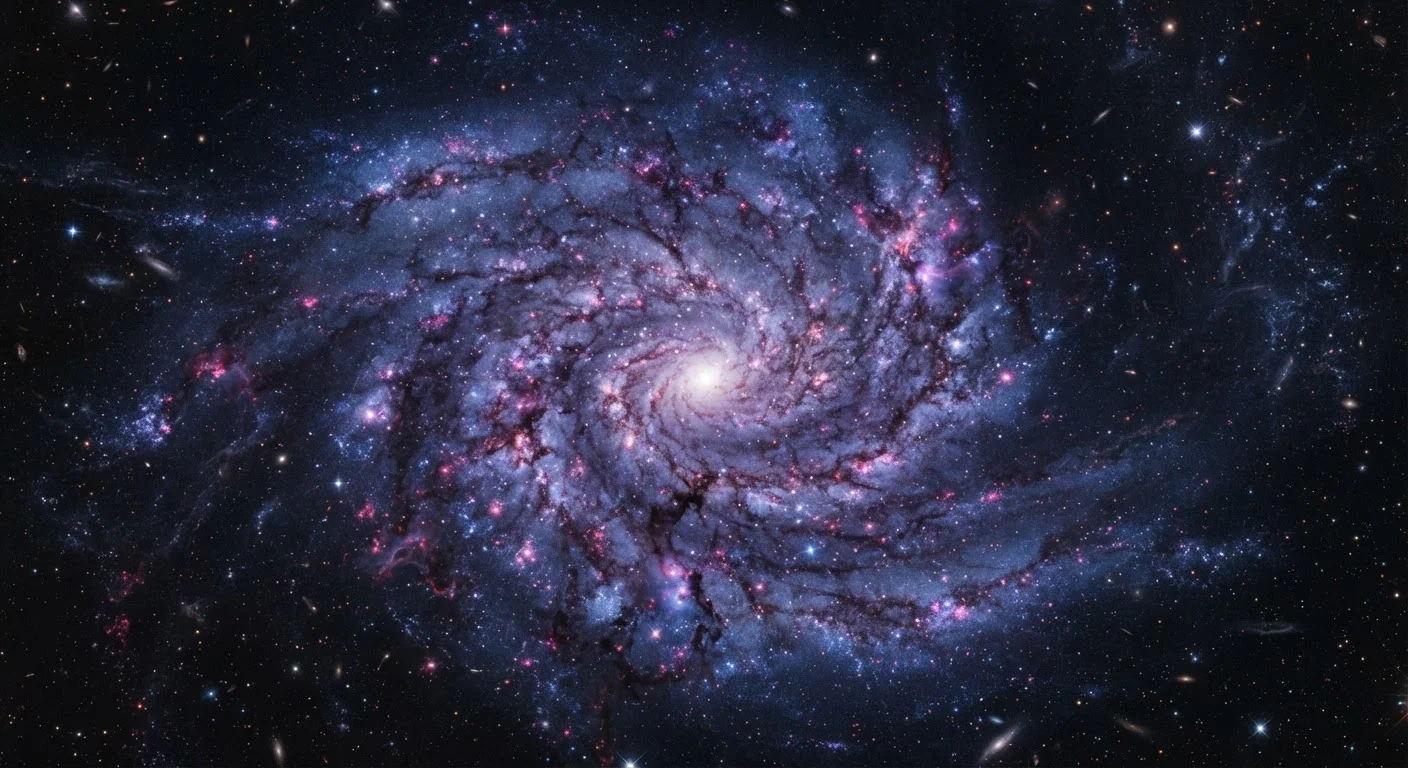
The case for dark matter rests on a straightforward observation: galaxies behave as if they contain far more mass than we can see. In the 1970s, astronomer Vera Rubin and her collaborators measured the rotation speeds of spiral galaxies and found that stars near the outer edges orbit just as fast as stars closer to the center. Under ordinary Newtonian gravity, outer stars should orbit more slowly, the same way planets farther from the Sun take longer to complete their orbits. They don't, and the most widely accepted explanation is that a large halo of invisible mass - dark matter - provides the extra gravitational pull.
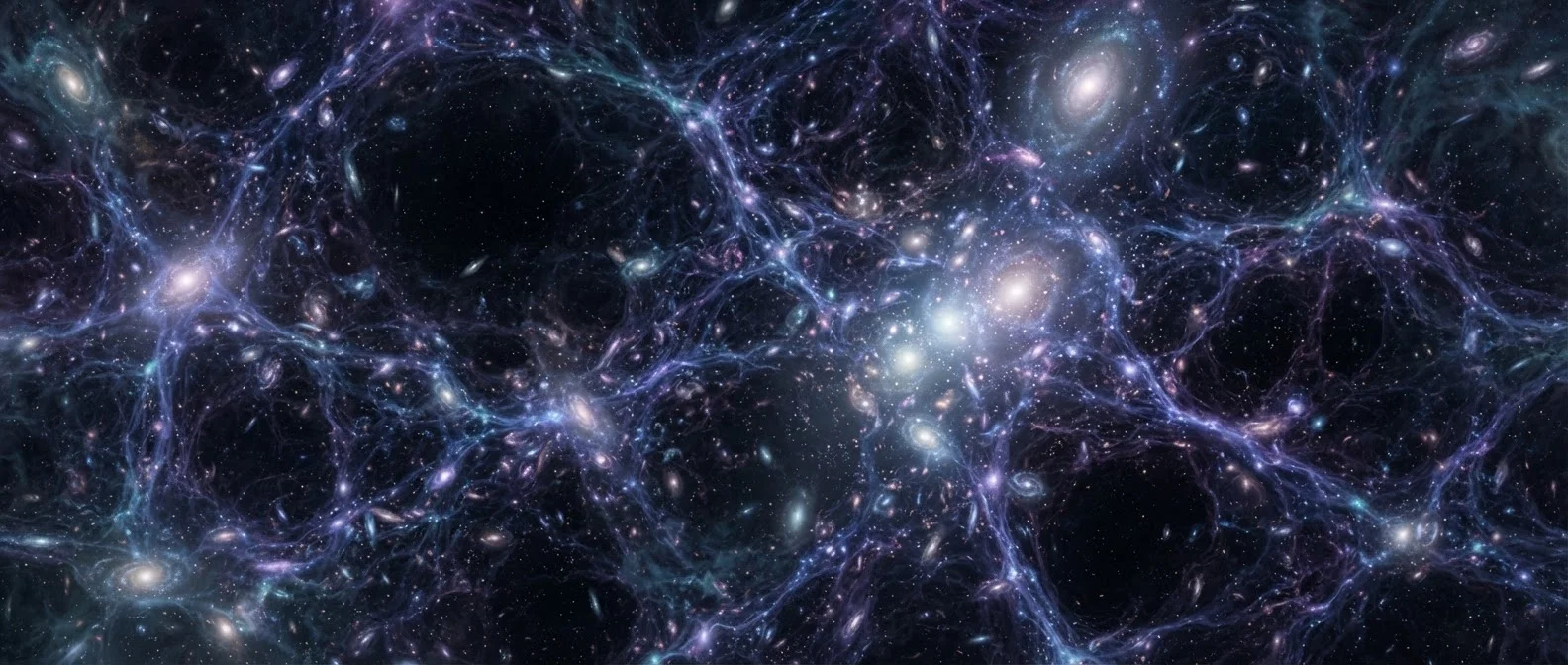
Dark matter also explains how the universe's large-scale structure - vast filaments of galaxies separated by enormous voids - could have formed so quickly after the Big Bang. Without it, ordinary matter alone would not have had enough gravitational attraction to collapse into the galaxies and clusters we observe today. Current estimates suggest dark matter makes up about 27% of the universe's total energy content. Its exact nature remains one of physics' biggest open questions; leading candidates include weakly interacting massive particles (WIMPs) and axions, but none has been detected directly.
Dark Energy: Space Pushing Back
Dark energy entered the scientific conversation dramatically in 1998, when two independent research teams studying distant Type Ia supernovae - stellar explosions used as cosmic measuring sticks - found that the universe's expansion is not slowing down. It is speeding up. This was genuinely shocking. Gravity should be applying the brakes; instead, something is pressing the accelerator.
The leading description of dark energy is the cosmological constant, a term Albert Einstein originally introduced (and later called a mistake) to represent the energy density of empty space. In this picture, dark energy is not a particle or a field in the conventional sense - it is an intrinsic feature of the vacuum, uniform across all of space and unchanging over time. It currently accounts for roughly 68% of the universe's total energy content. Unlike dark matter, dark energy does not clump or cluster; it acts identically everywhere, gently overwhelming gravity on the largest scales and driving galaxies apart faster and faster.
~68%
Universe composed of dark energy
According to the standard cosmological model (ΛCDM), dark energy is the dominant component of the universe's total energy budget.
~27%
Universe composed of dark matter
The standard cosmological model attributes roughly 27% of the universe's total energy content to dark matter.
~5%
Ordinary (visible) matter in the universe
All stars, planets, gas, and everything humans can directly observe makes up only about 5% of the universe's total energy-mass content.
Why the Distinction Matters
Understanding that these are separate phenomena clarifies why cosmologists need both to build an accurate model of the universe. Dark matter explains why structure formed; dark energy explains why that structure is now being stretched apart. They operate on different scales and through different mechanisms. Remove dark matter from the model and galaxies lose their coherence; remove dark energy and the observed acceleration of the universe becomes inexplicable.
Both concepts are inferred from indirect evidence rather than direct detection, which is why scientific investigation into each continues at a rapid pace. Missions such as the ESA's Euclid telescope and NASA's Nancy Grace Roman Space Telescope are designed specifically to probe these unknowns with greater precision. The science is ongoing, the questions are genuinely open, and the two phenomena - whatever they ultimately turn out to be - are firmly distinct chapters in the story of the cosmos.