Why Stargazing Is Worth Starting Tonight
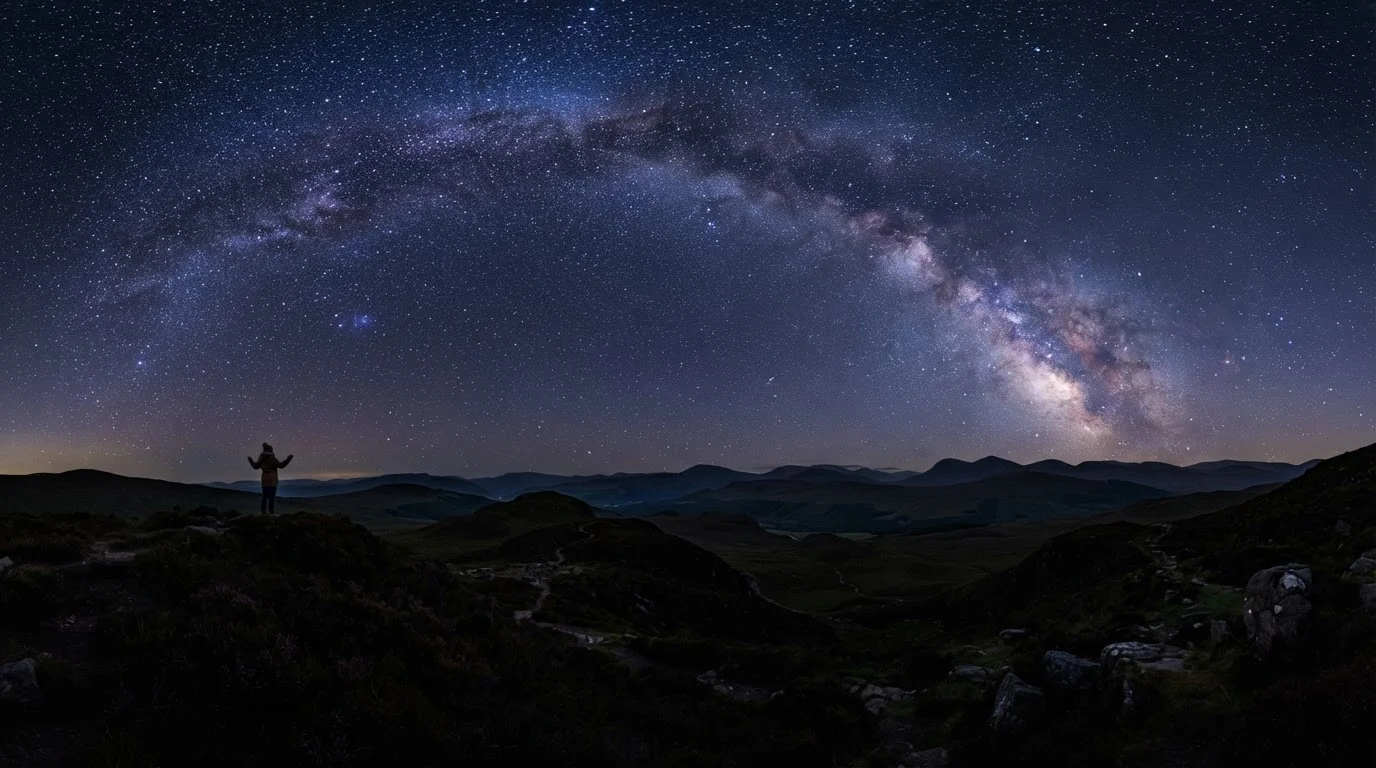
For most of human history, a dense canopy of stars was simply part of nightly life. Ancient navigators used it to cross oceans; farmers used it to mark seasons; every major civilization developed elaborate cosmologies around it. Today, roughly 99% of Americans live under skies brightened by artificial light, which means most people have never truly seen the Milky Way. Understanding what has been lost - and what can still be reclaimed - is a powerful motivator to step outside. See what the night sky looked like before light pollution to appreciate how dramatic that shift has been.
Stargazing is also one of the few scientific hobbies available to virtually everyone at zero cost. The skills involved - spatial memory, pattern recognition, patience - build gradually and rewarding in a way that mirrors other literacy-building pursuits. Much like starting a reading life from scratch, the barrier is largely psychological. Once you commit to the first few outings, the sky begins to feel familiar surprisingly quickly.
Choosing the Right Conditions
Three factors determine how much you will actually see: darkness, atmospheric clarity, and your own eye adaptation. None of them require special equipment to optimize.
Find Darker Ground
Light pollution is the single biggest obstacle for new stargazers. Even moving 20 miles from a city center can double the number of visible stars. Free online dark-sky maps produced by organizations like the International Dark-Sky Association show light-pollution levels by region and help identify nearby dark-sky preserves or rural parks. A Bortle scale rating of 4 or lower - a scale astronomers use to classify sky darkness from 1 (pristine) to 9 (inner city) - is a reasonable target for beginners seeking a genuinely rich view.
Pick Clear, Moonless Nights
Transparency - how free the atmosphere is of dust, humidity, and haze - matters as much as distance from city lights. Clear, low-humidity nights following a cold front tend to offer the best transparency. Equally important is the lunar phase: a full Moon floods the sky with reflected light, overpowering faint objects. New Moon nights, or the days immediately around them, offer the darkest conditions. Planning sessions around the lunar calendar pays off immediately.
Let Your Eyes Adapt
The human eye contains two types of light receptors: cones, which handle color and detail in bright light, and rods, which are exquisitely sensitive to faint light in darkness. Full dark adaptation takes 20-30 minutes and is disrupted instantly by white light. Bring a red-light flashlight or cover your phone screen with a red filter - red wavelengths do not reset rod sensitivity the way white light does.
Red Light Preserves Your Night Vision
Keep a small red-light flashlight in your stargazing kit and switch your phone to its lowest brightness with a red filter. Red wavelengths do not reset the dark-adapting rod cells in your eyes the way white or blue light does. Even a two-second glance at a bright screen can cost you five to ten minutes of re-adaptation.
What to Look for First
New stargazers often try to absorb too much at once. A targeted approach - learning just a few anchor stars and one or two constellations - builds a mental map much faster.
Start With Bright Stars
Begin with the brightest objects. Sirius, the brightest star in the night sky, is hard to miss on winter evenings in the southern portion of the sky. Arcturus burns a distinctive orange and dominates spring evenings in the north. Vega, Deneb, and Altair form the prominent Summer Triangle, easy to spot from June through September. These bright stars act as fixed landmarks from which you can triangulate fainter neighbors over time.
Learn One Constellation as a Navigation Anchor
The Big Dipper (technically an asterism within the constellation Ursa Major) is the most practical starting anchor in the Northern Hemisphere. Its two outer bowl stars, called the Pointer Stars, point directly to Polaris - the North Star - which sits almost exactly above Earth's north rotational pole. This makes it an instant compass. From Polaris, the entire northern sky can be organized and navigated. Once you have located how to read a star map, expanding from that anchor becomes intuitive.
Note Planets vs. Stars
Planets shine with a steady glow; stars twinkle due to atmospheric turbulence. This simple difference lets you identify planets without any equipment. Jupiter and Venus are often the brightest objects in the sky aside from the Moon, and their movement against the background of fixed stars is noticeable over just a few nights.
Dark adaptation
The gradual process by which your eyes become more sensitive to faint light after entering darkness, taking about 20-30 minutes to complete.
Bortle scale
A nine-point numerical scale used to measure the darkness of a night sky, from 1 (pristine dark) to 9 (inner-city glow).
Asterism
A recognizable pattern of stars that is not an officially designated constellation - the Big Dipper is the most familiar example.
Atmospheric transparency
A measure of how clearly light passes through the atmosphere on a given night; humidity, dust, and haze all reduce transparency and limit what you can see.
Magnitude
A numerical scale measuring a star's apparent brightness as seen from Earth - lower numbers mean brighter objects, and negative numbers indicate the very brightest.
Light pollution
Artificial light from cities and infrastructure that brightens the night sky and reduces the number of stars visible to the naked eye.
Tools That Actually Help Beginners
You do not need equipment to start, but a handful of low-cost or free resources meaningfully accelerate learning.
- Sky-map apps: Applications like Stellarium (available as a free web version and a paid mobile app) and SkySafari use GPS and your device's compass to overlay labeled constellation maps in real time. Hold your phone toward the sky and matching stars are identified instantly. These are scientifically accurate and maintained by astronomy professionals.
- Printed monthly star charts: Available from organizations like Sky & Telescope magazine, paper charts have the advantage of preserving your dark adaptation - no bright screen required. Many experienced observers still prefer them.
- 7×50 binoculars: Before investing in a telescope, binoculars offer a transformative upgrade. The designation 7×50 means 7-power magnification with 50mm objective lenses - a combination that gathers substantial light while maintaining a wide enough field of view to stay oriented. Craters on the Moon, Jupiter's four largest moons, and star clusters like the Pleiades all come alive through binoculars.
For those ready to look ahead, understanding which astronomical events are worth tracking throughout the year gives you a natural calendar to plan around - meteor showers, eclipses, and planetary oppositions each offer distinct and rewarding viewing opportunities.
Building the Habit
Stargazing literacy, like most observational skills, develops through repetition rather than intensive single sessions. Even 20 minutes of intentional sky time once or twice a week builds a durable mental map of the sky across seasons. Stars that are unfamiliar in July become reliable old friends by the following spring.
Keep a simple log - a small notebook or a note on your phone recording what you saw, the conditions, and where you were observing from. Over weeks, patterns emerge: you notice that Orion climbs higher as winter deepens, that the Summer Triangle sets earlier as autumn arrives, that the Moon's position shifts noticeably from night to night. This observational journal is not just satisfying; it is genuine scientific practice at the amateur level.
The night sky is one of the few things that rewards patience, attention, and curiosity in equal measure. The science underneath it - stellar evolution, gravitational physics, cosmological scale - is profound. But the entry point is simple: step outside, let your eyes adjust, and look up.