Carbon: Earth's Universal Currency
Carbon is arguably the most important element on Earth. It forms the backbone of every living molecule - from DNA to the sugars that fuel cellular metabolism. It also exists in the atmosphere as carbon dioxide (CO2) and methane (CH4), gases that regulate how much of the Sun's heat Earth retains. Understanding how carbon moves through Earth's systems is essential for understanding both life itself and the planet's climate.
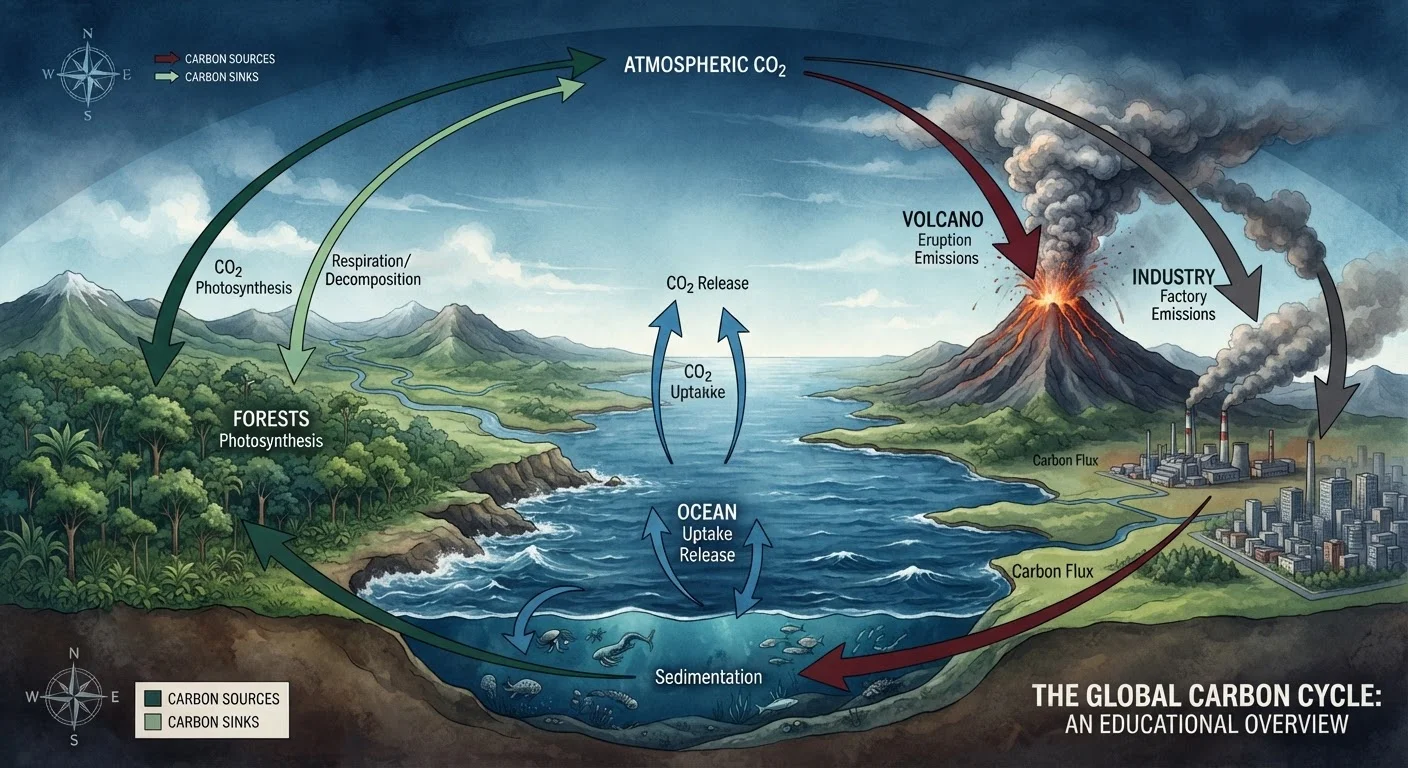
At any given moment, carbon exists in several major reservoirs: the atmosphere, oceans, terrestrial ecosystems (plants and soil), and geological formations like limestone and fossil fuels. The carbon cycle describes the pathways connecting these reservoirs. Some pathways are fast - photosynthesis and respiration exchange carbon in hours to decades. Others are extraordinarily slow - tectonic activity and rock weathering move carbon over millions of years. Together, they form a planetary recycling system of remarkable complexity.
420+ ppm
Current atmospheric CO2 concentration
Atmospheric CO2 has exceeded 420 parts per million - the highest level recorded in at least 800,000 years of ice-core data.
~25-30%
Share of human CO2 absorbed by oceans annually
According to NOAA and global carbon budget estimates, the world's oceans absorb roughly a quarter of human-produced carbon dioxide each year.
2× atmosphere
Carbon stored in global soils vs. atmosphere
Soil carbon stocks are estimated to be roughly twice the amount of carbon currently held in the atmosphere, underscoring the importance of soil health.
How Carbon Moves Through the Living World
The most familiar leg of the carbon cycle runs through living organisms. During photosynthesis, plants, algae, and some bacteria absorb CO2 from the air and convert it into sugars using sunlight. This process pulls carbon out of the atmosphere and locks it into organic matter - leaves, wood, roots, and ocean plankton. Globally, land plants and ocean photosynthesizers absorb roughly 120 billion metric tons of carbon per year.
When organisms breathe, digest food, or decompose after death, that carbon is released back into the atmosphere through respiration and decomposition. Microbes in the soil play a particularly critical role here: they break down dead organic material, releasing CO2 and methane as byproducts. This is why healthy, intact soils are so important - they don't just store carbon passively, they actively regulate how much carbon is released and when.
Fire is another fast-track pathway. Wildfires release the carbon stored in vegetation almost instantaneously, returning decades or centuries of accumulated biomass to the atmosphere in a matter of days.
The Ocean's Role as Carbon Sink and Buffer
The ocean is the planet's largest active carbon sink, absorbing an estimated 25-30% of human-caused CO2 emissions each year. Carbon enters seawater directly through gas exchange at the ocean surface, where atmospheric CO2 dissolves into water. Once dissolved, it can be transported to deep ocean layers through currents - a process known as the biological pump, in which marine organisms incorporate carbon into their bodies and shells, which sink to the seafloor when they die.
This deep-water storage effectively removes carbon from the active cycle for centuries. Ocean circulation patterns regulate how rapidly this sequestered carbon is mixed back toward the surface. Disrupting these currents - as a warming climate may do - could reduce the ocean's capacity to absorb CO2, accelerating atmospheric buildup.
The downside of the ocean's carbon absorption is ocean acidification. As seawater absorbs more CO2, it forms carbonic acid, lowering pH. This increasing acidity threatens marine organisms that build calcium carbonate shells and skeletons, from oysters to coral reefs.
The Slow Cycle: Rocks, Volcanoes, and Deep Time
Over millions of years, carbon moves through Earth's crust via geological processes. When organisms die in the ocean, their carbon-rich remains can accumulate in seafloor sediments, eventually being compressed into limestone or transformed - under heat and pressure - into coal, oil, and natural gas. This geological storage is extraordinarily stable; without human intervention, this carbon would remain locked underground for tens of millions of years.
Volcanoes return geologically stored carbon to the atmosphere through eruptions, releasing CO2 as magma degasses. Rock weathering is another slow release mechanism: when silicate rocks are exposed to air and rain, chemical reactions draw CO2 out of the atmosphere, but the process operates on timescales of tens of thousands of years. Scientists use evidence from ice cores and ocean sediments to reconstruct how these slow cycles have shaped past climates. Paleoclimate records show that natural carbon cycle disruptions - such as massive volcanic episodes - have triggered dramatic climate shifts throughout Earth's history.
Human Activity and the Disrupted Cycle
Since the Industrial Revolution, humans have been transferring vast amounts of geologically stored carbon back into the atmosphere by burning fossil fuels. This effectively short-circuits the slow carbon cycle, releasing in decades what took millions of years to accumulate. Deforestation compounds the problem by removing forests that would otherwise absorb atmospheric CO2.
The result is a measurable, rapid increase in atmospheric CO2 concentration - from approximately 280 parts per million (ppm) before industrialization to over 420 ppm today, higher than at any point in at least 800,000 years of ice-core records. This elevated CO2 enhances the greenhouse effect, trapping more heat and driving global temperature increases. Earth's atmospheric layers each respond differently to these compositional changes, with cascading effects on weather and climate patterns worldwide.
Understanding the carbon cycle isn't merely an academic exercise - it's the foundation for understanding why climate change is happening and what levers, from protecting forests to developing carbon capture technologies, might help rebalance a system that took billions of years to evolve.
“The carbon cycle is one of the great regulatory systems of the Earth. When we interfere with it - as we clearly have - we are conducting an unplanned experiment on the only habitable planet we know.”
— Richard Alley, Geoscientist and climate researcher, Pennsylvania State University