What Soil Is Made Of
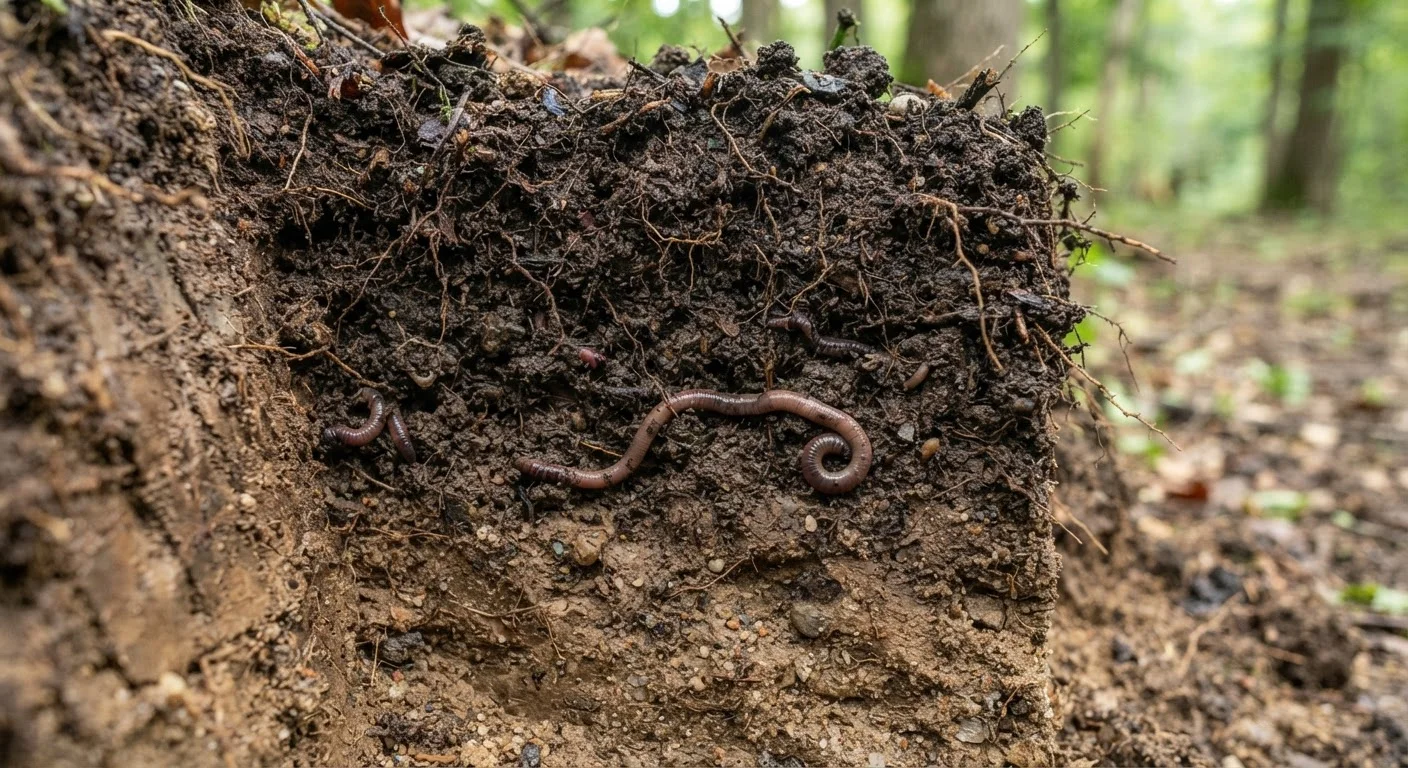
Soil is not a single substance - it is a carefully balanced mixture of four components: minerals, organic matter, water, and air. Minerals, derived from the slow weathering of rocks over thousands of years, form the structural skeleton. They range from coarse sand grains to microscopic clay particles, and their proportions determine whether a soil drains freely or holds water, crumbles easily or compacts into a brick.
Organic matter - decomposed plant and animal material - is what separates productive soil from sterile mineral dust. Though it typically makes up only 1-5% of soil by volume, it is disproportionately important. It binds mineral particles into aggregates, feeds microorganisms, retains moisture, and supplies the nitrogen, phosphorus, and other nutrients that plants require. The dark color of fertile topsoil comes almost entirely from this organic fraction.
Water and air occupy the pore spaces between particles. Plants draw water and dissolved nutrients upward through roots, while soil air - richer in carbon dioxide than the atmosphere above - supports the respiration of roots and the vast underground community of organisms that power the whole system.
1,500-2,400 Gt
Carbon stored in global soils
Estimates from the Intergovernmental Panel on Climate Change place soil organic carbon stocks well above atmospheric and vegetation reserves combined.
~33%
World's soils already degraded
The UN Food and Agriculture Organization's 2015 Status of the World's Soil Resources report estimated that roughly one-third of global soils are moderately to highly degraded.
500+ years
Time to form one inch of topsoil
Natural pedogenesis - the process of soil formation from parent rock - proceeds at roughly 0.004 inches per year under favorable conditions, according to soil science literature.
1 billion+
Bacteria per teaspoon of healthy soil
Soil ecologists estimate that a single gram of fertile soil hosts between 100 million and 1 billion individual bacterial cells across thousands of species.
The Hidden Ecosystem Underfoot
The biological richness of healthy soil rivals any tropical rainforest. Bacteria and archaea handle the most fundamental chemistry - breaking down complex organic molecules, fixing atmospheric nitrogen into plant-usable forms, and cycling sulfur, phosphorus, and other elements. Fungi extend thread-like hyphae through soil over remarkable distances, forming mycorrhizal networks that connect plant roots and exchange nutrients for sugars in one of ecology's most consequential partnerships.
Larger organisms add further complexity. Earthworms physically mix soil layers, create channels that improve drainage, and accelerate decomposition as organic matter passes through their digestive systems. Nematodes, mites, springtails, and beetle larvae each play roles in regulating bacterial populations and breaking down organic material at different scales.
This biodiversity is not merely interesting - it is functional. Soils with higher microbial diversity suppress plant pathogens more effectively, cycle nutrients more efficiently, and recover from disturbance more readily. When that diversity is lost through chemical saturation, compaction, or prolonged drought, the consequences cascade upward through the food web.
Soil's Role in the Carbon Cycle and Climate
Soil is Earth's largest terrestrial carbon reservoir. Globally, soils hold an estimated 1,500 to 2,400 billion metric tons of organic carbon - roughly twice the amount stored in the atmosphere and three times the amount stored in all living vegetation. This makes soil a critical regulator of atmospheric carbon dioxide concentrations and, by extension, of climate itself.
Carbon enters soil primarily through plant roots and the decomposition of above-ground plant litter. Soil microbes consume this organic material, releasing some carbon back as CO₂ through respiration while converting the remainder into stable compounds that persist for decades or centuries. When soil is disturbed - plowed deeply, drained, or heated - this equilibrium breaks down and carbon escapes to the atmosphere.
The relationship runs in the other direction too. As the climate warms, microbial activity in soil accelerates, releasing stored carbon faster and creating a feedback loop that amplifies warming. Understanding this dynamic is central to climate science, and it connects directly to the carbon cycle that governs how carbon moves through all of Earth's systems.
How Human Activity Degrades Soil - and Why It Matters
Soil forms extraordinarily slowly - a single inch of topsoil can take 500 years or more to develop under natural conditions. Human activity erodes it orders of magnitude faster. Intensive tillage breaks apart soil aggregates, destroying structure and exposing organic matter to rapid oxidation. Monoculture cropping depletes specific nutrients and reduces the biological diversity that keeps soil resilient. Overgrazing compacts the surface, reducing infiltration and triggering runoff. Deforestation removes the root systems and leaf litter that feed soil organisms and hold particles in place.
The consequences extend well beyond agriculture. Degraded soils release their stored carbon - contributing to the same atmospheric changes examined in discussions of the greenhouse effect. They filter water less effectively, allowing pollutants and sediments to reach rivers and aquifers. They support less plant life, reducing habitat for wildlife and accelerating biodiversity loss.
Regenerative practices - cover cropping, composting, reduced tillage, and strategic reforestation - can reverse degradation given enough time. But because soil forms so slowly, prevention remains far more effective than restoration. Treating soil as the non-renewable, ecologically essential resource that it is may be one of the most consequential shifts in land management humanity can make.