How the Greenhouse Effect Actually Works
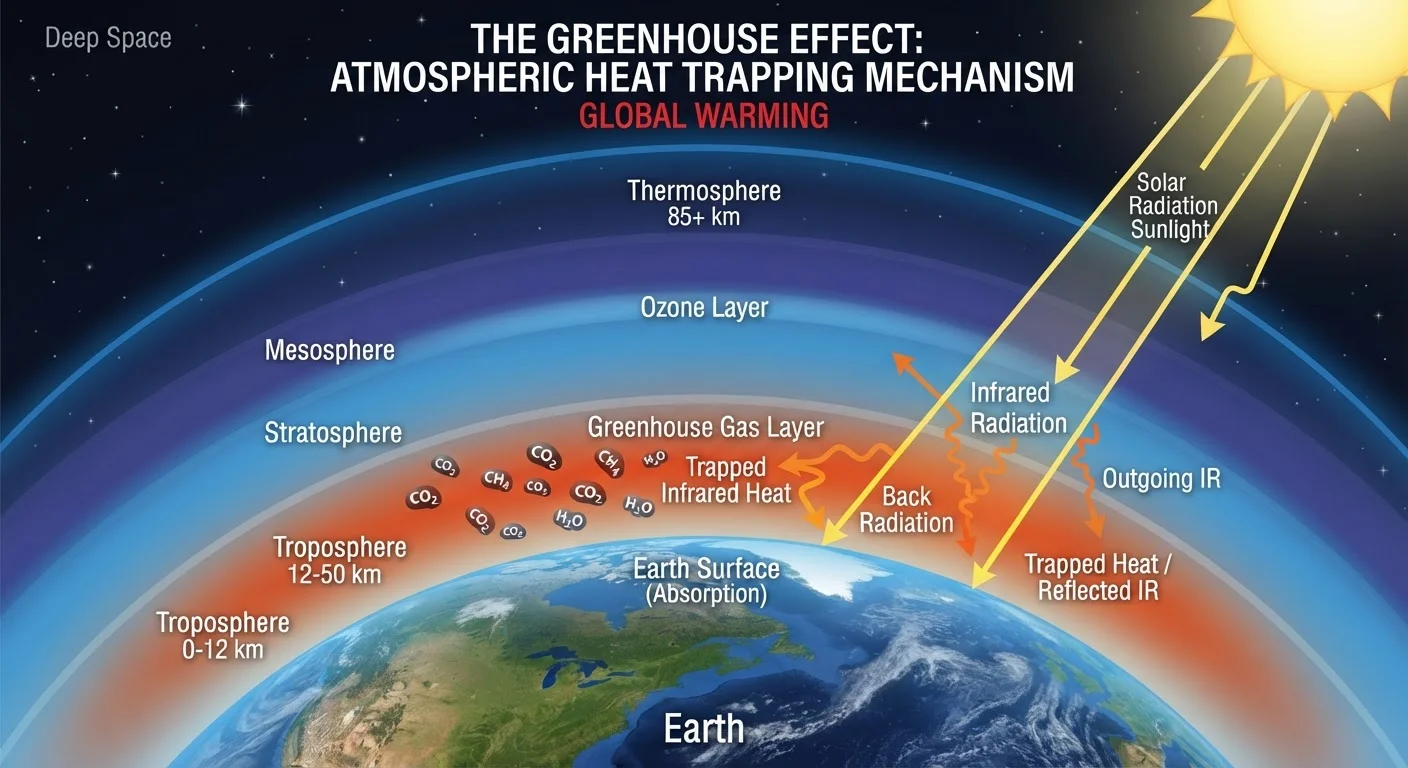
The sun emits energy primarily as visible light, which passes through Earth's atmosphere and warms the surface. The surface then radiates that energy back upward - but as infrared radiation (heat), a longer wavelength that travels differently through the atmosphere. This is where greenhouse gases come in.
Molecules of carbon dioxide (CO₂), methane (CH₄), nitrous oxide (N₂O), and water vapor absorb outgoing infrared radiation and re-emit it in all directions - including back toward Earth's surface. This partial trapping of heat is the greenhouse effect, and it's the reason Earth maintains temperatures suitable for liquid water and life.
A useful analogy: the atmosphere acts less like a physical greenhouse and more like a thermal blanket - thicker concentrations of greenhouse gases create a thicker blanket, retaining more heat over time.
420+ ppm
Current atmospheric CO₂ concentration
Ice core records indicate this level has not been reached in at least 800,000 years of Earth's climate history.
~59°F
Earth's average surface temperature with the greenhouse effect
Without any greenhouse effect, Earth's average surface temperature would fall to approximately 0°F - well below freezing.
80x
Methane's warming potency vs. CO₂ over 20 years
The Intergovernmental Panel on Climate Change (IPCC) estimates methane's 20-year global warming potential at roughly 80 times that of carbon dioxide.
Why Human Activity Changes the Equation
For most of human history, greenhouse gas concentrations fluctuated within a relatively stable natural range. The burning of fossil fuels - coal, oil, and natural gas - releases CO₂ that had been locked in geological formations for millions of years, essentially injecting ancient carbon into the modern atmosphere far faster than natural systems can absorb it.
Since the Industrial Revolution, atmospheric CO₂ concentrations have risen from roughly 280 parts per million (ppm) to over 420 ppm - a level not seen on Earth in at least 800,000 years of ice core records. Deforestation compounds the problem by reducing the number of trees available to absorb CO₂ through photosynthesis. To understand how carbon moves between the atmosphere, oceans, and land, see our article on how carbon moves through Earth's systems.
Methane emissions from livestock, landfills, and natural gas infrastructure add another layer. Although methane breaks down faster than CO₂, it traps heat at roughly 80 times the rate over a 20-year period - making even small increases in atmospheric methane consequential.
What an Enhanced Greenhouse Effect Means in Practice
When the greenhouse effect intensifies beyond its natural baseline, the consequences ripple across interconnected Earth systems. Higher average temperatures alter precipitation patterns, intensifying droughts in some regions while increasing flood risk in others. Arctic sea ice and glaciers melt, contributing to sea level rise that threatens coastal communities. Warmer ocean temperatures fuel more intense storm systems and disrupt marine ecosystems.
These aren't projections based on speculation - they are trends already being measured by satellites, ocean buoys, and global weather stations. The scientific consensus on human-caused climate change, reflected in the work of thousands of independent researchers, is as strong as consensus gets in empirical science. Readers interested in how specific misconceptions about this science hold up to scrutiny can explore our article examining common climate myths against the evidence.
It's also worth noting that terrestrial systems like soil play a role in the feedback loop - healthy soils act as carbon stores, while degraded soils can release stored carbon back into the atmosphere. Our piece on what soil does for the planet covers this in more depth.
Separating the Natural from the Amplified
One of the most important distinctions in climate science is between the greenhouse effect as a background condition of life on Earth and the enhanced greenhouse effect driven by human emissions. Conflating the two - or dismissing concern because the greenhouse effect is "natural" - misses the core issue: it's not the existence of the mechanism that poses a problem, but the rate and scale of its intensification.
Natural climate variability - driven by orbital cycles, volcanic eruptions, and solar output changes - does shift Earth's energy balance over very long timescales. But the warming trend documented over the past century is occurring at a pace orders of magnitude faster than natural drivers can explain. The atmosphere is changing faster than many biological and ecological systems can adapt.
Understanding the greenhouse effect in these terms - not as a threat invented by scientists, but as a well-characterized physical process now being pushed out of its stable range - is foundational to understanding the science of climate change accurately.
This article is for general informational and educational purposes only.