What Is Earth's Atmosphere?
Earth's atmosphere is a thin envelope of gases held in place by gravity, extending from the planet's surface to roughly 10,000 kilometers (6,200 miles) above it. It is composed primarily of nitrogen (about 78%) and oxygen (about 21%), with trace amounts of argon, carbon dioxide, water vapor, and other gases. Without it, liquid water couldn't exist on the surface, solar radiation would be lethal, and temperature swings between day and night would be catastrophic.
Scientists divide the atmosphere into five principal layers based on how temperature changes with altitude - a property called the temperature lapse rate. Each layer has a distinct chemical composition, physical behavior, and role in supporting life and regulating Earth's climate. Understanding how the carbon cycle interacts with the atmosphere begins with knowing which layer you're talking about.
| Total atmospheric thickness | ~10,000 km (6,200 mi) (NASA Earth Fact Sheet) |
| Primary gas composition | 78% nitrogen, 21% oxygen (NOAA / standard atmospheric science) |
| Layer with all Earth's weather | Troposphere |
| Location of the ozone layer | Stratosphere (15-35 km altitude) (World Meteorological Organization) |
| Coldest atmospheric region | Mesosphere (~−90°C / −130°F) (NASA Atmospheric Science) |
| ISS orbital altitude | ~400 km (within thermosphere) (NASA International Space Station Program) |
The Five Layers, Explained
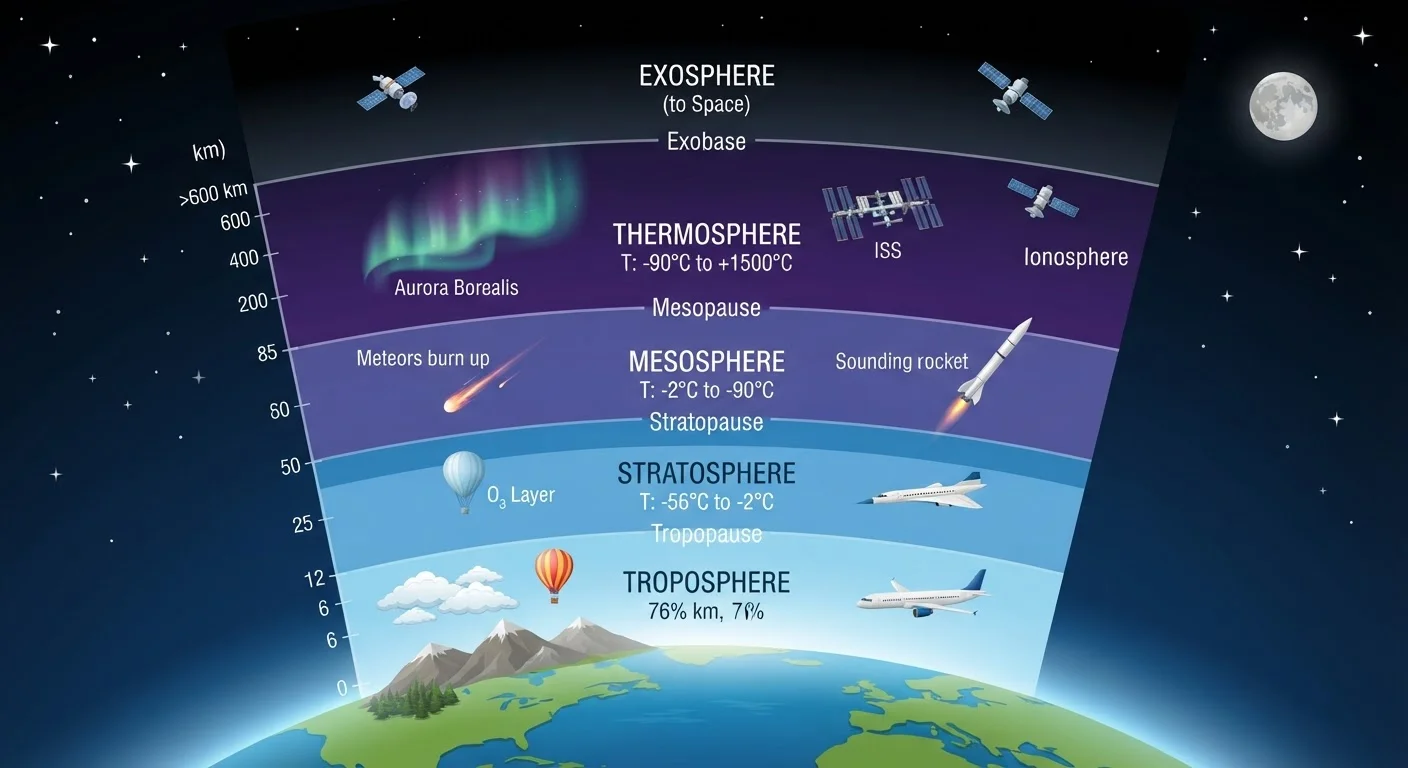
Moving upward from Earth's surface, the five layers are: troposphere, stratosphere, mesosphere, thermosphere, and exosphere.
Troposphere (0-12 km)
This is where all weather happens and where virtually all life exists. Temperature decreases with altitude here, driving the convection that creates clouds, rain, and wind. Nearly 75% of the atmosphere's total mass sits in the troposphere. The thin boundary at its top - the tropopause - acts as a lid that traps most weather systems below it.
Stratosphere (12-50 km)
Unlike the troposphere, the stratosphere warms with increasing altitude, largely because it contains the ozone layer - a region of concentrated ozone (O₃) that absorbs most of the Sun's ultraviolet-B and UV-C radiation. This temperature inversion creates stable, calm conditions, which is why commercial aircraft often cruise in the lower stratosphere. Depletion of stratospheric ozone by human-made chemicals, such as chlorofluorocarbons (CFCs), has been a well-documented environmental concern since the 1970s.
Mesosphere (50-85 km)
Temperatures drop sharply again in the mesosphere, reaching as low as −90°C (−130°F) near its top - the coldest region of the atmosphere. Most meteors burn up in this layer, producing the streaks of light we call shooting stars. Despite its importance, the mesosphere is the least studied atmospheric layer because it sits too high for aircraft and too low for most orbiting satellites.
Thermosphere (85-600 km)
In the thermosphere, temperatures rise dramatically - potentially exceeding 2,000°C (3,600°F) - because solar radiation energizes gas molecules even though the air is extremely thin. The International Space Station orbits within the thermosphere. This layer also contains the ionosphere, a region where solar energy ionizes atoms, enabling long-distance radio communication and producing the auroras (Northern and Southern Lights).
Exosphere (600 km and beyond)
The exosphere is the outermost layer, a diffuse transition zone where atmospheric gases - primarily hydrogen and helium - gradually thin into the vacuum of space. There is no sharp boundary; instead, gas particles simply become sparse enough that they rarely collide and can escape Earth's gravity entirely.
Troposphere
The lowest layer of Earth's atmosphere, extending from the surface to about 12 km. It contains the majority of the atmosphere's mass and is where all weather occurs.
Ozone Layer
A region within the stratosphere, roughly 15-35 km above Earth's surface, where ozone (O₃) molecules are concentrated enough to absorb most incoming UV-B and UV-C radiation from the Sun.
Temperature Lapse Rate
The rate at which air temperature changes with increasing altitude. In the troposphere, temperature decreases with altitude; in the stratosphere, it increases - a reversal that defines the boundary between layers.
Ionosphere
A region within the thermosphere where solar radiation ionizes gas atoms, creating electrically charged particles. It reflects radio waves and is responsible for the auroras.
Tropopause
The boundary between the troposphere and the stratosphere. It acts as a temperature inversion that traps most weather activity below it.
Exosphere
The outermost atmospheric layer beginning around 600 km, where the atmosphere gradually thins into interplanetary space with no distinct upper boundary.
Why Atmospheric Layers Matter for Climate and Life
Each layer contributes something essential. The troposphere maintains breathable air and a water cycle. The stratospheric ozone layer shields life from harmful ultraviolet radiation. The ionosphere reflects radio waves and displays auroras. The thermosphere and exosphere buffer Earth from the rawness of space.
Human activity has measurably altered two layers in particular. Greenhouse gas emissions accumulate in the troposphere, trapping outgoing infrared radiation and raising surface temperatures - a mechanism central to ongoing climate change. Meanwhile, stratospheric ozone continues its slow recovery following international agreements to phase out ozone-depleting substances, demonstrating that science-informed policy can reverse atmospheric damage. For a clear-eyed look at how misconceptions complicate this conversation, see our article on persistent climate myths examined against the evidence.
These layers don't operate in isolation from the rest of the Earth system either. Atmospheric chemistry is deeply coupled to land and ocean processes - including how carbon is continuously exchanged between the air, soil, and sea. Even the health of soil beneath our feet influences atmospheric composition through carbon storage and greenhouse gas release. Earth's atmosphere isn't just overhead - it's connected to everything below.