Why Reading the Past Matters
Modern weather stations have existed for only a few hundred years, and comprehensive global temperature records stretch back barely 150 years. Yet Earth's climate has been changing for billions of years - shifting through ice ages, warm periods, and mass extinction events long before any human picked up a thermometer. To understand where the climate is heading, scientists must first understand where it has been.
The field of paleoclimatology (from the Greek palaios, meaning ancient) does exactly that. Rather than measuring today's atmosphere directly, paleoclimatologists decode climate signals preserved in natural archives - physical materials that accumulated layer by layer over time and locked in a record of the conditions that existed when they formed. These are called proxy records, because they stand in as indirect measurements of temperature, precipitation, and atmospheric chemistry.
Understanding these records is essential context for interpreting current climate trends. To see how carbon's role connects to these deep-time patterns, see how carbon moves through Earth's systems.
The Major Climate Proxies Explained
No single archive tells the whole story. Scientists draw on a suite of proxy records, each offering a different window into the past.
Ice Cores
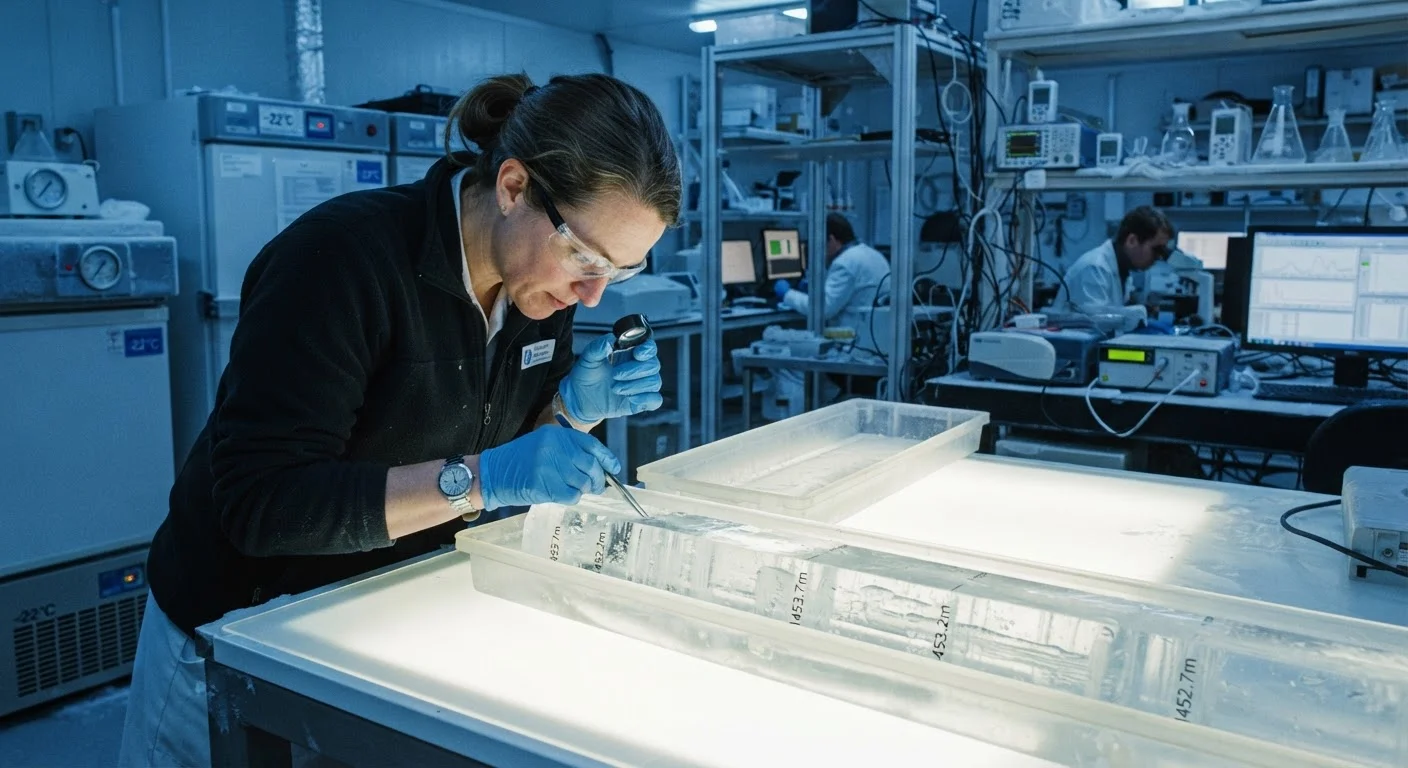
Drilled from the thick ice sheets of Antarctica and Greenland, ice cores are arguably the most powerful paleoclimate tool available. As snow accumulates and compresses into ice over thousands of years, tiny air bubbles become trapped - preserving the actual atmosphere of the time. Analyzing those bubbles gives scientists direct measurements of past carbon dioxide and methane concentrations. Isotopic analysis of the ice itself (comparing ratios of oxygen-18 to oxygen-16) reveals past air temperatures. Antarctic ice cores have extended this record back roughly 800,000 years, covering eight glacial cycles.
The Oldest Ice Tells the Most
The deepest - and therefore oldest - layers of an ice core are the most compressed and most challenging to analyze, but they hold the most ancient atmospheric records. Scientists working on the oldest Antarctic ice have recovered air samples from 800,000 years ago, allowing direct comparison of greenhouse gas concentrations across eight complete glacial cycles. Plans are underway to drill ice that may extend this record past one million years.
Tree Rings (Dendroclimatology)
Trees grow one ring per year, and the width and density of each ring reflects growing conditions - warm, wet years produce wider rings; cold or dry years produce narrower ones. By overlapping ring patterns from living trees with those from ancient preserved timber, scientists have built continuous records spanning thousands of years in some regions. Tree rings offer exceptional annual resolution but are limited to land areas where trees grew and were preserved.
Ocean Sediments
The ocean floor accumulates sediment grain by grain over millions of years. The shells of tiny marine organisms called foraminifera (forams) settle into this sediment after the organisms die. Because foram shell chemistry varies with the temperature and chemistry of the water the organism lived in, analyzing sediment cores lets scientists reconstruct sea surface temperatures and ocean circulation patterns going back tens of millions of years. This is how we know about climates that predate the ice sheets entirely.
Coral Skeletons and Speleothems
Coral skeletons grow in annual bands, much like trees, and record ocean temperature and salinity. Cave formations called speleothems (stalactites and stalagmites) grow from dripping mineral-rich water; their chemical composition reflects rainfall patterns and surface temperatures at the time of formation. Both archives can be dated precisely using uranium-thorium radiometric methods.
Ocean circulation patterns recorded in sediment cores help scientists understand how heat moved through the climate system during past warm and cold periods.
How Scientists Build and Verify the Record
Collecting a proxy sample is only the beginning. Transforming raw physical material into a usable climate reconstruction requires rigorous methodology.
Collect the physical archive
Researchers drill, core, or sample the physical material - whether that means lowering a drill through kilometers of Antarctic ice sheet, pulling a sediment core from the deep ocean floor, or extracting a cross-section from a centuries-old tree. Sample integrity is paramount: contamination from modern air or surface material can compromise the entire record.
Date the sample layers
Accurate timescales are essential. Depending on the archive, scientists use annual layer counting (ice cores and tree rings have visible annual layers), radiometric dating (carbon-14 for material up to ~50,000 years old; uranium-thorium for speleothems), or correlation with known geological events such as volcanic ash layers that appear in multiple archives simultaneously.
Measure the climate signal
Laboratory instruments analyze the proxy material for the specific chemical or physical property that carries climate information: isotope ratios in ice or shell carbonate, gas concentrations in trapped bubbles, ring width measurements, or trace element ratios in coral. Mass spectrometers and gas chromatographs are standard workhorses in paleoclimate labs.
Calibrate against the modern instrumental record
The overlap period - typically the last 150 years, where proxy records and direct measurements coexist - is used to calibrate the proxy signal. Scientists verify that the proxy variable tracks known temperature or precipitation changes during that window. Without this calibration step, a raw isotope ratio has no meaningful climate interpretation.
Cross-reference multiple proxies
A single proxy record is useful; multiple independent proxies covering the same period and pointing to the same conclusion are compelling. Scientists compile proxy databases - some containing hundreds of records from around the world - and apply statistical methods to produce regional or global reconstructions with quantified uncertainty ranges.
Cross-validation is central to confidence in any reconstruction. When ice cores, tree rings, and ocean sediments independently converge on the same temperature signal for the same period, scientists can be confident the pattern is real and not an artifact of one archive's limitations. Disagreements between proxies drive further investigation rather than being papered over.
Modern statistical methods, including ensemble approaches that average across many proxy records, allow researchers to quantify uncertainty honestly - producing reconstructions with defined error ranges rather than false precision. This is the same standard applied to climate data charts and baselines that you'll encounter in research reports.
The resulting record has allowed scientists to confidently identify the Medieval Warm Period, the Little Ice Age, and numerous glacial-interglacial cycles - and to place the warming trend of the past century in context against hundreds of thousands of years of natural variability. That context is foundational to the attribution science behind linking extreme weather events to climate change.