Defining the Terms: A Question of Timescale
Weather and climate both describe the state of Earth's atmosphere, but they operate on fundamentally different timescales - and that distinction is the entire point.
Weather is the current condition of the atmosphere at a specific place and time: today's temperature, this afternoon's thunderstorm, tonight's wind chill. It is inherently variable and, beyond about two weeks, largely unpredictable in its specifics.
Climate is the long-term statistical pattern of those atmospheric conditions - the average, the range, and the extremes that a location typically experiences. By scientific convention, climate is calculated using at least 30 years of weather observations, a period long enough to filter out short-term noise and reveal meaningful trends. The World Meteorological Organization updates its global climate normals every decade using successive 30-year windows.
A useful analogy: weather is your mood on a given day; climate is your personality. One bad morning tells you little about who you are overall.
| Criterion | Weather | Climate |
|---|---|---|
| Timescale | Hours to days | Decades (30+ years) |
| What it measures | Current atmospheric conditions | Long-term statistical patterns |
| Predictability | ~1-14 days with confidence | Trends projected over decades |
| Example | A blizzard in Chicago in January | Chicago averages 38 inches of snow per year |
| Relevant to climate change? | Not individually | Yes - warming shifts statistical distributions |
| Tool for understanding | Forecast models | Climate normals, trend analysis, paleoclimate data |
Why One Cold Day Doesn't Disprove Warming
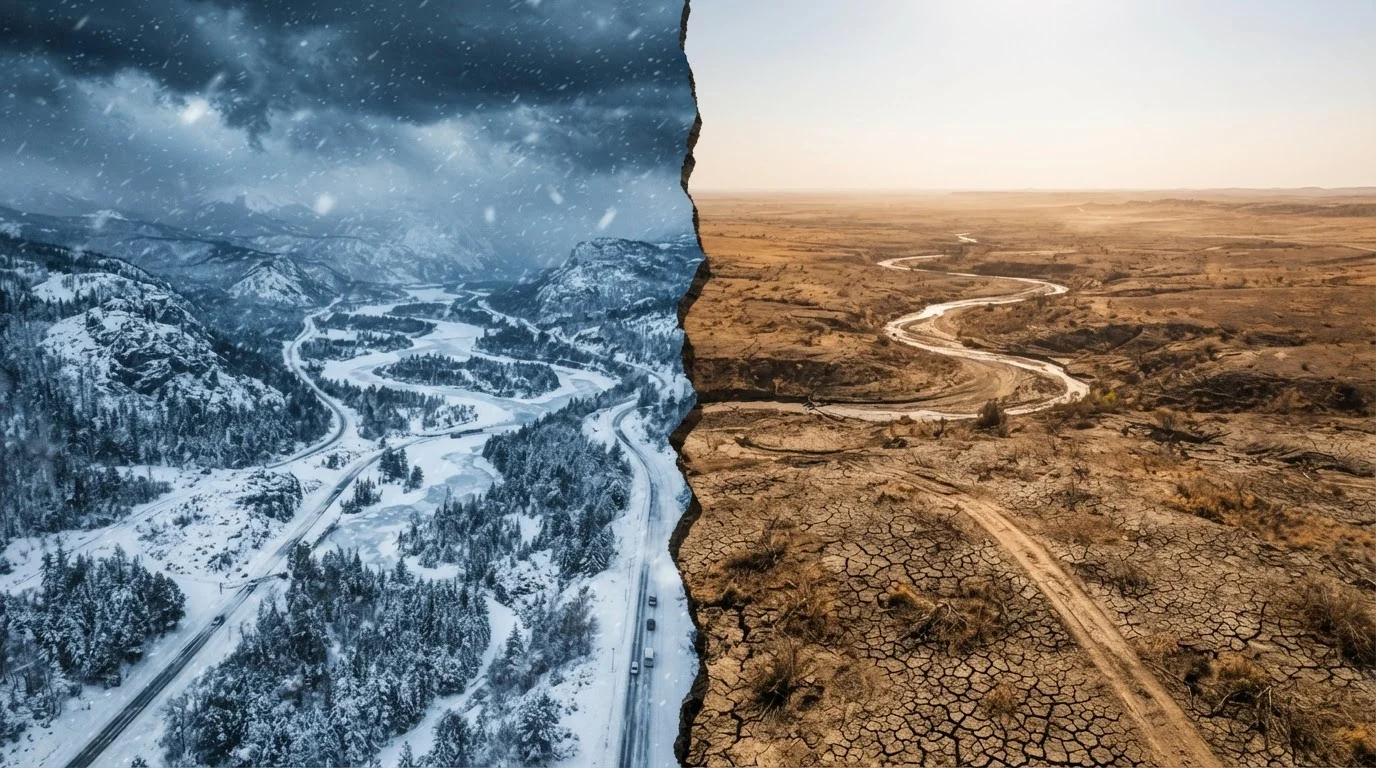
Among the most persistent misunderstandings in public science discourse is the idea that extreme winter cold contradicts global warming. The logic seems intuitive - if the planet is warming, why is it so cold outside? But this conflates a single data point (weather) with a multi-decade statistical trend (climate).
Climate scientists describe global warming as a shift in the distribution of temperatures over time. Imagine a bell curve of daily temperature readings. Warming doesn't eliminate cold days - it shifts the entire curve toward higher values, meaning record-hot days become more common and record-cold days become rarer, even as cold days continue to occur. The signal is in the statistics, not in any individual event.
This is also why attribution science has become a vital field: researchers can now calculate how much climate change altered the probability of a specific extreme event, whether a heat wave, flood, or drought - without claiming climate caused any single storm in isolation.
For a deeper look at how scientists detect climate patterns beyond direct observation, the field of paleoclimatology is instructive. Ice cores, tree rings, and ocean sediments preserve centuries of climate history, providing context no weather station alone could supply.
How Confusing the Two Distorts Public Understanding
The weather-climate confusion isn't a trivial semantic issue - it has measurable effects on how people interpret environmental news. When a senator brings a snowball onto the Senate floor to argue against climate change, or when a cold snap is cited as evidence that warming has stalled, the underlying error is always the same: treating a weather event as climate-level evidence.
Scientifically, this is equivalent to concluding that smoking is harmless because one smoker lived to 95. The anecdote doesn't invalidate the population-level statistical reality.
Misleading framings like these are examined in detail alongside other common errors in persistent climate myths, examined against the evidence. Understanding the distinction also requires some comfort with how climate data is presented - baselines, anomalies, and trend lines each carry specific meanings that casual reading can obscure. Interpreting those charts correctly is a skill worth building.
Climate operates through interconnected systems. Ocean circulation patterns, for example, move vast amounts of heat around the planet and influence regional weather in ways that can seem counterintuitive - including producing cold snaps in regions that are, on average, warming.
Keeping weather and climate conceptually separate isn't just an academic exercise. It is the foundational literacy required to evaluate climate news, policy arguments, and environmental claims with any accuracy.