
What Is a Climate Tipping Point?
A climate tipping point is a threshold in Earth's climate system where a relatively small additional change triggers a self-reinforcing feedback loop - pushing a major component of the system into a fundamentally different state. Once crossed, many tipping points are difficult or impossible to reverse on human timescales, even if global temperatures stabilize or decline.
The concept comes from dynamical systems science and has been applied rigorously to Earth's climate since at least the early 2000s. Researchers publish findings on tipping points primarily through institutions such as the Potsdam Institute for Climate Impact Research and journals including Nature and Science. For broader scientific grounding, see how paleoclimatologists reconstruct past threshold-crossing events in the climate record.
Tipping Point
A threshold in a complex system where a small additional change causes the system to shift rapidly and often irreversibly to a new state. In climate science, these are points beyond which self-reinforcing feedbacks take over.
Tipping Element
A large-scale component of the Earth system - such as an ice sheet or ocean current - that can cross a tipping point. Scientists monitor these as indicators of potential irreversible change.
Tipping Cascade
A chain reaction in which one tipping element crossing its threshold triggers instability in other connected systems, amplifying overall climate change beyond what any single tipping element would cause alone.
Permafrost
Ground that remains frozen for two or more consecutive years. Arctic and sub-arctic permafrost stores vast quantities of organic carbon that can be released as greenhouse gases when it thaws.
AMOC
The Atlantic Meridional Overturning Circulation - a system of ocean currents that transports warm surface water northward and cold deep water southward, playing a key role in regulating temperatures across the North Atlantic region.
Feedback Loop
A process in which an initial change produces effects that either amplify (positive feedback) or dampen (negative feedback) the original change. Positive feedbacks near tipping points accelerate warming or system disruption.
Key Tipping Elements Scientists Monitor
Researchers use the term tipping elements to describe the large-scale components of the climate system most vulnerable to crossing thresholds. The following are among the most studied:
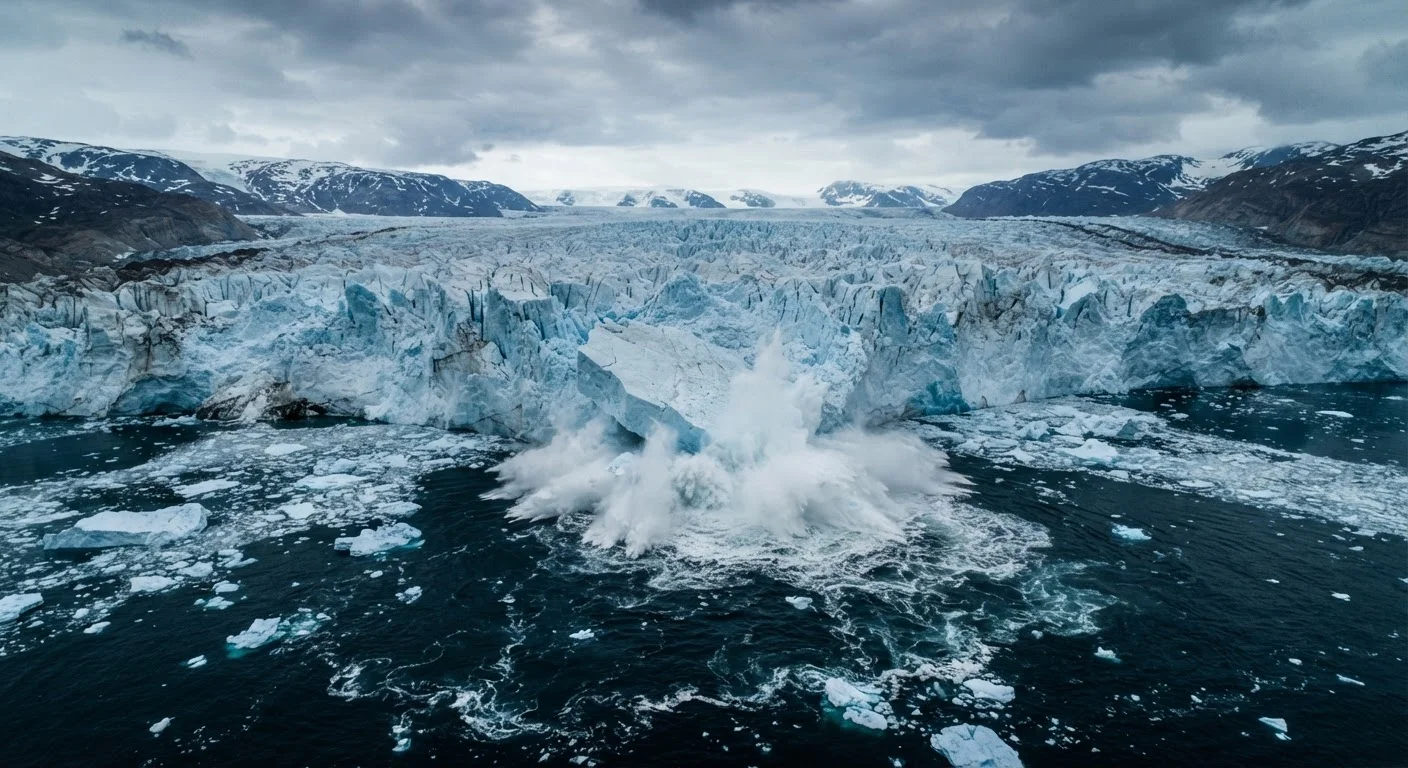
- Greenland Ice Sheet: If enough surface ice melts, internal meltwater feedback can drive continued disintegration even without further warming. Full loss would raise global sea levels by roughly 7 meters over centuries.
- West Antarctic Ice Sheet: Resting on bedrock below sea level, this sheet is vulnerable to marine ice sheet instability - a process where warming ocean water undercuts ice from below, potentially triggering irreversible retreat.
- Amazon Rainforest Dieback: Deforestation combined with warming can push regions of the Amazon past a moisture-recycling threshold, converting large areas from tropical forest to savanna and releasing stored carbon.
- Permafrost Thaw: Arctic permafrost stores an estimated 1.5 trillion metric tons of organic carbon. Sustained thawing releases carbon dioxide and methane, adding greenhouse gases to the atmosphere independently of human emissions - a classic self-amplifying feedback.
- Atlantic Meridional Overturning Circulation (AMOC): This ocean current system distributes heat across the planet. Evidence suggests it is weakening; a significant slowdown or collapse would alter rainfall patterns and temperatures across Europe and North America. Ocean circulation's role in climate is explored in depth in a companion article.
- Coral Reef Die-offs: Mass coral bleaching becomes irreversible when ocean temperatures stay elevated long enough to prevent regrowth. Tropical reef systems support roughly a quarter of all marine species.
| Tipping elements formally identified | 16 major systems (Lenton et al., Science, 2022) |
| Carbon stored in permafrost | ~1.5 trillion metric tons (IPCC Sixth Assessment Report) |
| Sea level rise from full Greenland Ice Sheet loss | ~7 meters (Estimated over centuries; IPCC AR6) |
| Current global warming above pre-industrial | ~1.1-1.2°C (WMO State of Global Climate reports) |
| Marine species supported by coral reefs | ~25% (UNEP coral reef assessments) |
How Close Are We, and Why Does It Matter?
A landmark 2022 analysis published in Science by Lenton and colleagues assessed 16 major tipping elements and concluded that several may already be approaching their thresholds at current warming levels - between 1.1°C and 1.5°C above pre-industrial temperatures. The study emphasized that tipping points may also interact: Greenland melt could weaken AMOC, which in turn affects rainfall that sustains the Amazon. Scientists call this a tipping cascade.
Uncertainty remains substantial. Researchers do not yet have precise temperature thresholds for most systems - estimates are expressed as ranges, not exact values. Some scientists argue certain tipping points may already be committed to, regardless of near-term emission cuts. Others emphasize that the speed and magnitude of warming still significantly affects outcomes, including how rapidly change unfolds and whether ecosystems can partially adapt.
Understanding tipping points matters because they represent a qualitative shift in climate risk - from gradual, manageable change to potentially abrupt, large-scale reorganization. This is distinct from the more familiar pattern of extreme weather attribution. For context on how warming is already affecting daily weather extremes, see extreme weather events linked to climate change.
If you encounter arguments that downplay these risks as speculative, common climate misconceptions addresses the most frequent ones against the scientific record.
This article presents general scientific information for educational purposes. It reflects the current state of peer-reviewed research and does not constitute policy advice or predictions about specific local impacts.