
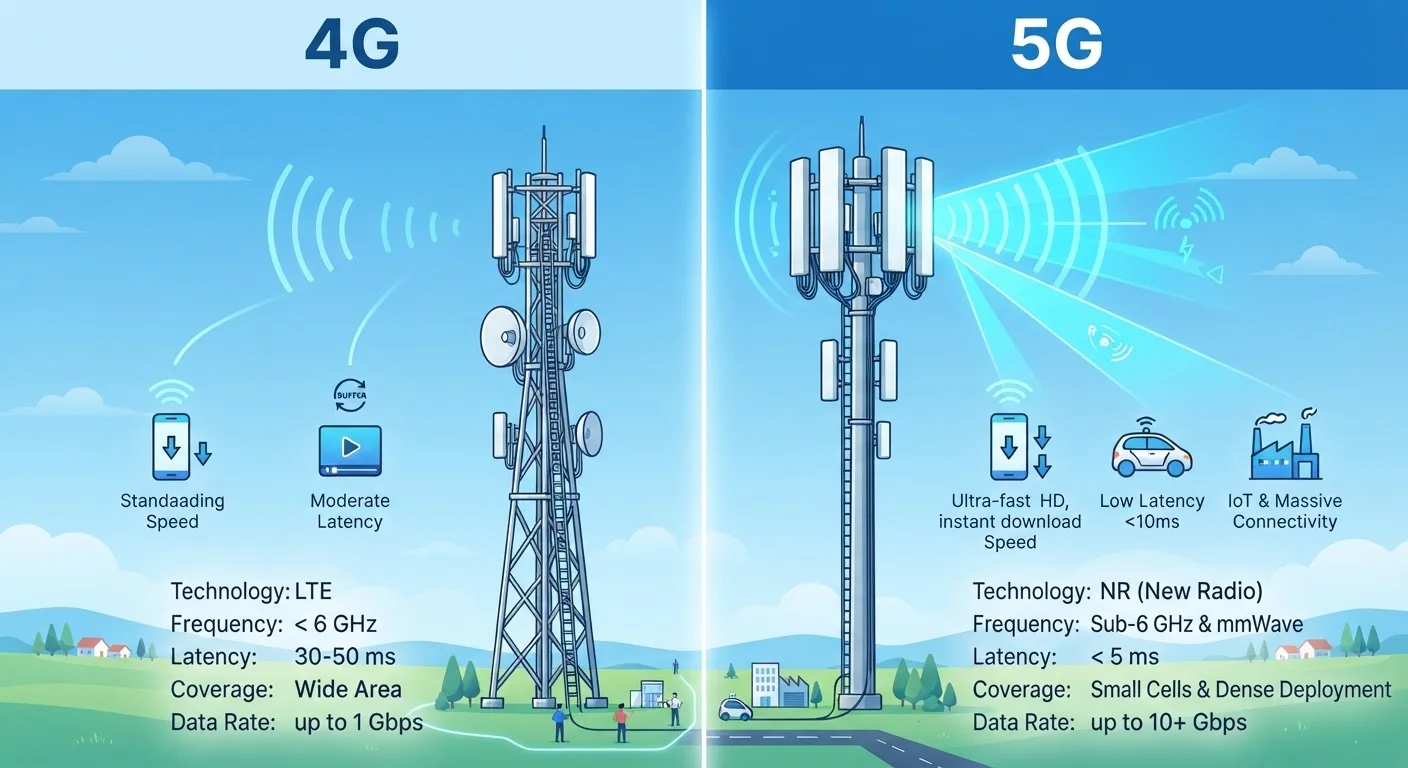
The Core Difference: Speed and Infrastructure
4G LTE (Long-Term Evolution) became the dominant US mobile standard around 2010-2012 and now covers the vast majority of the country. 5G started rolling out commercially around 2019 and is still expanding. Both are wireless cellular standards - meaning they use radio waves transmitted from towers to connect your phone to the internet - but they operate on different frequencies, use different hardware, and deliver noticeably different performance in the right conditions.
In terms of raw speed, 5G has a clear theoretical edge. Peak 5G download speeds can exceed 1 Gbps (gigabit per second) on certain network types, while 4G LTE typically peaks closer to 100-300 Mbps under ideal conditions. In everyday use, the gap is smaller but still real. However, average real-world 5G speeds vary widely depending on which type of 5G signal your phone is receiving - a distinction worth understanding before drawing conclusions. See our breakdown of 5G frequency bands for more on that trade-off.
| Criterion | 4G LTE | 5G |
|---|---|---|
| Typical download speed | 25-100 Mbps (real-world) | 100-900 Mbps (varies by band) |
| Latency | 30-50 ms | 10-30 ms (current networks) |
| US coverage | Broad, including rural areas | Urban and suburban, expanding |
| Network capacity | Can congest in dense areas | Handles more simultaneous users |
| Device requirement | Most phones since ~2012 | 5G-capable phone required |
| Infrastructure maturity | Fully deployed and stable | Still rolling out nationwide |
Latency, Capacity, and What They Mean in Practice
Latency is the delay between sending a request and receiving a response - measured in milliseconds (ms). 4G LTE typically delivers latency in the 30-50 ms range. 5G is designed to push that below 10 ms in ideal deployments, though most current 5G networks land somewhere in between. For casual browsing or streaming video, the difference is barely noticeable. For real-time applications - competitive mobile gaming, video calls, or connected industrial tools - lower latency does matter in measurable ways.
Capacity is another underappreciated advantage of 5G. 5G networks can handle more devices simultaneously without degrading performance. In a crowded stadium or a busy downtown street, 4G LTE can become congested as hundreds of devices compete for bandwidth. 5G's architecture is built to handle that density more gracefully, which is part of why industries beyond consumer phones - logistics, healthcare, manufacturing - are investing in it.
~30 ms
Typical 4G LTE latency
Industry benchmarks place average 4G LTE round-trip latency between 30 and 50 milliseconds under normal conditions.
<10 ms
Target 5G latency (ideal deployment)
The 5G standard is engineered for sub-10 ms latency, though most current commercial networks haven't fully reached that threshold.
1 Gbps+
Peak theoretical 5G download speed
Peak speeds above 1 Gbps are possible on millimeter-wave 5G, though average real-world speeds are significantly lower.
For a broader look at how network infrastructure ties all of this together, the infrastructure behind every phone call is worth reading.
Coverage: Where 4G Still Wins
Despite its advantages on paper, 5G has a significant practical limitation: coverage. As of the mid-2020s, 5G coverage in the US is concentrated in urban centers, suburbs of major cities, and along major transportation corridors. Rural areas remain predominantly 4G LTE or, in some cases, older 3G and even 2G infrastructure.
This matters because a 5G phone on a 4G network performs exactly like a 4G phone - it simply falls back to the available signal. Carriers market 5G availability broadly, but the experience depends entirely on where you are standing. If your daily life takes you outside dense urban zones, the practical difference between a 4G and 5G plan may be minimal today.
There are also several persistent misconceptions about what 5G can and cannot do. Our article on common beliefs about 5G that don't hold up separates what's established from what isn't.
What You Actually Need to Use 5G
Three things are required to connect to a 5G network: a 5G-capable device, a mobile plan that includes 5G access, and physical proximity to a 5G tower. If any one of those is missing, your phone will use 4G LTE regardless.
Most flagship phones released after 2020 include 5G modems, and many mid-range models followed shortly after. However, older devices - even ones that are otherwise capable - are locked to 4G. If you're evaluating whether to upgrade, checking your device specs matters. Our guide to phone specs explains how to read those details without getting lost in technical language. You might also consider how eSIM vs. physical SIM choices intersect with carrier and network compatibility when switching plans.
For a fuller picture of how 5G actually functions under the hood - and where it still falls short - see how 5G actually works. And if you want to put both technologies in historical context, network generations at a glance covers the full arc from 1G to 5G in plain language.