What Each Technology Actually Does
Both a physical SIM (Subscriber Identity Module) and an eSIM (embedded SIM) serve the same core purpose: they store the credentials that identify your device to a mobile carrier's network. Without one or the other, your phone cannot authenticate itself to make calls, send texts, or use mobile data.
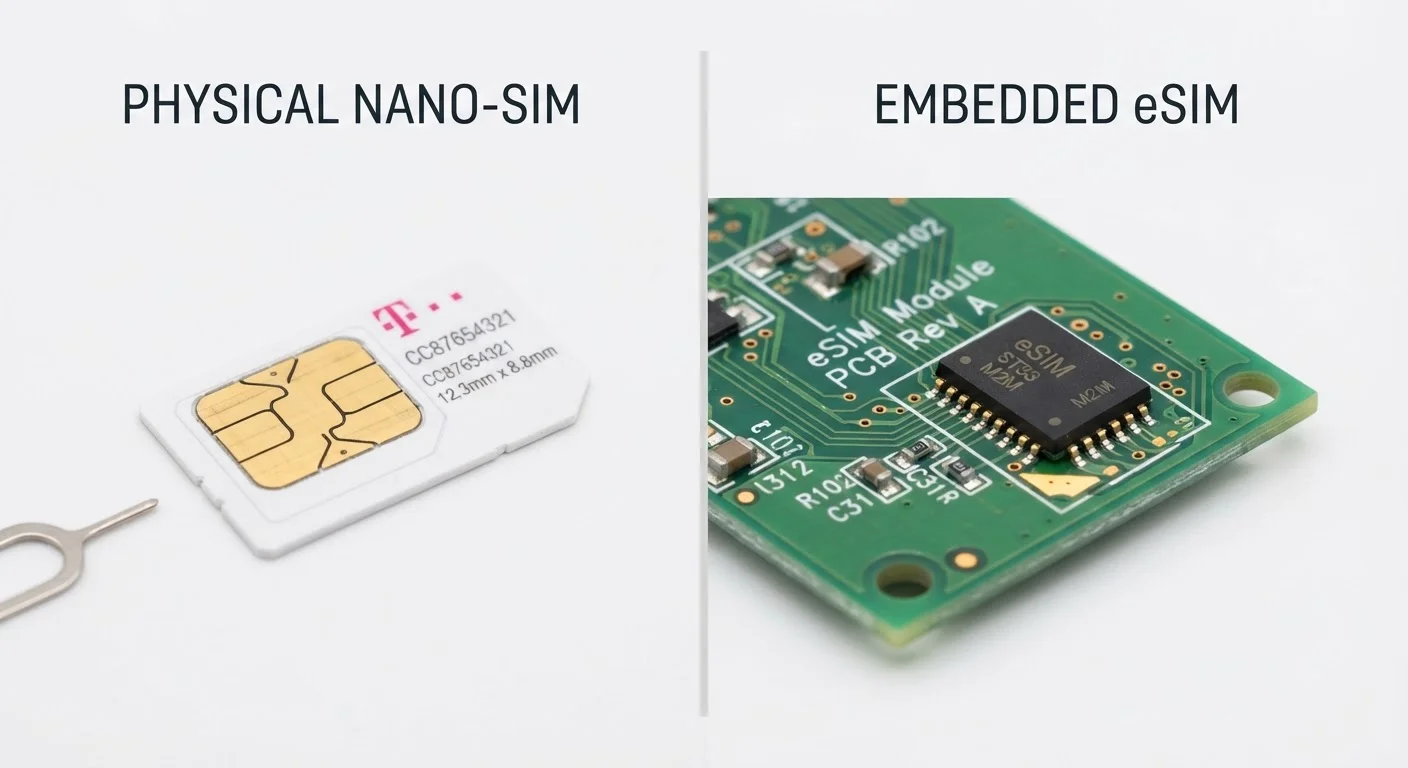
The difference is physical form and how those credentials are loaded. A traditional SIM is a small removable card - available in standard, micro, and nano sizes - that you insert into a tray on the side of your phone. The carrier information is written onto the card before you receive it. An eSIM, by contrast, is a chip permanently soldered to the phone's motherboard at the factory. Carrier credentials are delivered electronically, typically by scanning a QR code or completing an in-app activation flow.
For a plain-language explanation of terms like IMSI, ICCID, and carrier authentication, see the Mobile Plan Glossary covering 40 key wireless terms.
| Criterion | Physical SIM | eSIM |
|---|---|---|
| Form factor | Removable card (nano, micro, standard) | Chip soldered to motherboard |
| Carrier activation method | Pre-loaded card, insert and use | QR code or in-app digital download |
| Switching carriers | Requires new physical card | Software profile swap, no card needed |
| Dual-line support | Requires dual SIM tray on device | Multiple profiles stored on one chip |
| Global compatibility | Near-universal | Growing, but patchy in some regions |
| Device loss recovery | Move card to new device immediately | Carrier must reissue profile to new device |
| Physical theft risk | Card can be removed and used elsewhere | No removable card to steal |
| Required device support | Works on virtually any phone | Requires eSIM-capable hardware and carrier |
Practical Differences That Affect Daily Use
For most people on a single domestic carrier, the day-to-day experience of using an eSIM versus a physical SIM is nearly identical. The distinction becomes meaningful in specific situations.
Switching Carriers
With a physical SIM, switching carriers means obtaining a new SIM card - either by mail or in-store - and inserting it. With an eSIM, the process is software-based: your new carrier pushes a profile to your device. This can happen in minutes, though your carrier must support eSIM provisioning on their end.
Dual-SIM Use
Many modern smartphones support one physical SIM and one eSIM simultaneously, or two eSIM profiles active at once. This is useful for keeping a work and personal number on one device, or for using a local data plan while traveling without losing your home number. Understanding how your phone manages these connections relates closely to how it handles roaming and network switching.
Device Loss or Damage
If you lose a phone with a physical SIM, you can move that SIM to another device immediately. With an eSIM, you'll need to contact your carrier to transfer or reactivate your profile on a new device - a process that varies by carrier but generally requires identity verification.
Compatibility and Carrier Support
eSIM support has expanded significantly among flagship smartphones, but it is not universal. Most premium Android devices and iPhones released after 2018 include eSIM capability. Budget and mid-range devices are less consistent. Some iPhone models sold in the United States have removed the physical SIM tray entirely, making eSIM the only option on those handsets.
Carrier support is the other variable. A device may be eSIM-capable, but if your carrier has not enabled eSIM activation on their network, you cannot use it. Major US carriers broadly support eSIM, but smaller regional carriers and MVNOs (Mobile Virtual Network Operators - carriers that lease network access from larger carriers) vary. Confirming eSIM support with your specific carrier before relying on it is advisable.
Internationally, physical SIM infrastructure remains more consistent. Many countries with developing telecom markets have robust physical SIM ecosystems but limited eSIM rollout. For frequent international travelers, this makes having a physical SIM slot a practical asset - though eSIM-based international data plans are increasingly available through major carriers and travel-specific providers. This intersects with how prepaid and postpaid structures work abroad; see our breakdown of prepaid vs. postpaid wireless for context.
Security and Plan Transparency Considerations
From a security standpoint, eSIMs have a modest structural advantage: because there is no removable card, there is no risk of SIM swapping via physical theft of the card itself. However, SIM swap fraud - where a bad actor convinces a carrier to transfer your number to a new SIM - is a social engineering attack that affects both technologies equally, since it exploits carrier verification processes rather than the hardware.
On the plan transparency side, eSIM makes it easier to hold multiple active carrier profiles, which can obscure which plan is actually being used for a given call or data session. If you're managing two lines, confirming which profile is active for data is worth checking in your phone's settings, particularly if the two plans have different data caps or roaming terms. Understanding what your carrier plan actually covers - data limits, throttling thresholds, and network priority - matters regardless of SIM type. The same questions apply whether you're on Wi-Fi calling or standard cellular.
For a broader look at how device hardware decisions connect to your phone experience, the Phones & Devices hub covers smartphones, specs, and related technology in plain terms.