
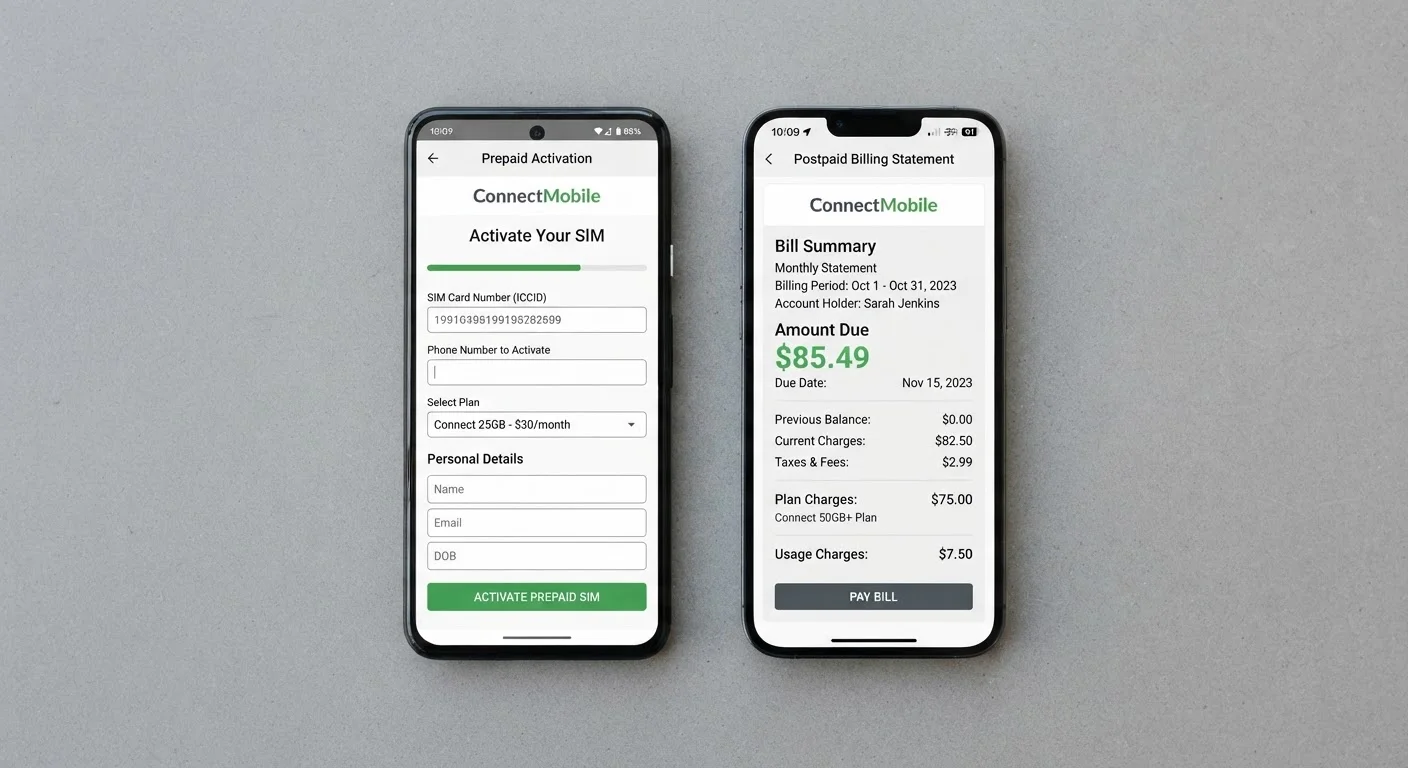
How Each Billing Model Works
The core difference between prepaid and postpaid wireless is simple: when you pay. With a prepaid plan, you pay before service begins. Once that balance or time period runs out, service either stops or slows - there's no bill at the end of the month and no ability to rack up unexpected charges. With a postpaid plan, the carrier extends you credit for a month of service, sends a bill, and collects payment after the fact.
That timing difference drives almost every other structural distinction between the two models - from credit checks to network priority to what happens when you hit your data limit. To understand what all the line items on either type of bill actually mean, see our guide to decoding your wireless bill.
| Criterion | Prepaid Wireless | Postpaid Wireless |
|---|---|---|
| Payment timing | Pay before service starts | Billed after month ends |
| Credit check required | No | Yes, typically |
| Network priority during congestion | Lower (on most carriers) | Higher |
| Device financing available | Rarely | Yes, installment plans common |
| Contract or commitment | None | Month-to-month (device loans tie you in) |
| Overage risk | None - service stops or slows | Possible on some plan types |
| International roaming options | Limited | More robust |
| Multi-line household billing | Less streamlined | Consolidated with per-line discounts |
Network Priority and Data Behavior
One structural detail that carriers rarely headline is network prioritization - the process by which a carrier decides which customers get the fastest data speeds when a cell tower is handling heavy traffic. Most major carriers prioritize their postpaid subscribers ahead of prepaid users during congestion. In practical terms, this means that during peak hours in a crowded area, a prepaid customer on the same physical network may experience slower speeds than a postpaid customer.
Both plan types also enforce data thresholds differently. On postpaid plans, hitting a soft data cap usually triggers speed throttling for the rest of the billing cycle. On prepaid plans, the same threshold either ends service entirely or reduces speeds - depending on the plan design. Neither model typically allows unlimited high-speed data in perpetuity at entry-level price points. For what carriers often leave out of the plan description, see what mobile carriers don't spell out at sign-up.
Credit, Contracts, and Device Financing
Postpaid accounts require a credit check because the carrier is extending a month of service on good faith that you'll pay. Applicants with limited or poor credit history may be denied, required to pay a deposit, or steered toward a lower-tier postpaid tier. Prepaid accounts skip this step entirely - no credit check, no deposit, no approval process beyond buying a SIM or activating a plan.
Device financing - spreading a phone's cost across 24 or 36 monthly installments - is almost exclusively a postpaid feature. Carriers structure installment plans as a lending product attached to your postpaid billing relationship. If you're on a prepaid plan and want a new device, you'll generally need to purchase it outright or through a separate retailer financing arrangement. For a fuller look at how carriers bundle service and device costs, see how carrier commitment structures work.
Contracts - meaning long-term service agreements with early termination fees - have largely faded from the US market. Most postpaid plans today are month-to-month for the service itself, though device installment agreements do create a financial tie to the carrier for the loan term.
Which Structure Fits Which Reader
Neither model is universally better. Prepaid makes the most structural sense for readers who want spending control, have no need for carrier-financed devices, or simply prefer not to go through a credit evaluation. It also suits infrequent users or those who want a low-stakes way to test a network before committing. If you're new to choosing a plan, this first-timer's guide to US mobile plans walks through the decision from the ground up.
Postpaid makes more structural sense for readers who rely on consistent top-tier network performance, need device financing, manage multiple lines, or use international roaming regularly. The consolidated billing and multi-line discount structures of postpaid accounts also tend to benefit households - a topic covered in detail in our breakdown of family plan pricing structures.
Before committing to either type, it's worth running through a checklist of coverage, data policies, and fees. Our pre-signup checklist for any mobile plan covers exactly that.