
The Base Plan Charge: What You're Actually Buying
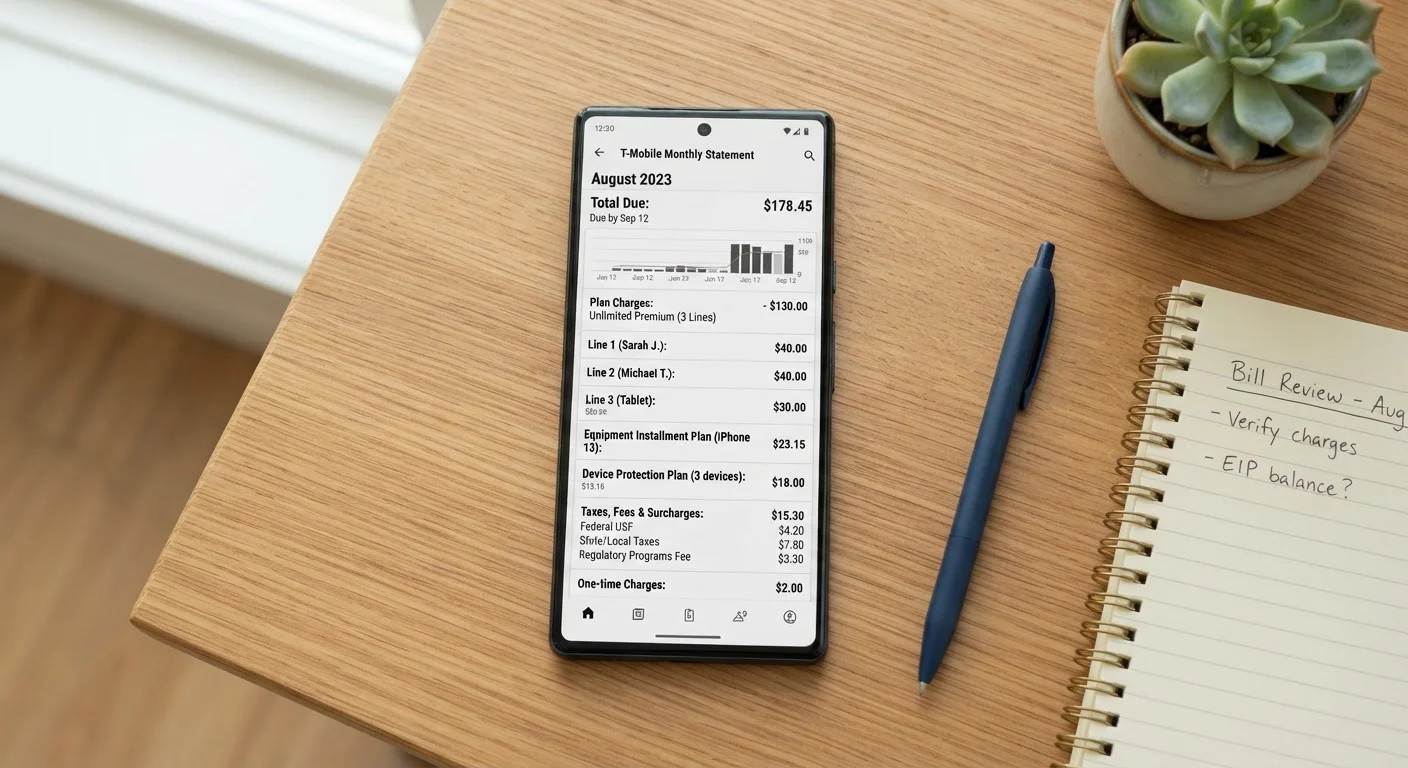
The largest single line on most wireless bills is the base plan charge - the advertised monthly cost for your service tier. This covers your allotment of data, unlimited talk and text (on most modern plans), and access to the carrier's network. What it does not include is almost everything else on the bill.
Carriers frequently list this rate assuming you've enrolled in autopay and paperless billing. If you pay by check or credit card, or receive a paper statement, your effective rate may be $5-$10 higher per line. Always read the fine print beneath any advertised price to see which discounts are baked in. For a broader look at how plan structures are built, see our first-timer's guide to US mobile plans.
Device Payments: Service vs. Hardware
If you financed a phone through your carrier, you'll see a separate device installment line on your bill. This is not part of your wireless service - it's a loan repayment, typically spread over 24 to 36 months. The device payment continues until the phone is paid off, regardless of whether your plan price changes.
This distinction matters because carriers often advertise promotional pricing that combines service discounts with device trade-in credits. Understanding the two charges separately lets you evaluate whether the device deal is actually saving you money over the full term. Our breakdown of contract plans and device financing explains these structures in detail.
Separate Your Device Cost From Your Plan Cost
When budgeting for wireless service, always add your device installment line to your service subtotal before comparing plans. A plan that looks cheaper may simply be hiding a longer or more expensive financing term for the same phone. Knowing both numbers independently gives you a clearer apples-to-apples comparison.
Taxes and Government-Mandated Fees
A portion of every wireless bill goes to federal, state, and local governments. These charges are legally required and the carrier has no discretion over them:
- Federal excise tax: A percentage-based tax applied to certain wireless services under federal law.
- State and local sales tax: Varies significantly by location - some states tax wireless services at rates above their general sales tax rate.
- 911 fee: A per-line charge that funds emergency dispatch infrastructure. Most states mandate this fee separately.
- Universal Service Fund (USF) surcharge: Funds programs like Lifeline, which subsidizes service for low-income households, and E-Rate, which supports school connectivity.
Because these are government-set, you cannot negotiate them away. However, they do vary by where your billing address is registered, so a move to a different state can change your tax total.
Carrier-Set Fees: The Discretionary Layer
Separate from government taxes, carriers add their own surcharges. These are sometimes labeled as "regulatory cost recovery fees" or "administrative charges," and while they sound official, they are set entirely by the carrier - not by law. Common examples include:
- Administrative fee: A general overhead charge that may cover customer service or network costs. The amount and label vary by carrier.
- Regulatory programs fee: Carriers recover their own contribution to programs like the USF through this line, separate from what they pass directly as a government surcharge.
- Roaming cost recovery: Some carriers add a small fee to recover the cost of maintaining roaming agreements with other networks.
These fees tend to increase over time with minimal notice. Carriers typically send bill messages or emails about changes, which most customers overlook. Staying alert to these notices is one of the easiest ways to catch unexpected cost increases. For a deeper look at what carriers often leave unsaid, see what mobile carriers don't spell out at sign-up.
Carrier Fees Are Not Government Taxes
Labels like "regulatory recovery fee" or "administrative surcharge" can sound as though they're legally required, but they are set and collected by the carrier - not a government agency. This distinction matters because government taxes are fixed by law, while carrier fees can be raised at the carrier's discretion, typically with 30 days' notice in the terms of service.
Add-On Features and Their Costs
Below the core charges, many bills list optional features - hotspot data upgrades, international day passes, insurance or device protection plans, and streaming service bundles. Each appears as a separate line with its own monthly cost.
Device protection plans, in particular, are often added at purchase and forgotten. Check your bill for any recurring add-on charges and evaluate whether you're actively using each service. If you travel internationally, our guide to how international roaming is billed on US plans explains how those day-pass charges are triggered and calculated.
For multi-line accounts, per-line discounts often appear here as credits - negative amounts that reduce the subtotal. Understanding which credits are permanent versus promotional helps you anticipate when your bill may increase. See how family plan pricing works across multiple lines for the full picture.
How to Read Your Bill Proactively
The most practical habit is comparing your bill total month to month rather than just paying it. A sudden increase usually points to one of three things: a promotional discount that expired, a new fee the carrier added, or an add-on that was activated without your clear intent.
Keep a copy of your plan agreement - the document you received when you signed up or switched plans - and cross-reference it against your bill annually. Before committing to any new plan, run through the checklist for evaluating a mobile plan so you know exactly what you agreed to pay. If terminology on the bill still feels unclear, the mobile plan glossary defines 40 common terms in plain language.