From Your Phone to the Tower: The First Hop
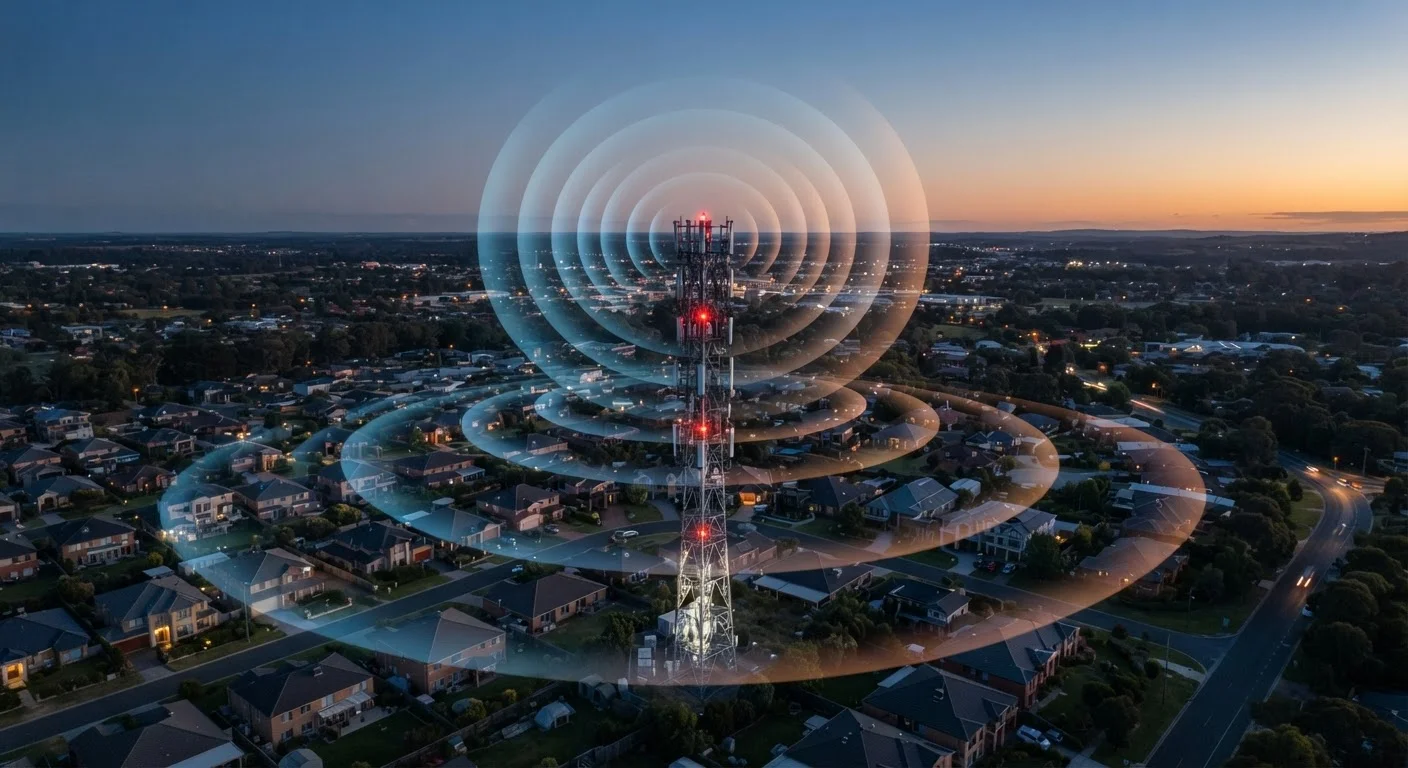
When you press 'call,' your phone converts your voice into digital data and transmits it as a radio signal. That signal travels through the air to the nearest cell tower - typically within a few miles, sometimes less in dense cities. The tower's antennas pick up that signal and pass it to a base station, a compact computing unit usually mounted at the base of or inside the tower structure.
A single tower doesn't just serve one person. It handles dozens or hundreds of simultaneous connections, dividing available radio spectrum among all the devices in its range. This is why a crowded stadium or a major event can slow your data speeds dramatically - everyone nearby is competing for the same slice of airwave capacity.
For a broader look at how radio signals and coverage areas actually work, see our plain-language guide to wireless networks.
Backhaul: The Hidden Highway Beneath Your Call
Once the base station receives your signal, it needs to send that data somewhere useful. That's where backhaul comes in. Backhaul is the connection between the cell tower and the rest of the network - think of it as the highway that carries traffic from the on-ramp (the tower) to the main road (the internet or phone-switching network).
Most backhaul today runs on fiber-optic cables buried underground. Fiber can carry enormous amounts of data at the speed of light, which is why carriers have been aggressively expanding fiber access to their tower sites. In areas where burying fiber isn't practical - mountainous terrain, remote locations - carriers sometimes use microwave links, which are line-of-sight radio connections between towers or relay stations.
417,000+
Cell tower sites in the United States
According to CTIA - The Wireless Association, the U.S. had over 417,000 cell tower sites as of recent industry reporting.
~800,000
Small cell nodes deployed nationwide
CTIA data indicates hundreds of thousands of small cell nodes have been deployed to supplement macro towers, particularly for dense urban 5G coverage.
~90%
U.S. population with 4G LTE access
The FCC has reported that 4G LTE service covers approximately 90% or more of the U.S. population, though rural geographic coverage remains significantly lower.
The quality of backhaul directly affects your experience. A tower with weak or congested backhaul becomes a bottleneck, slowing everyone connected to it even if the radio signal between your phone and the tower is strong.
Switching Centers and the Wider Network
After traveling through backhaul, your data reaches a mobile switching center - essentially a large routing facility that figures out where your call or data needs to go. If you're calling another mobile number, the switching center contacts that person's carrier network and establishes a connection. If you're loading a website, it routes your request to the broader internet.
Modern 4G LTE and 5G networks use what's called an all-IP (Internet Protocol) core, meaning voice calls are converted into data packets - similar to how a video call over Wi-Fi works - rather than traveling on dedicated circuit lines the way old landlines did. This approach is more efficient and allows carriers to manage voice and data on the same infrastructure.
To understand how 4G and 5G differ at both the tower and core network level, our article on what actually separates 4G LTE and 5G breaks it down clearly.
Why 5G Demands a Denser Network
5G isn't just a faster version of 4G - it introduces fundamentally different radio frequencies that change how infrastructure must be built. High-band 5G (millimeter wave, or mmWave) offers extreme speeds but travels only a few hundred feet and is easily blocked by walls, trees, or even rain. To cover a city with mmWave 5G, carriers must install small cell antennas on streetlights, utility poles, and building exteriors - far more densely than traditional macro towers.
Mid-band 5G strikes a balance between speed and range, and it's what most people experience as 5G today. Low-band 5G covers wide areas but offers speeds closer to advanced 4G LTE. Carriers typically layer all three frequency types to build a complete network.
This layered approach means the infrastructure investment for 5G is significantly larger than for 4G - which ultimately factors into network costs that appear on your wireless bill as line items and fees.
Check Coverage Before You Commit
Carrier coverage maps show where their equipment reaches, but terrain, buildings, and network congestion affect real-world performance. Before switching plans or carriers, consider checking independent coverage tools or asking neighbors in your area about their experience - especially in rural zones or areas with dense building stock.
Tower Sharing and What It Means for Coverage
Most Americans assume each carrier owns a completely separate tower network. In practice, the steel structures themselves are often owned by independent tower companies, which lease antenna space to multiple carriers. Each carrier installs its own radios and equipment, but they may share the same physical pole.
This matters because a carrier's advertised coverage map reflects where its equipment reaches - not simply where towers exist. Two carriers sharing a tower can have very different coverage in the same spot if one has upgraded its equipment and the other hasn't.
Your phone also silently manages its own connection choices throughout the day - switching between towers, frequency bands, and in some cases Wi-Fi calling. That process is explained in detail in our piece on roaming, Wi-Fi calling, and network switching.