What a Wireless Network Actually Is
A wireless network is, at its core, a system that lets devices communicate using radio waves instead of physical cables. When you make a call or load a webpage on your phone, that data is converted into a radio signal, sent through the air to a nearby cell tower, and then routed through a much larger wired system before reaching its destination.
The cell tower - technically called a base station - is the first hop in that journey. Towers are spread across the country in overlapping clusters, so as you move around, your phone hands off from one tower to the next without dropping your connection. That handoff happens silently, many times a day.
For a deeper look at the physical infrastructure involved, see how cell towers and backhaul lines work together.
Base station
The technical name for a cell tower. It's the antenna-equipped structure that communicates directly with your phone over radio waves.
Frequency band
A specific range of radio frequencies assigned for wireless communication. Different bands have different ranges and data capacities.
Latency
The time delay between sending a request (like tapping a link) and receiving a response. Lower latency means a more responsive connection.
MVNO
Mobile Virtual Network Operator - a wireless company that doesn't own towers but buys network access from a major carrier and sells plans under its own name.
Spectrum
The range of radio frequencies available for transmitting wireless signals. Portions of the spectrum are licensed by the government to carriers.
mmWave
A very high-frequency type of 5G signal that delivers extremely fast speeds but only over very short distances, typically in dense urban areas.
How Signals Travel from Tower to Phone
Radio signals travel on specific frequencies, measured in hertz (Hz). Wireless carriers are assigned portions of the radio spectrum - called bands - by the federal government. Each band has trade-offs: lower-frequency bands travel farther and penetrate walls better, while higher-frequency bands can carry more data but over shorter distances.
Your phone is constantly scanning for the strongest, least-congested signal available. When it finds one, it locks onto that frequency band and negotiates a connection with the tower. This negotiation happens in fractions of a second and repeats whenever conditions change.
Latency - the delay between sending a request and getting a response - is just as important as raw speed. A network can have high throughput but still feel sluggish if latency is high, which is common in overloaded areas during peak hours.
If terms like band, spectrum, or latency are unfamiliar, the wireless terminology reference defines them clearly.
4G and 5G: What the Generation Labels Mean
The numbers in 4G and 5G refer to generations of mobile network technology. Each generation introduced faster speeds, more capacity, and new technical standards. 4G, which became widespread in the early 2010s, made streaming video and GPS navigation on phones practical. 5G, the current generation, promises significantly faster speeds and much lower latency.
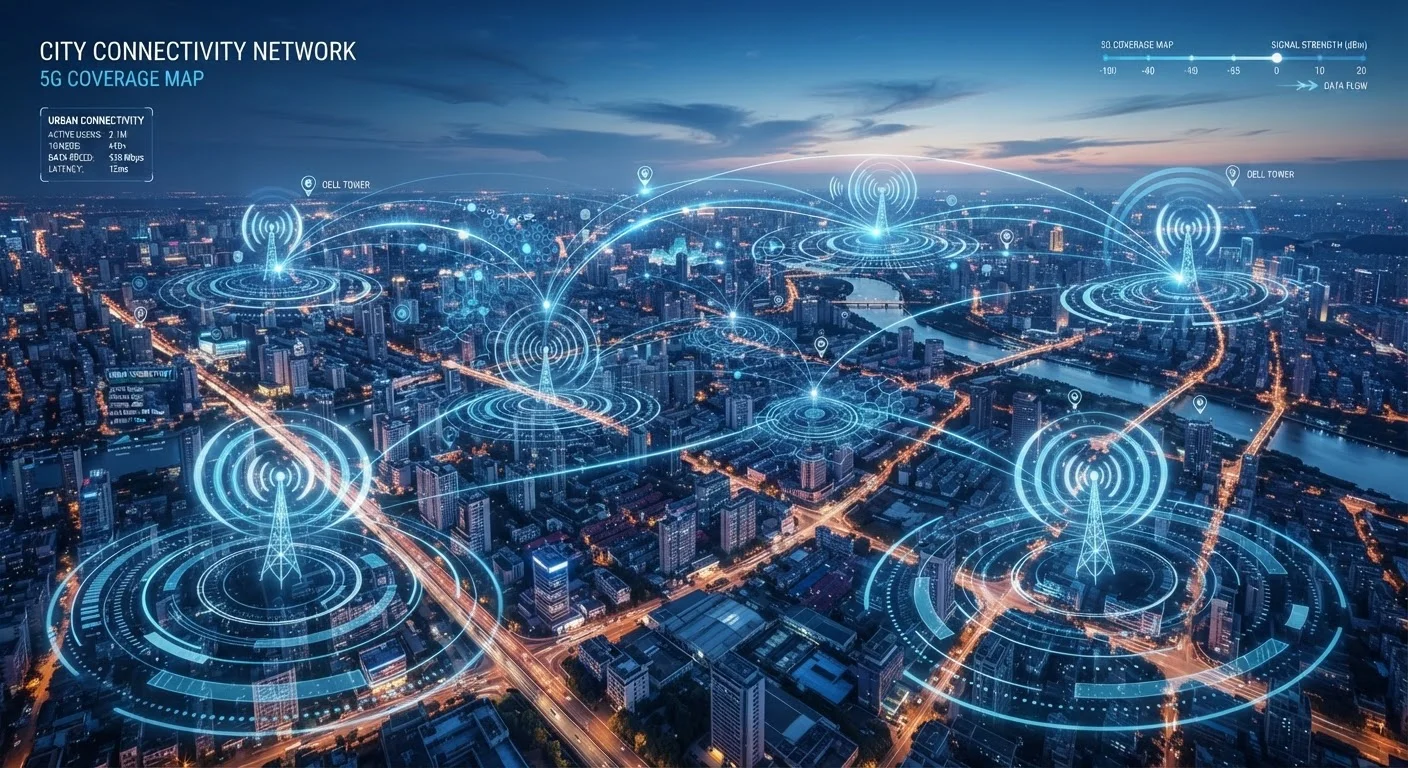
In practice, 5G rollout has been uneven. Dense urban areas often have strong 5G coverage, while rural and suburban areas may still rely almost entirely on 4G. Within 5G itself, there are different types - some using low-band frequencies that cover wide areas at modest speeds, others using high-band (called mmWave) that deliver extreme speeds over very short distances, typically limited to stadiums and dense city blocks.
Check Coverage Before Assuming 5G
Carrier websites offer coverage maps that show where 4G and different types of 5G are available. Before assuming you'll get 5G speeds, look up your home address and regular commute on the map. Coverage can vary significantly even within the same city.
For a concise breakdown of every network generation from 1G onward, see network generations at a glance.
Carriers, MVNOs, and Who Owns the Network
In the United States, a small number of major carriers own and operate the actual tower infrastructure. Other wireless companies - called MVNOs (Mobile Virtual Network Operators) - don't own towers. Instead, they pay the major carriers for access to their networks and resell that capacity under their own brands and pricing structures.
This means a plan from a smaller, lower-cost wireless company may run on exactly the same towers as a major carrier. The practical differences often come down to customer service, plan flexibility, and how traffic is prioritized during network congestion - major carriers typically give their own subscribers priority over MVNO subscribers when a tower is busy.
Understanding this structure helps you read plan marketing more critically. For a full breakdown of plan types and what to look for, see the first-timer's guide to choosing a mobile plan.
What This Means for Your Daily Phone Use
Most people never need to think about frequency bands or base stations in daily life - and that's fine. But a basic understanding of how wireless networks work pays off in a few concrete ways.
- Coverage gaps make more sense. If your signal drops in a particular spot, you now know it's likely because you're too far from a tower, or a physical obstacle is blocking the signal - not a random glitch.
- Plan comparisons get easier. When a carrier advertises 5G, you know to ask what kind of 5G and whether it covers where you actually live and work.
- MVNO trade-offs are clearer. A cheaper plan on the same network as a major carrier can be a smart choice - as long as you understand the deprioritization trade-off during busy periods.
For unfamiliar terms you encounter while reading plan agreements, the mobile plan glossary covers 40 key definitions in plain language. And if you're new to smartphones altogether, smartphone ownership from day one is a practical place to continue.