Why This Vocabulary Matters
When a carrier advertises "nationwide 5G" or your phone shows a small icon that says "LTE," those labels carry specific technical meanings - ones that directly affect call quality, download speed, and whether your phone works at all in a given area. Understanding the core vocabulary of wireless networks helps you read coverage maps accurately, pick a plan that fits your actual needs, and troubleshoot problems without guesswork.
This reference covers the terms you'll encounter most often: signal fundamentals, frequency bands, network generations, and performance concepts. For a broader look at how billing language maps to these concepts, see what each line item on your wireless bill actually means. For a foundational overview of how mobile networks are built, this plain-language starting point covers the basics without assumptions.
Frequency
The number of times a radio wave cycles per second, measured in hertz (Hz). In mobile networks, frequency determines how far a signal travels and how much data it can carry.
Band
A labeled, licensed slice of the radio frequency spectrum designated for a specific use. Each band has a number and a corresponding frequency range standardized across devices and carriers.
Spectrum
The full range of radio frequencies available for wireless communication. Spectrum is a finite resource regulated in the US by the FCC and licensed to carriers for specific geographic markets.
LTE
Long-Term Evolution, the radio access technology underlying 4G mobile networks. LTE defines how devices communicate with cell towers to deliver mobile broadband service.
Latency
The time it takes for a data packet to travel from your device to a server and back, measured in milliseconds. Lower latency means more responsive connections, which matters most for real-time applications.
Carrier Aggregation
A technique that combines two or more frequency bands at the same time to increase speed and network capacity. Devices must support it to benefit from it.
Millimeter Wave (mmWave)
High-frequency 5G spectrum above 24 GHz that delivers extremely fast speeds over very short distances. It does not travel far and is blocked easily by walls or obstacles.
MIMO
Multiple Input, Multiple Output - an antenna technology that uses multiple antennas at both the tower and device to transmit several data streams simultaneously, improving speed and reliability.
Signals, Spectrum, and Bands Explained
A radio signal is an electromagnetic wave that carries information - your voice, a text, a streaming video - through the air between your phone and a cell tower. The frequency of that wave describes how many times it cycles per second, measured in hertz (Hz). Mobile networks operate in the megahertz (MHz) and gigahertz (GHz) ranges.
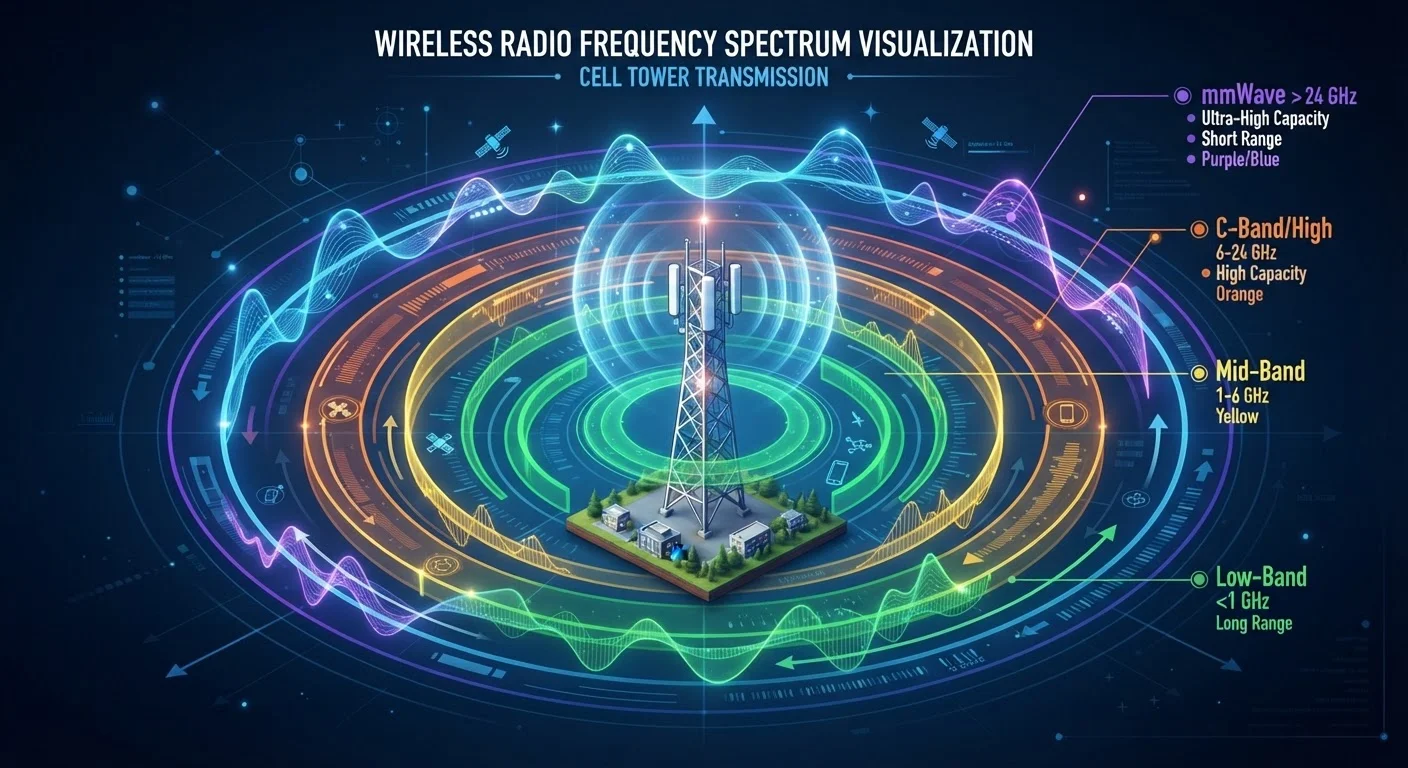
Frequency determines two key trade-offs: range versus capacity. Lower frequencies (below roughly 1 GHz) travel farther and penetrate walls more easily, making them valuable for broad rural coverage. Higher frequencies (above 2.5 GHz, and especially the millimeter-wave bands above 24 GHz used in some 5G deployments) carry vastly more data but lose strength quickly over distance and struggle indoors.
A band is a labeled slice of the radio frequency spectrum assigned for a specific use. In the US, bands are licensed and allocated by the Federal Communications Commission (FCC). Carriers hold licenses to specific bands in specific geographic markets, which is why coverage varies by region even on the same national network. You may see band numbers referenced in your phone's settings - for example, Band 12 (700 MHz) or Band 41 (2.5 GHz) - which correspond to standardized frequency ranges used across carriers and device manufacturers.
Spectrum refers to the full range of radio frequencies. Because spectrum is finite, how it is divided and shared has a direct impact on network performance. Understanding shared versus dedicated spectrum explains why networks slow down during crowded periods.
| US spectrum regulator | Federal Communications Commission (FCC) |
| Low-band frequency range | Below ~1 GHz (e.g., 600 MHz, 700 MHz) |
| Mid-band frequency range | 1 GHz - 6 GHz (e.g., 2.5 GHz, 3.5 GHz) |
| mmWave frequency range | Above 24 GHz |
| Typical 4G LTE latency | 30-50 milliseconds |
| 5G target latency | Under 10 milliseconds (ideal conditions) (3GPP 5G specifications) |
Network Generations and Performance Terms
4G LTE - Long-Term Evolution - is the network standard that became dominant in the US during the 2010s. It supports download speeds typically ranging from 10 Mbps to 50 Mbps under real-world conditions, though peak theoretical speeds are higher. 5G is the current generation, building on 4G infrastructure with new bands and radio technology. Its performance varies widely depending on which 5G variant your phone connects to: low-band 5G offers broad coverage but speeds only modestly faster than 4G, while mid-band and high-band (millimeter-wave) 5G deliver significantly higher speeds in smaller geographic areas.
A few performance terms worth knowing:
- Latency - the delay between sending a request and receiving a response, measured in milliseconds (ms). Lower is better. 5G targets latencies well below 10 ms in ideal conditions; 4G LTE typically runs 30-50 ms in practice.
- Throughput - the actual volume of data transferred per second. Distinct from theoretical peak speed, which is rarely achieved in everyday use.
- Carrier aggregation - a technique that combines multiple frequency bands simultaneously to boost speed and capacity. Phones that support it can pull data across two or more bands at once.
- MIMO (Multiple Input, Multiple Output) - an antenna technology that uses several antennas at both the tower and device to send and receive multiple data streams simultaneously, improving speed and reliability.
For a timeline of how these generations evolved, see Network Generations at a Glance: 1G Through 5G. If you want to go deeper on plan-specific terms like MVNO or QCI, the Mobile Plan Glossary covers 40 terms found in US wireless agreements.
~600 MHz
Lowest licensed 5G band in the US
Low-band 5G at 600 MHz offers the widest geographic coverage but more modest speed gains over 4G LTE.
30-50 ms
Typical 4G LTE round-trip latency
Real-world 4G LTE latency in everyday conditions, based on broadly published network performance benchmarks.
2+
Bands combined via carrier aggregation
Carrier aggregation allows a compatible device to draw on two or more bands simultaneously to increase throughput.