Why Network Generations Matter to Everyday Users
Every time you stream a video, make a call, or load a map on your phone, you are relying on a specific generation of mobile network technology. The "G" in 1G through 5G stands for generation - each one a major overhaul of how wireless signals carry data between devices and cell towers. Understanding these generations helps explain why your phone plan looks the way it does and what your device is actually capable of. For deeper context on how frequencies and signal bands underpin all of this, see our wireless terminology reference.
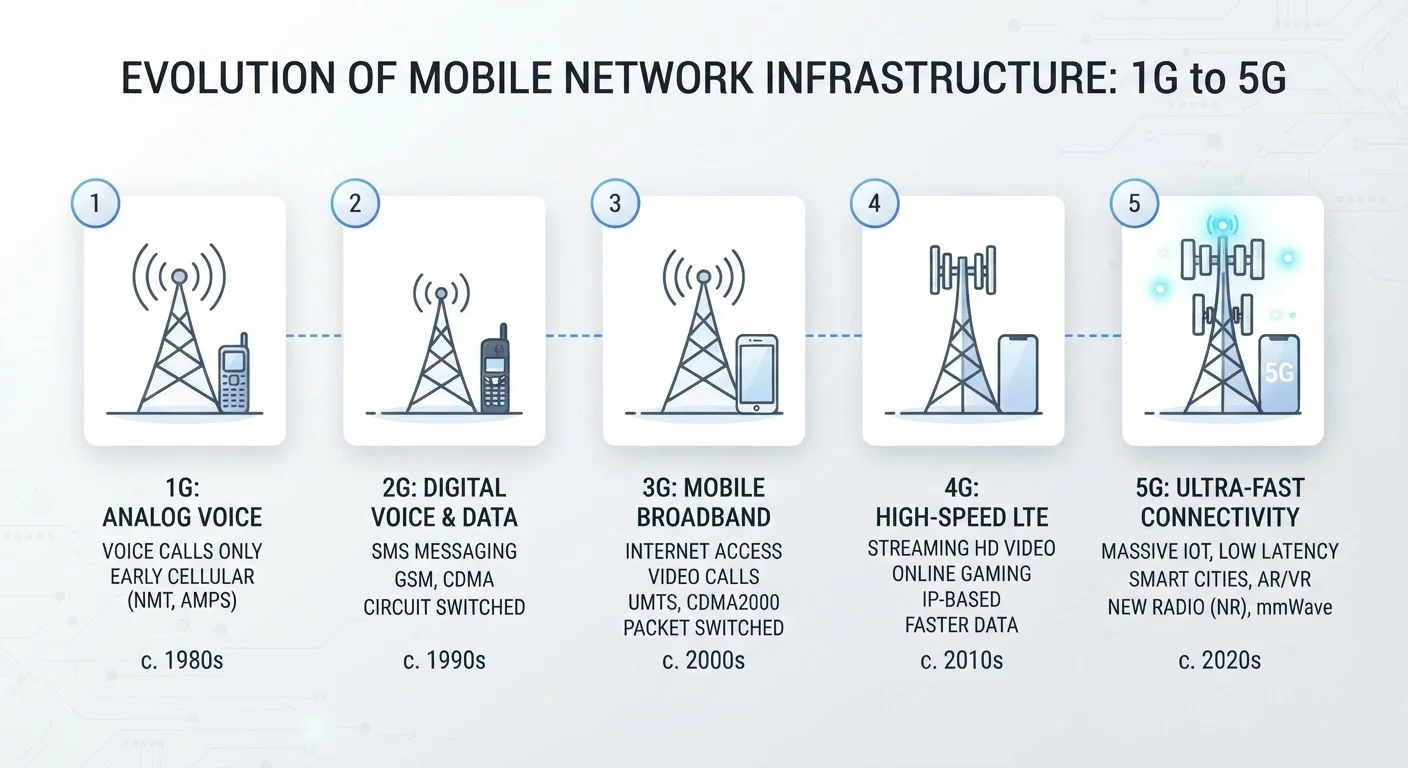
The Five Generations: What Each One Introduced
1G - Analog Voice (early 1980s)
The first generation carried voice calls only, using analog radio signals. Call quality was poor by modern standards, and calls offered essentially no security - radio scanners could pick them up. Coverage was limited to major urban areas in the United States.
2G - Digital Voice and Messaging (early 1990s)
The shift to digital encoding made calls clearer and introduced basic text messaging (SMS) and simple data services. Two competing standards - GSM and CDMA - defined carrier ecosystems that still influence how some older devices roam today. 2G was the foundation for prepaid and international calling as we know it.
3G - Mobile Data (early 2000s)
3G made it practical to browse the web and use email on a handset. Download speeds typically ranged from a few hundred kilobits per second to a few megabits - slow by current standards, but enough to power the first generation of smartphones. The mobile internet as a mainstream concept was born here.
4G LTE - Broadband-Class Speed (around 2010)
LTE (Long-Term Evolution) was the real inflection point for mobile media. Typical real-world speeds jumped to 10-50 Mbps in most markets, making video streaming, video calling, and app-based services genuinely usable. 4G LTE remains the backbone of mobile connectivity in the United States and covers the vast majority of the populated landmass. Understanding what plan you are on matters here - see our mobile plans overview for guidance.
5G - Higher Capacity and Lower Latency (rolling out since 2019)
5G is not simply faster 4G. It is a rearchitected system designed to handle far more simultaneous connections with lower latency (the delay between sending and receiving data). Actual performance varies widely depending on whether a carrier deploys low-band, mid-band, or millimeter-wave (mmWave) spectrum. Low-band 5G offers broad coverage but modest speed gains over 4G. Mid-band and mmWave deliver the headline speeds - sometimes exceeding 1 Gbps - but with much shorter range. Most consumers today use a mix of 4G and 5G depending on location.
What This Means for Your Device and Plan
Your phone's hardware determines which generations it can access. A 5G-capable device will fall back to 4G LTE in areas where 5G is not yet deployed - which is still a large portion of rural America. Carriers are legally and contractually required to disclose which network types a plan covers, so checking coverage maps before choosing a plan is worthwhile.
Network generation also affects how your phone handles roaming and handoffs between towers. Roaming and network switching involves your phone constantly evaluating signal strength and negotiating connections - a process shaped by which generations both your device and the local tower support. Consumers shopping for devices can find additional context in our phones and devices hub.
LTE
Long-Term Evolution - the dominant 4G standard used globally. LTE defines how data is encoded and transmitted between devices and cell towers at broadband-class speeds.
Latency
The time it takes for a data packet to travel from your device to a server and back. Lower latency means more responsive apps; 5G is designed to reduce latency significantly compared to 4G.
Spectrum
The range of radio frequencies licensed to carry wireless signals. Different frequency bands offer different trade-offs between range and speed - lower frequencies travel farther, higher frequencies carry more data.
mmWave
Millimeter-wave - a very high-frequency 5G band capable of multi-gigabit speeds over short distances. It is most effective indoors, in stadiums, and in dense urban environments, not across wide geographic areas.
Handoff
The automatic process of your phone switching from one cell tower (or network generation) to another as you move, ideally without interrupting your call or data session.