What Spectrum Actually Is
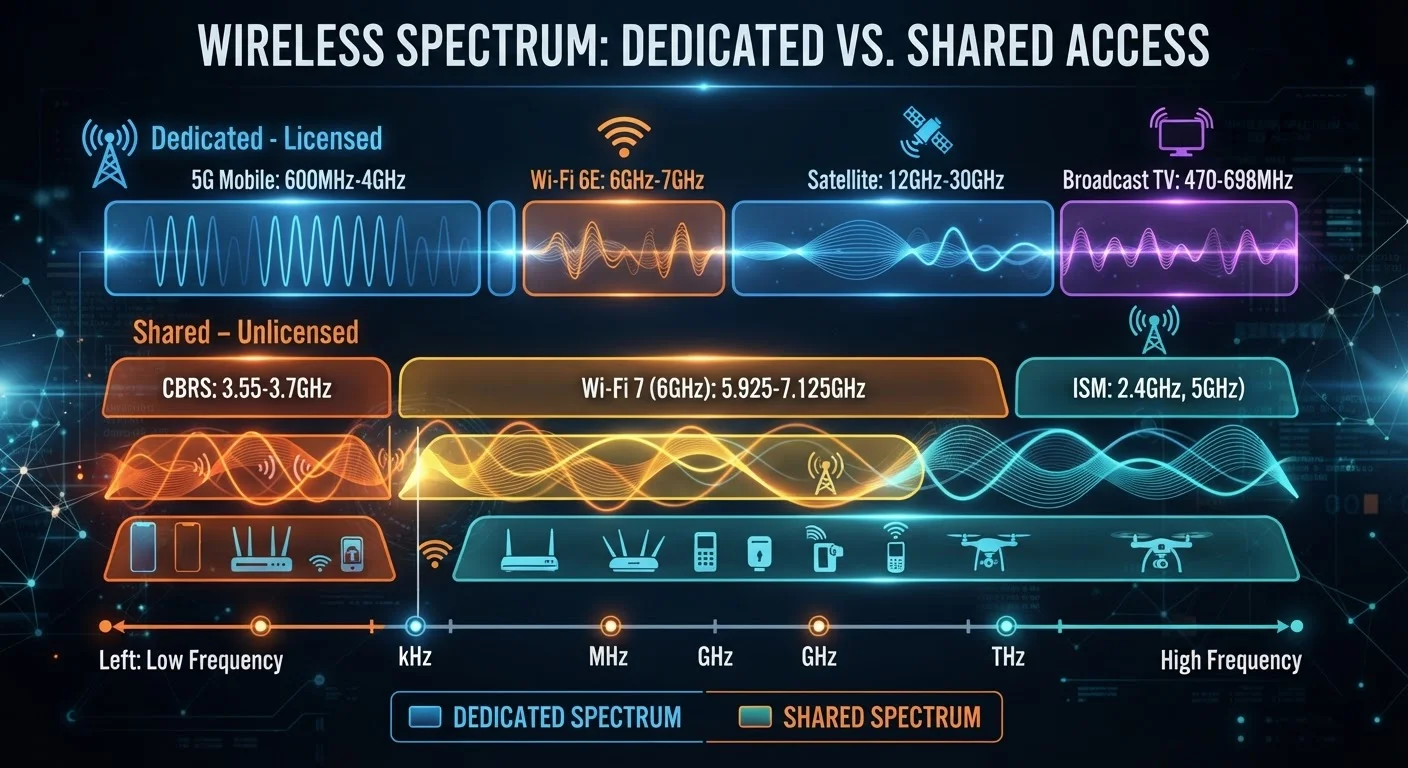
Before comparing shared and dedicated spectrum, it helps to understand what spectrum means in the first place. Radio spectrum refers to the range of electromagnetic frequencies used to transmit wireless signals - everything from AM radio to Wi-Fi to your mobile data connection travels through it. If you want a deeper grounding in this topic, the wireless terminology reference covers the key vocabulary clearly.
The critical point is that spectrum is finite. The U.S. government, through the Federal Communications Commission (FCC), regulates which frequencies can be used for which purposes. Carriers pay billions of dollars to license specific bands. Once a band is in use, only so much data can travel through it at once - and that limited capacity must be distributed among all connected devices.
For a broader introduction to how mobile networks function, this plain-language starting point is a useful foundation before going deeper.
How Shared Spectrum Works - And Why It Slows Down
When you use your phone on a standard mobile plan, you're accessing shared spectrum. That means the frequencies your carrier has licensed are divided in real time among every device connected to a given cell tower. Under light load - say, 3 a.m. in a quiet neighborhood - you might get speeds close to the theoretical maximum for your network type. But in a crowded stadium, an airport, or a downtown area at noon, hundreds or thousands of devices compete for the same bandwidth simultaneously.
This competition is the root cause of network congestion. The tower can only transmit so much data per second. As more devices connect, each one gets a smaller slice. Speeds drop, latency increases, and video calls stutter. How network congestion develops and why it's hard to fix explains this dynamic in detail.
| Criterion | Shared Spectrum | Dedicated Spectrum |
|---|---|---|
| Who uses the bandwidth | All users on a tower simultaneously | Reserved for one user or organization |
| Speed consistency | Variable - drops during peak hours | Consistent - unaffected by public load |
| Typical use case | Consumer mobile plans | Enterprise, public safety, private networks |
| Cost | Included in standard plan pricing | Significant additional cost or licensing fee |
| Congestion risk | High in dense, busy areas | Minimal to none |
| Availability in 5G | Default for all consumer 5G plans | Available via network slicing or private 5G |
Carriers manage shared spectrum using sophisticated scheduling algorithms that constantly reprioritize which devices get bandwidth and when. Deprioritization - where heavy users are moved to the back of the queue during congestion - is one common mechanism, and it's often disclosed in the fine print of unlimited plans.
What Dedicated Spectrum Looks Like in Practice
Dedicated spectrum means a defined portion of radio bandwidth is reserved exclusively for a specific user, organization, or purpose - no sharing with the general public. This can be achieved through outright spectrum licensing (where a company owns the rights to a frequency band in a geographic area), through long-term leases from a carrier, or through a technology called network slicing.
Network slicing is a 5G capability that allows a carrier to carve a physical network into multiple virtual networks, each with guaranteed bandwidth and performance characteristics. A hospital, for example, could have a dedicated slice that prioritizes its connected medical devices, completely insulated from the congestion affecting regular smartphone users on the same tower.
Citizens Broadband Radio Service (CBRS): A Middle Ground
The FCC created the Citizens Broadband Radio Service (CBRS) band - 3.5 GHz - specifically to allow businesses to deploy private, dedicated-style wireless networks without purchasing a traditional spectrum license. Organizations can use CBRS to build on-site private LTE or 5G networks for warehouses, campuses, or industrial facilities. It's not available to individual consumers but represents an important policy tool for expanding dedicated spectrum access beyond traditional carriers.
Outside of enterprise and public-safety use, most consumers won't encounter true dedicated spectrum. But 5G's architecture makes dedicated-style performance more accessible than previous generations allowed. For more on how 5G frequencies themselves differ, see the comparison of Sub-6 GHz vs. mmWave 5G.
What This Means for Your Everyday Mobile Experience
For most consumers, shared spectrum is simply the reality of mobile connectivity - and it works well the majority of the time. Where it matters most is in high-density environments and during peak usage hours. If you've noticed that your mobile data is slower on weekday evenings or at large events, shared spectrum congestion is almost certainly the reason.
Understanding the shared vs. dedicated distinction also helps when evaluating plan features. Some carriers market priority data tiers, which effectively move you higher in the queue during congestion - a partial middle ground between fully shared and fully dedicated access. These aren't the same as true dedicated spectrum, but they do reduce the worst effects of peak-hour slowdowns.
If your household is weighing plan structures, the trade-offs between shared data plans vs. individual lines involve similar resource-allocation questions at the account level. Knowing how the underlying network handles capacity makes those plan decisions easier to navigate.