Why 5G Isn't Just One Thing
When carriers advertise 5G, they're describing a standard - not a single, uniform signal. The way that signal actually travels depends entirely on which radio frequency band the network uses. Two phones both showing a 5G icon can be operating on frequencies that perform completely differently.
The two main categories are Sub-6 GHz (frequencies below 6 gigahertz) and mmWave (millimeter wave, typically between 24 GHz and 100 GHz). Understanding what separates them is the key to knowing what your 5G connection can actually do. If terms like gigahertz, band, or spectrum are new to you, the wireless terminology reference covers those basics clearly.
How Each Frequency Band Behaves
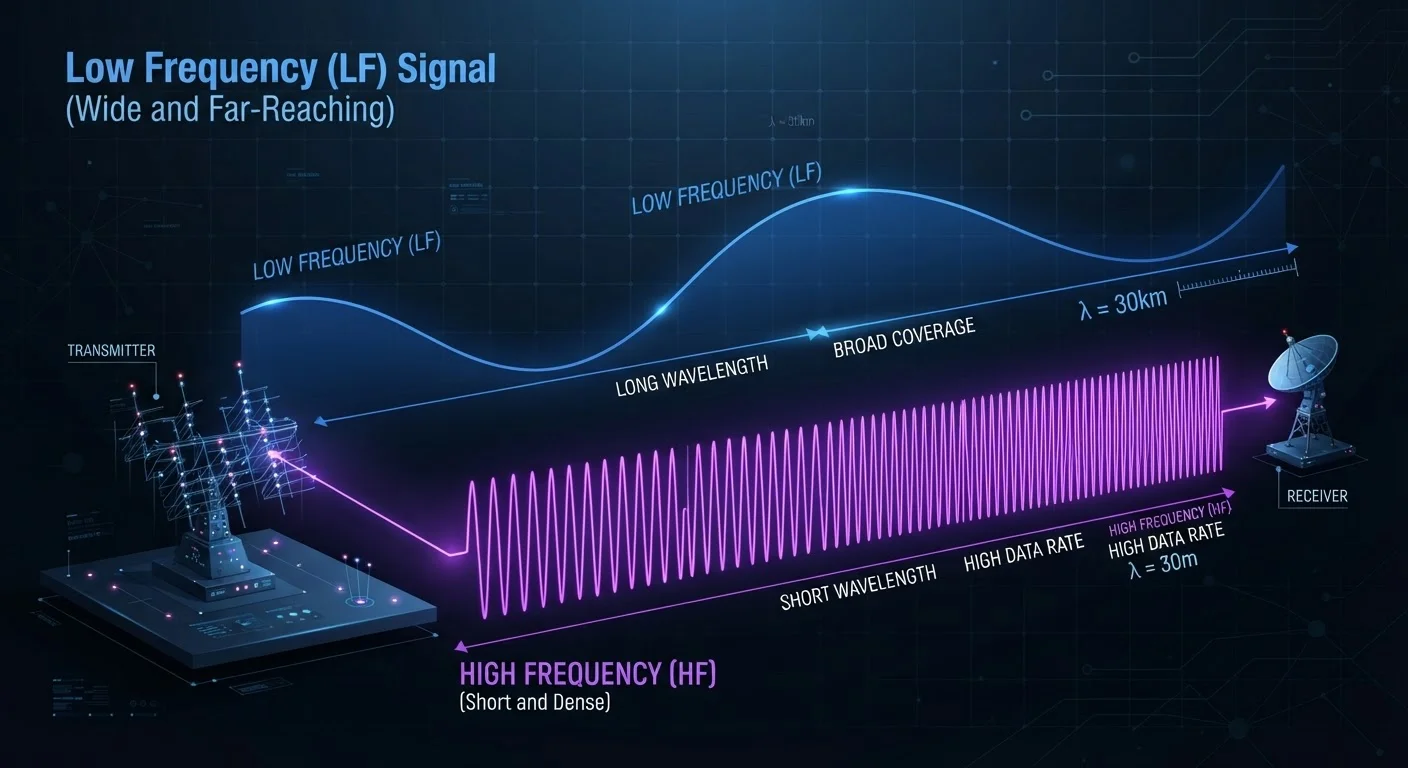
Radio waves follow a consistent physical rule: lower frequencies travel farther and pass through obstacles more easily, while higher frequencies carry more data but lose strength quickly over distance and through solid objects.
Sub-6 GHz 5G inherits the range characteristics of older cellular bands. A single tower can serve users miles away and maintain a signal inside buildings, cars, and through foliage. The trade-off is that the available spectrum is narrower, which limits peak speeds. In practice, many Sub-6 GHz 5G connections deliver speeds that are a meaningful but not dramatic improvement over 4G LTE. For context on what actually changed between generations, see our piece on what separates 4G LTE and 5G.
mmWave 5G operates at much higher frequencies and has access to wide swaths of unused spectrum. That translates to extraordinary peak speeds - often cited in the multi-gigabit range under ideal conditions. But the physics work against it: mmWave signals weaken rapidly, can't reliably penetrate a window, and may even be blocked by a human hand covering the antenna. Effective range is typically measured in hundreds of feet, not miles.
| Criterion | Sub-6 GHz 5G | mmWave 5G |
|---|---|---|
| Typical range per tower | Miles | Hundreds of feet |
| Building penetration | Good | Poor to none |
| Peak download speeds | Moderate improvement over 4G | Potentially multi-gigabit |
| Coverage availability | Widespread across US | Dense urban spots only |
| Spectrum width | Narrower | Very wide |
| Device support | Most 5G phones | Select high-end phones |
| Best environment | Suburban, rural, general mobility | Crowded urban venues |
Where Each Type Is Actually Deployed
Deployment patterns reflect the physics. Sub-6 GHz 5G is what most carriers have rolled out across broad geographic areas. It reuses many existing tower sites - sometimes even the same hardware - which makes it far faster and cheaper to deploy widely. The majority of Americans who have 5G access are using Sub-6 GHz bands.
mmWave deployment is concentrated in dense, high-foot-traffic locations: sections of major city downtowns, sports arenas, airports, and convention centers. Carriers install small mmWave nodes - often mounted on lamp posts or building exteriors - to saturate a limited physical area with high-speed capacity. Step a block away, and coverage may disappear entirely.
This coverage gap matters when evaluating 5G claims. Common beliefs about 5G often assume mmWave-level performance everywhere, which is not how real-world networks are built.
What This Means for Your Device and Plan
Your phone must support the specific band your carrier uses in your area or you won't connect to 5G at all. Many mid-range 5G phones support Sub-6 GHz bands only. mmWave support requires additional antenna hardware, which has historically appeared in higher-end devices and is not universal even among flagship models. Checking a device's band specifications before purchase is worth the effort if mmWave access matters to you.
Spectrum allocation also shapes how congested a network feels during peak hours. Because Sub-6 GHz spectrum is a finite shared resource across many users, it can slow under heavy load - a dynamic explained well in the context of shared vs. dedicated network spectrum. mmWave's wider channels can handle more simultaneous users in a small area, which is why it excels in stadiums or transit hubs even if it can't reach your home.
Mid-Band 5G: The Middle Ground
Carriers also deploy a middle tier sometimes called mid-band 5G, using frequencies between roughly 1 GHz and 6 GHz. This range offers a better balance of coverage and speed than the extremes described here. When carriers refer to their "nationwide" 5G with improved performance, they often mean mid-band deployments. It still falls within the Sub-6 GHz category but performs noticeably faster than low-band options.