The Shared Pipe Problem
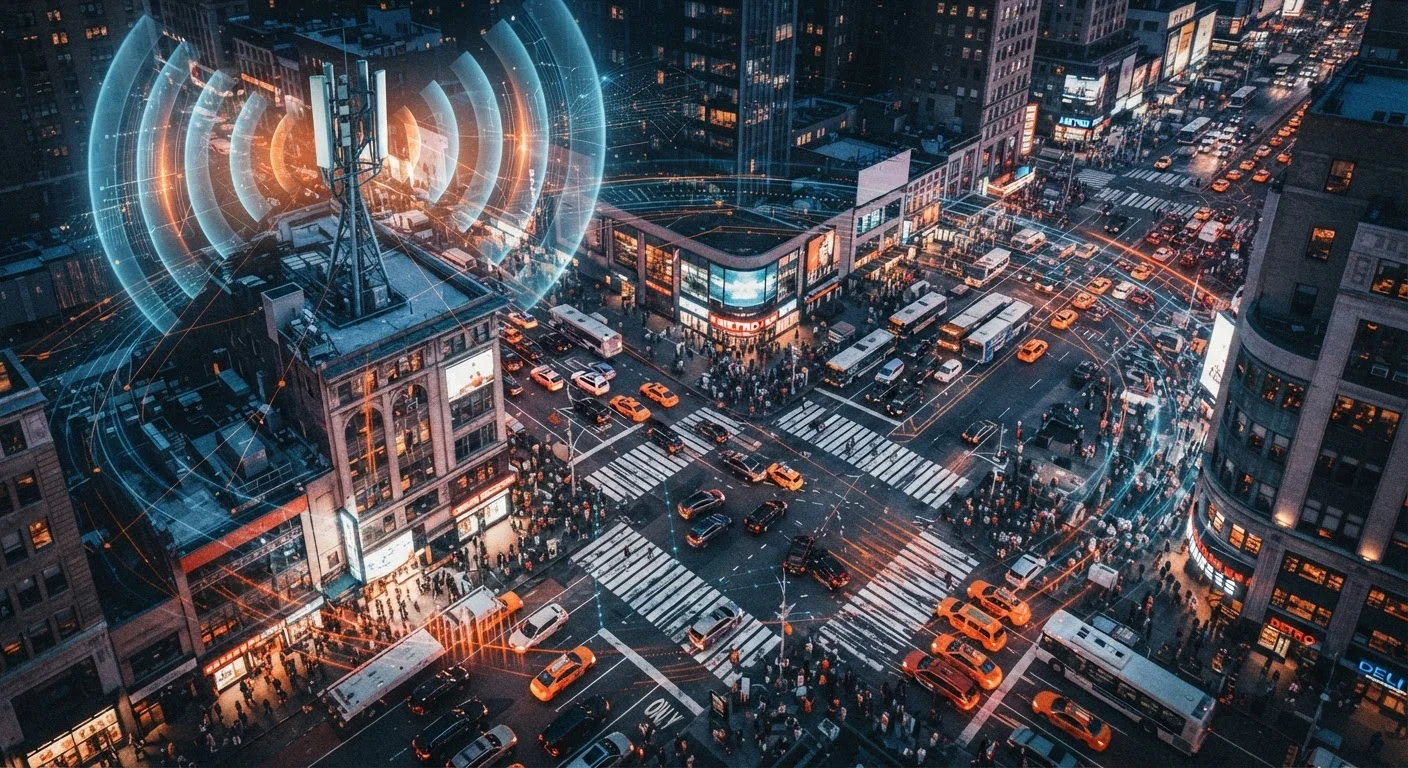
Every cell tower broadcasts across a finite slice of radio spectrum - a physical resource that cannot be stretched on demand. That spectrum is divided into channels, and those channels are shared dynamically among every device connected to the tower at a given moment. When ten people are connected, each gets a generous portion of the available capacity. When ten thousand people connect - say, at a stadium or in a dense urban neighborhood at 8 p.m. - each device gets a much smaller slice.
This is the fundamental mechanic behind congestion. The tower itself hasn't broken. No cable has been cut. The network is simply oversubscribed relative to what it was engineered to handle at that moment. Understanding this matters because it reframes congestion as a structural reality of shared wireless infrastructure, not a failure by any single carrier or device.
For a broader look at how successive network generations have expanded that capacity over time, see Network Generations at a Glance: 1G Through 5G.
When and Where Congestion Hits Hardest
Congestion isn't random. It follows predictable human behavior patterns.
- Evening residential peak: Typically 7-10 p.m. local time, when households shift to streaming, gaming, and social media simultaneously.
- Weekday lunch hours: Dense office districts see a burst of usage as workers reach for their phones.
- Large public events: Stadiums, concert venues, and outdoor festivals concentrate tens of thousands of devices within the range of a handful of towers.
- Emergencies and breaking news: Sudden spikes in call and data volume can overwhelm networks in minutes.
Geography compounds the problem. A tower placed to serve a neighborhood of 2,000 residents may be adequate most of the time, but if that neighborhood grows - or if a new apartment complex opens - the same hardware must now serve more users. Carriers monitor these patterns and plan upgrades accordingly, but infrastructure investment always lags behind demand growth.
~7 p.m.
Typical daily peak congestion hour on U.S. mobile networks
Network analytics firms consistently identify early evening as the highest-demand period for residential mobile data traffic across major U.S. carriers.
100x
Capacity increase targeted by 5G mid-band vs. 4G LTE
The ITU's IMT-2020 specifications set a theoretical 100-fold area traffic capacity improvement as a 5G design goal, though real-world gains vary by deployment.
80%+
Share of U.S. mobile data traffic handled by 4G LTE
Despite 5G expansion, the majority of mobile data in the United States continues to traverse 4G LTE infrastructure, according to network measurement reports from Opensignal and similar firms.
How Carriers Manage a Congested Network
Carriers use several technical and policy tools to manage congestion, with varying degrees of transparency to the consumer.
Traffic prioritization is the most consequential for everyday users. On most unlimited plans, subscribers are subject to deprioritization - a policy that places their data requests at the back of the queue when a tower is congested. The carrier isn't capping your speed outright; it's making your traffic wait while higher-priority users are served first. The practical effect during a busy evening can look indistinguishable from throttling.
Carrier aggregation is a technical approach that combines multiple spectrum bands simultaneously to increase effective bandwidth per device. A phone using carrier aggregation might pull data across two or three separate frequency bands at once, effectively widening the pipe. This is one reason mid-band 5G has made a noticeable real-world difference in congested urban areas - it opens up substantially more spectrum for aggregation.
Carriers also deploy small cells - low-power mini-towers mounted on streetlights and building facades - to offload traffic from overloaded macro towers in dense areas. This densification strategy is central to 5G deployment plans, though it is expensive and requires cooperation from municipalities. For a detailed look at how 5G technology handles these challenges, How 5G Actually Works - And Where It Falls Short covers the technical mechanics and real-world limitations clearly.
What You Can Actually Do About It
Congestion is largely outside any individual user's control, but a few practical steps can reduce its impact on your experience.
Switch to Wi-Fi during peak hours. Moving your traffic off the cellular network entirely - onto your home broadband or a trusted Wi-Fi connection - sidesteps tower congestion completely. Your phone can also make calls over Wi-Fi if your carrier supports it. See Roaming, Wi-Fi Calling, and Network Switching for how that process works in practice.
Understand your plan's priority tier. Read the fine print on your plan. If it includes a deprioritization threshold - commonly expressed as a data amount after which you may experience reduced speeds - you'll know when you're most vulnerable during congested periods.
Adjust timing when possible. Scheduling large downloads or video calls outside peak windows (late night or early morning) will reliably yield better speeds on the same network and the same plan.
Check Your Plan's Deprioritization Threshold
Most unlimited plan fine print includes a data threshold - often between 22 GB and 50 GB per month - after which your traffic can be deprioritized during congestion. Knowing your threshold helps you predict when your speeds are most at risk during busy periods. This information is typically in the plan's terms and conditions, not the marketing summary.
None of these steps change the underlying infrastructure, but they do let you work around congestion rather than being blindsided by it.