Why the Words on a Juice Bottle Actually Matter
Stand in any grocery store juice aisle and you'll see shelves packed with brightly colored bottles shouting words like 'orchard blend,' 'fruit punch,' 'tropical nectar,' and '100% pure.' It looks like a spectrum of the same basic thing. It isn't. Each of those terms carries a specific legal meaning defined by the U.S. Food and Drug Administration (FDA), and the difference between them can mean the difference between a product that is essentially fruit water with a drop of juice and one that is genuinely nothing but pressed fruit.
The confusion is understandable. Manufacturers know that consumers associate the word 'juice' with something wholesome and fruit-forward, so they use variations of it as broadly as the law allows. Learning to decode this vocabulary is one of the most practical label-reading skills you can develop. For a broader look at navigating the full Nutrition Facts panel, see our guide to reading a Nutrition Facts label.
What '100% Juice' Actually Guarantees
When a label says '100% juice' - and federal regulations require that claim to appear prominently if made - the product must be composed entirely of juice. No added sugars, no water added beyond what is used in processing from concentrate, no synthetic sweeteners. The juice may come from concentrate, meaning water was removed and then restored, but the end product must be nutritionally equivalent to single-strength juice.
One nuance worth knowing: a product can be labeled '100% juice' while blending multiple juice types. A bottle might say '100% juice' in large text and then reveal in smaller print that it is apple juice with small amounts of grape and cherry - all of which are still technically juice. This is entirely legal and common. The ingredient list on the back will tell you the exact juices used, in descending order by volume.
≥10%
Minimum juice content in a 'juice drink'
FDA labeling rules require juice beverages to display their juice percentage, and products using 'juice drink' terminology typically contain at least 10% juice.
100%
Juice content required for '100% juice' claim
Under 21 CFR Part 101, a product making a '100% juice' claim must contain only juice, with no added sugars, water, or sweeteners beyond processing norms.
25-50%
Typical juice content in fruit nectars
While there is no single U.S. federal minimum for all nectars, most products voluntarily follow Codex Alimentarius standards, which specify juice minimums by fruit type in this general range.
Juice Drinks, Cocktails, and Blends: The Diluted Middle Ground
Terms like 'juice drink,' 'juice cocktail,' 'juice punch,' and 'fruit beverage' signal that the product contains juice but is not entirely juice. Under FDA rules, these products must declare the percentage of juice they contain on the label - look for a statement like 'Contains 15% juice' usually found near the nutrition information or below the product name.
The juice content in these products can range widely, from around 10% up to just under 100%. The remaining volume is typically water, added sugars (such as high-fructose corn syrup or cane sugar), natural flavors, citric acid for tartness, and sometimes vitamins like ascorbic acid (vitamin C) added to reinforce the fruit-adjacent impression. From a sugar standpoint, some juice drinks contain as much or more added sugar per serving than a soda, which is why checking the added sugars line on the Nutrition Facts panel is so important. Our field guide to the Nutrition Facts label walks through exactly how to find and interpret that number.
Understanding Nectar: A Category of Its Own
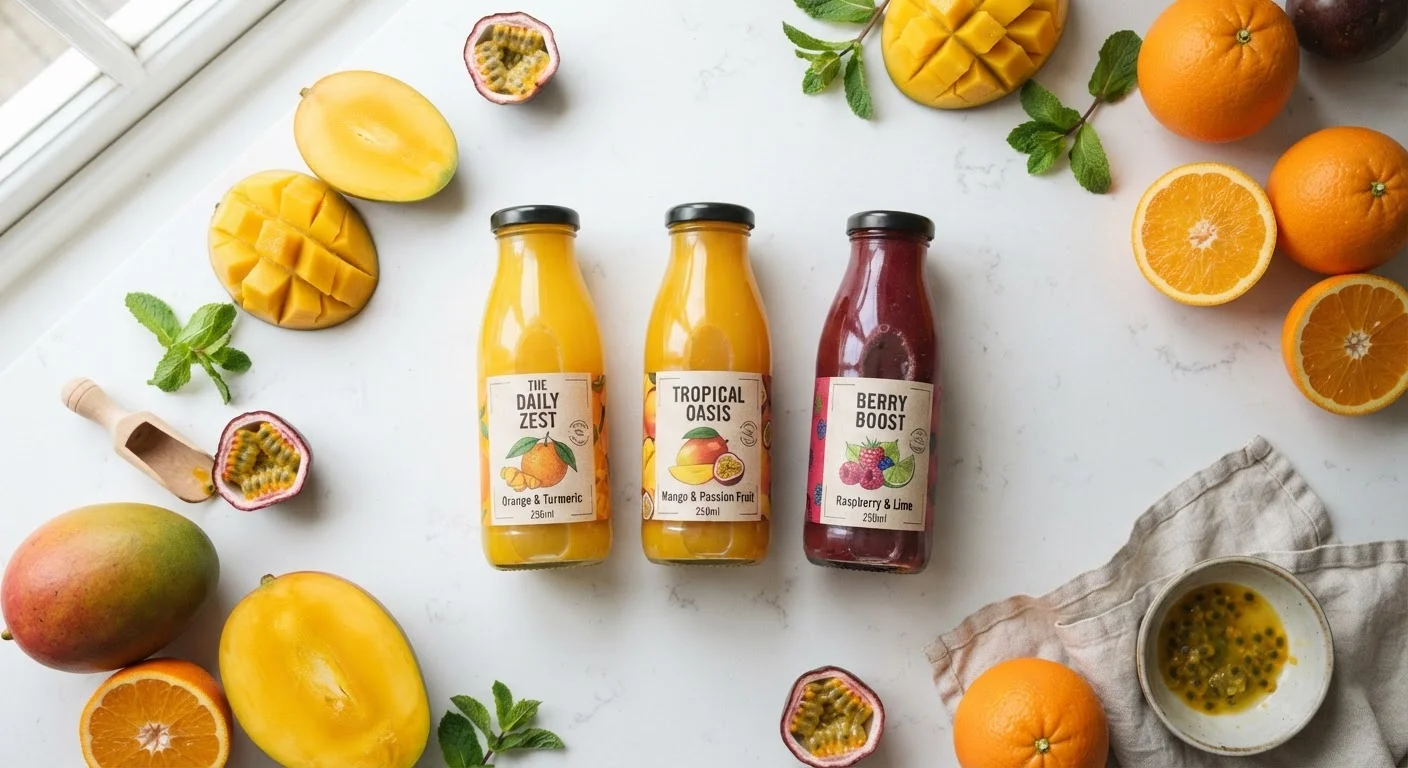
Nectar occupies a defined middle ground, common with fruits that are either too thick, too tart, or too low-yielding to produce a palatable straight juice. Think guava, mango, passion fruit, apricot, and peach. In the United States, there is no single federal minimum juice percentage for all nectars - the standard varies by fruit type and is partly guided by international Codex Alimentarius standards that U.S. manufacturers often follow voluntarily.
Typically, nectars contain between 25% and 50% juice, with water and often some sweetener making up the rest. This is not a flaw in the product; it reflects the nature of the fruit. A straight guava juice, for instance, would be almost impossibly thick. Nectar is the intended, traditional form for these fruits, and it can still be a flavorful, nutrient-containing choice - just read the label to understand how much added sugar is present.
Quick Check for Added Sugars
Before buying any juice-adjacent product, flip to the Nutrition Facts panel and look specifically at the 'Added Sugars' line - not just 'Total Sugars.' Natural fruit sugars are present in all juices, but added sugars indicate sweeteners were introduced during processing. A product with 0g added sugars is either 100% juice or unsweetened, regardless of what the front label implies.
How to Read Any Juice Label in Under a Minute
You don't need to memorize regulations to make a smart choice. A quick three-step scan covers it:
- Front panel: Does it say '100% juice'? If yes, it's all juice. If it says 'drink,' 'cocktail,' 'punch,' 'blend,' or 'beverage,' look for the juice percentage statement nearby.
- Nutrition Facts: Check 'Total Sugars' and 'Added Sugars.' A 100% juice will have 0g added sugars. Anything with added sugars listed means sweeteners were introduced beyond the fruit itself.
- Ingredient list: Ingredients are listed by weight, largest first. If juice appears third or fourth after water and sugar, the product is mostly water and sweetener with a juice accent.
This same logic applies whether you're comparing orange juice varieties or evaluating a tropical fruit punch at a school cafeteria. For context on how juice compares to whole-fruit beverages in terms of satiety, the comparison in our article smoothie vs. juice is worth reading. And once you've chosen your juice, how you store it matters too - see our tips on storing drinks at home without losing flavor.
This article is for general informational purposes only. It is not medical or dietary advice. Consult a qualified healthcare professional or registered dietitian for personalized nutrition guidance.