
Why the Label Matters More Than You Think
The Nutrition Facts panel is one of the most data-dense pieces of consumer information most Americans encounter daily - yet it's routinely misread or ignored. Confusion about serving sizes, misinterpretation of % Daily Values, and the sheer volume of numbers can cause even careful shoppers to make poorly informed choices. If you've ever felt that nutrition labels create more questions than answers, you're not alone. That's exactly the kind of trap covered in our guide on nutritional information overload.
The good news: once you understand the structure of the label, reading it accurately takes less than a minute. This guide walks through each section in the order it appears, so you can build a reliable habit.
What you will need
Step-by-Step: Reading Each Section of the Label
Follow these steps in order every time you evaluate a packaged food. The label is standardized by the FDA, so the layout is consistent across nearly all products sold in the United States.
Start with Serving Size and Servings Per Container
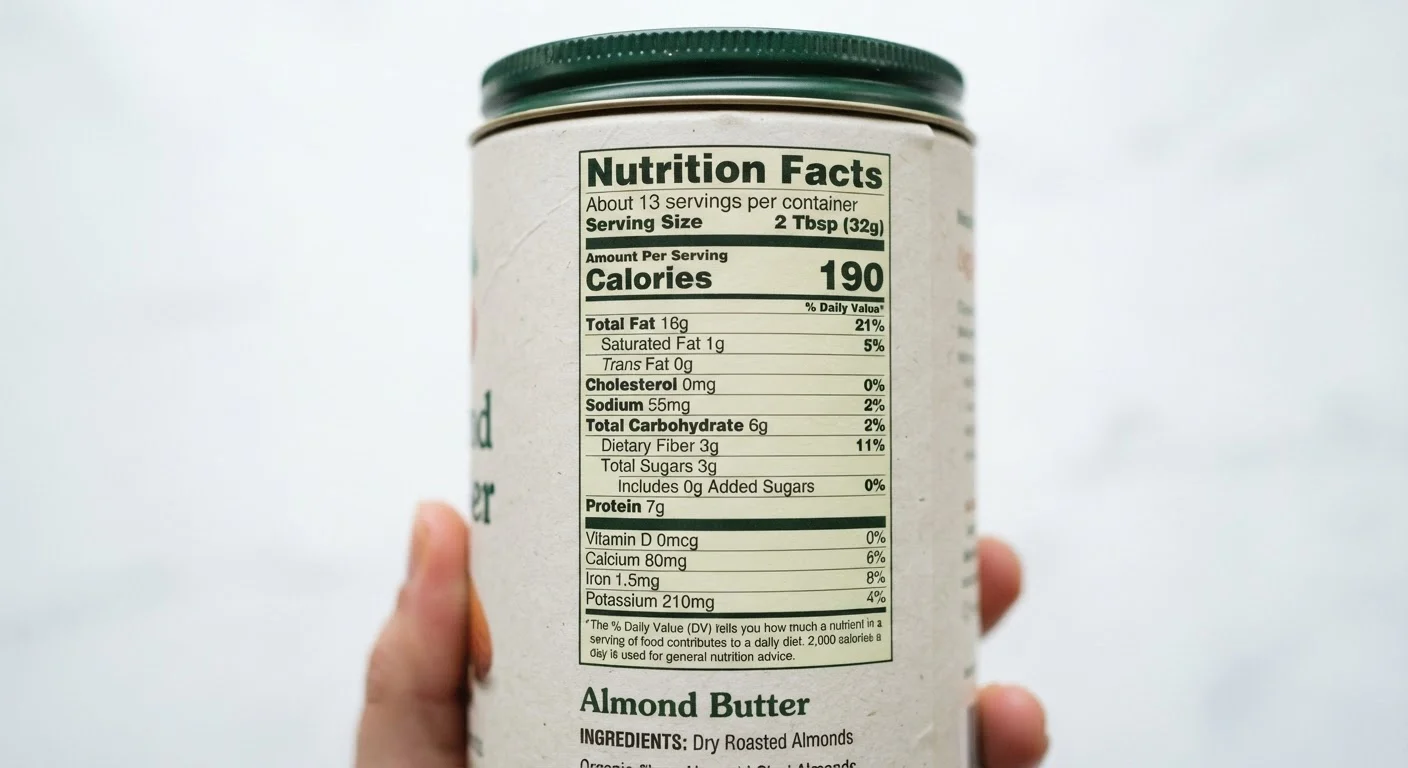
The very first line of the label is the most important: serving size. Every calorie count, gram, and percentage that follows is calculated for this amount - not for the entire package. Serving sizes are standardized by the FDA to reflect amounts people typically consume, but a package may contain two, three, or even more servings.
Check servings per container next. If a bag of crackers lists 150 calories per serving and contains 3 servings, eating the whole bag means consuming 450 calories. This is one of the most common misreadings of the label.
Read the Calorie Count in Context
Calories appear in large bold type directly below serving size. This figure represents the total energy provided by one serving from all three macronutrients: fat (9 calories per gram), carbohydrates (4 cal/g), and protein (4 cal/g).
Treat calories as one data point, not a verdict. A food's caloric content says nothing about its fiber content, micronutrient profile, or how satisfying it will be. Portion perception also plays a role here - research consistently shows that visual cues and packaging size distort how much people think a serving actually is. See why your mental picture of portion size is probably off for more on this.
Scan the Nutrients to Limit
The label lists several nutrients health authorities recommend keeping in check:
- Saturated fat: Linked to elevated LDL cholesterol at high intake levels. Look for lower % Daily Values.
- Sodium: Most Americans consume well above recommended amounts. High-sodium diets are associated with elevated blood pressure in sodium-sensitive individuals.
- Added sugars: Distinguished from naturally occurring sugars (like those in fruit or dairy) since 2016 FDA label updates. Added sugars contribute calories with no additional nutritional benefit.
Trans fat is also listed; current regulations require manufacturers to eliminate artificial trans fats, but checking for zero grams remains worthwhile.
Identify Nutrients to Prioritize
Below the nutrients to limit, the label shifts to nutrients most Americans tend to under-consume:
- Dietary fiber: Supports digestive health, blood sugar regulation, and satiety. Aim for higher % Daily Values here.
- Vitamin D, Calcium, Iron, and Potassium: The FDA requires these four because deficiencies are most common across the population.
Other vitamins and minerals may appear voluntarily. Higher % Daily Values for these beneficial nutrients generally indicate a more nutrient-dense product.
Understand % Daily Value
% Daily Value (% DV) is a standardized benchmark showing how much a nutrient in one serving contributes to a total daily intake based on a 2,000-calorie diet. It's a reference tool, not a personal prescription - your actual needs may differ based on age, sex, activity level, or health conditions.
% DV is most useful for comparison: use it to quickly assess whether a product is a meaningful source of fiber or calcium, or whether it delivers a disproportionate share of daily sodium in a single serving.
Review the Ingredient List
The ingredient list sits below the Nutrition Facts panel and follows one consistent rule: ingredients are listed in descending order by weight. The first ingredient is the most abundant in the product; the last is the least.
Scan the first three to five ingredients - they tell you what the product is primarily made of. Long lists with many forms of sugar (corn syrup, dextrose, fructose, evaporated cane juice) or sodium (salt, sodium benzoate, monosodium glutamate) at or near the top are worth noting. For beverage labels specifically, the ingredient order can be especially revealing - learn how juice labeling rules work to apply the same logic to drinks.
Putting It All Together
No single number on a Nutrition Facts label tells the whole story. Calories matter, but as explored in our piece on the limits of calorie counting, they don't capture nutrient density, satiety, or food quality. A product can be low in calories and still deliver very little nutritional value - and a higher-calorie food can be rich in fiber, vitamins, and minerals that support long-term health. The concept of nutrient density is a practical lens for making sense of those trade-offs.
Use the label as a comparative tool: hold two similar products side by side and check serving size, fiber, added sugars, and sodium first. These four data points alone will often reveal meaningful differences. For a broader framework on putting nutritious meals together without obsessive tracking, see our practical guide to building a balanced plate.
If terminology on the label - words like bioavailability, refined grains, or glycemic index - still feels unfamiliar, our nutritional terms reference guide defines the vocabulary you're most likely to encounter.
This article is for informational purposes only and is not a substitute for advice from a qualified healthcare professional or registered dietitian. Individual nutritional needs vary based on age, health status, and other factors.