
Why Nutrition Vocabulary Matters
Walk through any grocery store and you'll encounter terms like "antioxidant-rich," "low glycemic," and "bioavailable" on packaging, in recipes, and across health articles. These words carry real scientific meaning - but they're often used loosely, which makes it harder to separate useful information from marketing noise.
This reference guide defines the nutrition terms you're most likely to encounter in everyday life. Whether you're reading a nutrition facts label or exploring general guidance on what healthy eating actually means, a working vocabulary makes the information more useful. Pair this glossary with our micronutrients reference for a more complete picture of dietary building blocks.
Macronutrient
One of the three main nutrient categories - carbohydrates, proteins, and fats - that supply energy and structural materials to the body. They are needed in relatively large amounts compared to micronutrients.
Micronutrient
Vitamins and minerals required by the body in small amounts to support functions like immune response, bone health, and energy metabolism. Unlike macronutrients, they provide no direct energy.
Bioavailability
The fraction of an ingested nutrient that the body actually absorbs and can use. It varies based on the food source, preparation method, and individual digestive factors.
Glycemic Index (GI)
A scale from 0 to 100 that ranks how quickly a carbohydrate-containing food raises blood glucose compared to a reference food. High-GI foods cause faster spikes than low-GI foods.
Glycemic Load (GL)
A measure that combines a food's glycemic index with its actual carbohydrate content per serving, giving a more realistic picture of its effect on blood sugar in a typical portion.
Antioxidant
A compound that helps protect cells by neutralizing free radicals - unstable molecules that can damage DNA and other cellular structures. Common dietary antioxidants include vitamins C and E and beta-carotene.
Dietary Fiber
A type of carbohydrate found in plant foods that the body cannot digest. Soluble fiber may help moderate blood sugar and cholesterol; insoluble fiber supports digestive regularity.
Essential Nutrient
A nutrient the body cannot synthesize in adequate amounts on its own and must obtain through food. Essential nutrients include certain amino acids, fatty acids, vitamins, and minerals.
Empty Calories
Calories from foods or drinks that provide energy but little to no nutritional value - such as vitamins, minerals, or fiber. Sugary beverages and highly processed snack foods are common examples.
Phytonutrient
Naturally occurring plant compounds - such as flavonoids, carotenoids, and polyphenols - that may support health. They are not classified as essential nutrients but are found abundantly in fruits, vegetables, and whole grains.
Daily Value (DV)
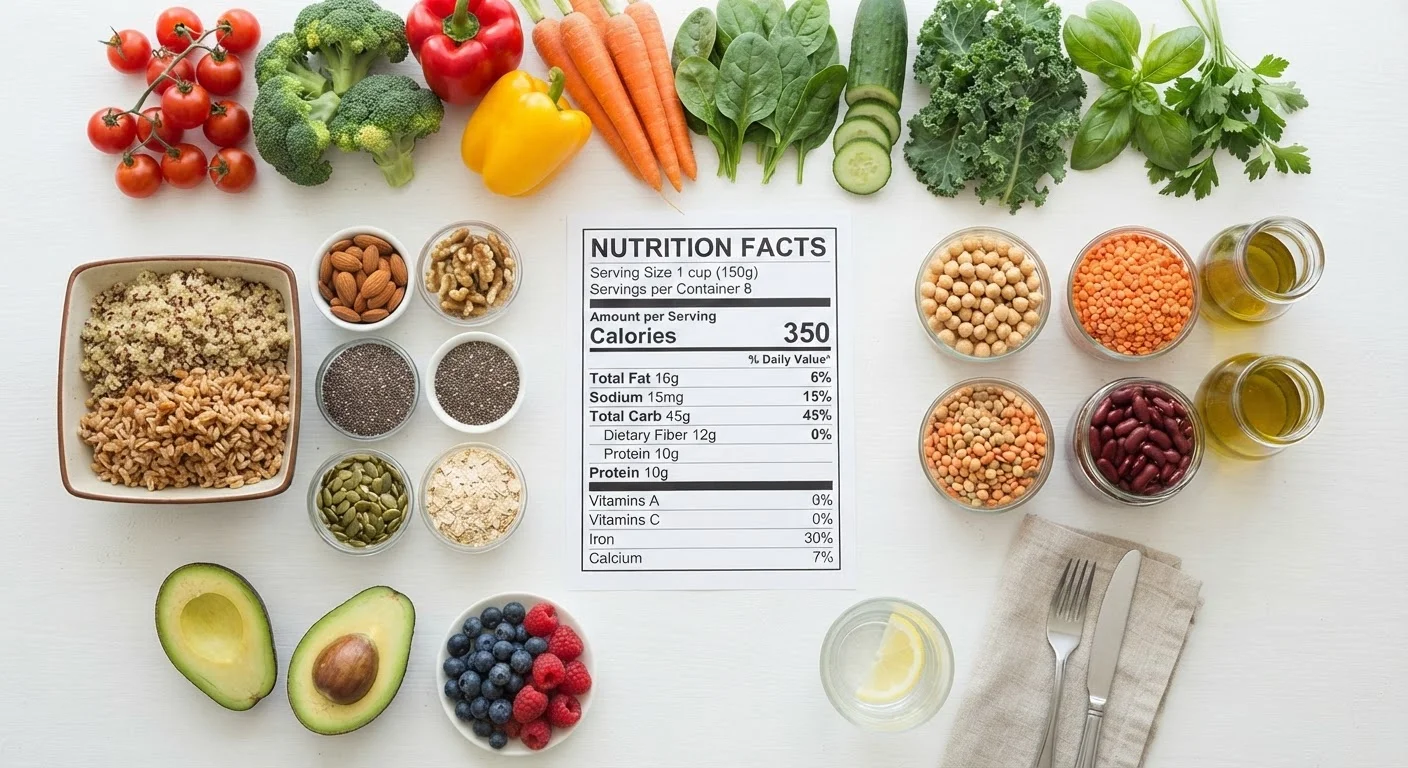
A reference amount set by the FDA used on Nutrition Facts labels to indicate how much of a nutrient a serving of food contributes toward recommended daily intake for a general adult diet of 2,000 calories.
Fortification
The deliberate addition of nutrients to a food that were not originally present or were lost during processing. Common examples include vitamin D added to milk and folic acid added to flour.
Core Macronutrient and Energy Terms
Nutrition science begins with how the body obtains and uses energy. The three macronutrients - carbohydrates, proteins, and fats - supply that energy, measured in kilocalories (commonly called calories). Understanding how these terms interact helps you interpret both food labels and broader dietary guidance.
- Complete vs. incomplete protein: Proteins are built from amino acids. A complete protein contains all nine essential amino acids (those the body cannot make on its own). Animal proteins are typically complete; most plant proteins are not, though combinations like rice and beans can cover the full spectrum.
- Saturated vs. unsaturated fat: Saturated fats are solid at room temperature (butter, coconut oil) and are generally consumed in moderation according to current dietary guidelines. Unsaturated fats - both monounsaturated and polyunsaturated - are liquid at room temperature and are found in foods like olive oil, avocados, and fatty fish.
- Dietary fiber: A type of carbohydrate the body cannot digest. Soluble fiber dissolves in water and may help moderate blood sugar and cholesterol; insoluble fiber adds bulk to stool and supports digestive regularity.
For a broader look at how kitchen technique intersects with these concepts, see our home cook's glossary of essential cooking terms.
Absorption, Bioavailability, and the Glycemic Index
Knowing what a food contains is only half the picture. How much of a nutrient your body actually absorbs and uses is equally important - and that's where several commonly misunderstood terms come in.
| Macronutrients | Carbohydrates, proteins, fats (USDA Dietary Guidelines) |
| Calories per gram of fat | 9 kcal (FDA nutrition labeling standards) |
| Calories per gram of carbs or protein | 4 kcal each (FDA nutrition labeling standards) |
| High glycemic index threshold | GI of 70 or above (Harvard T.H. Chan School of Public Health) |
| Essential amino acids | 9 (must come from diet) (National Institutes of Health) |
| Daily Value calorie basis | 2,000 calories per day (FDA Nutrition Facts label reference) |
Bioavailability refers to the proportion of a nutrient that is absorbed and available for the body to use. For example, the iron in plant foods (non-heme iron) is generally less bioavailable than the iron in red meat (heme iron), though consuming vitamin C alongside plant-based iron sources can improve absorption.
Glycemic index (GI) ranks carbohydrate-containing foods by how quickly they raise blood glucose relative to a reference food (usually pure glucose or white bread). A high-GI food causes a rapid spike; a low-GI food produces a more gradual rise. Glycemic load (GL) refines this further by accounting for portion size, making it a more practical measure in real eating contexts.
Antioxidants are compounds that help neutralize unstable molecules called free radicals in the body. Vitamins C and E, beta-carotene, and selenium are among the best-studied dietary antioxidants. While research on their specific health effects is ongoing, diets rich in fruits, vegetables, and whole grains are consistently associated with higher antioxidant intake.
This article is for informational purposes only and does not constitute medical or dietary advice. For personal nutrition guidance, consult a registered dietitian or qualified healthcare professional.