
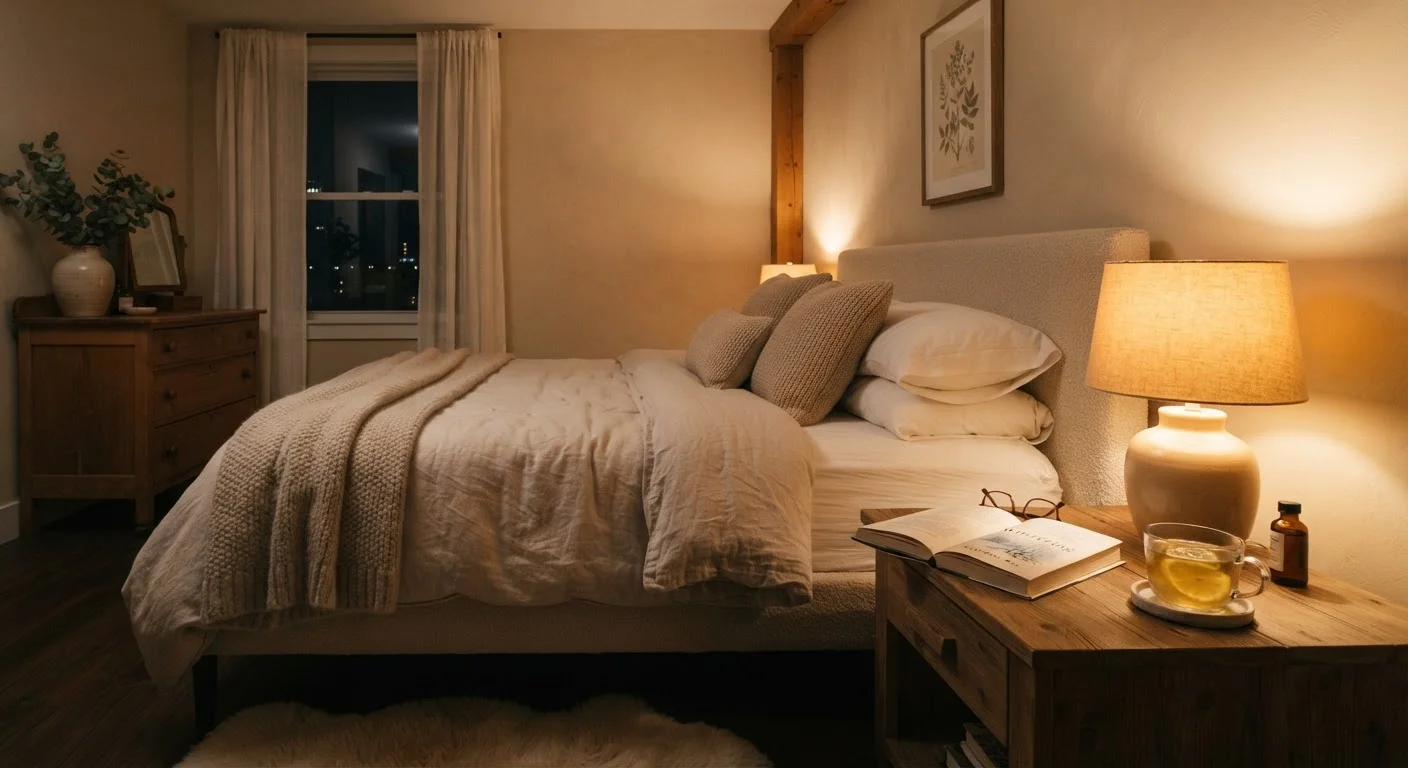
Why a Wind-Down Routine Actually Matters
Sleep doesn't start the moment your head hits the pillow - it starts earlier, with the gradual biological signals your body uses to shift from alertness to rest. Core body temperature begins to drop, melatonin production rises, and the nervous system progressively downregulates. A deliberate wind-down routine works with these processes rather than against them.
Research published in sleep medicine literature consistently shows that behavioral regularity around bedtime - not just consistent sleep timing - is associated with better sleep quality and faster sleep onset. Essentially, your brain is highly pattern-sensitive: repeated cues teach it that sleep is approaching, reducing the cognitive effort of transitioning from wakefulness.
This matters especially for people who lie awake ruminating. If you struggle with a racing mind at night, see our complementary guide on calming an overactive mind before bed for specific nervous system strategies.
What the Evidence Says Actually Works
Several pre-sleep behaviors have genuine research support:
Supports natural melatonin production through light control
Reducing light intensity in the hour before bed aligns with your circadian biology, allowing melatonin to rise without suppression from bright or blue-spectrum light.
Warm bathing accelerates sleep-onset body cooling
A warm shower or bath 60-90 minutes before bed triggers peripheral heat loss that mimics and accelerates the core temperature drop associated with sleep onset.
Journaling offloads cognitive load before sleep
Externalizing unfinished thoughts or next-day tasks onto paper reduces mental activation, making it easier for the brain to disengage from problem-solving mode.
Routine repetition conditions the brain for sleep
Consistent behavioral cues function as conditioned signals, making sleep onset progressively easier as the brain learns to associate the sequence with rest.
Low cost and requires no special equipment
Most evidence-backed wind-down strategies involve simple environmental adjustments or low-tech activities, making them accessible to virtually anyone regardless of budget.
Light exposure management is probably the most robustly supported habit. Bright light - especially blue-spectrum light - suppresses melatonin secretion. Dimming overhead lights and switching to warmer-toned lamps in the hour before bed can measurably support your natural circadian rhythm. For a nuanced look at device screens specifically, screen time and sleep research is worth reading before drawing firm conclusions.
A warm bath or shower taken 60-90 minutes before bed leverages a counterintuitive mechanism: as you exit warm water, your skin rapidly loses heat, accelerating the core body temperature drop that naturally accompanies sleep onset. Studies have found this can shorten the time it takes to fall asleep.
Cognitive wind-down through journaling or to-do lists has controlled-trial support. A 2018 study in the Journal of Experimental Psychology found that writing a specific to-do list for the next day - rather than a gratitude list - was particularly effective at offloading pre-sleep worry and shortening sleep onset time.
Popular Habits That Don't Fully Deliver
Not every widely recommended sleep ritual holds up to scrutiny.
Melatonin supplements have limited evidence for healthy adults
While melatonin can be useful for jet lag and specific circadian disorders, evidence for its routine use as a general sleep aid in healthy adults is modest. Dosing, timing, and individual response vary considerably.
Aromatherapy effects are largely subjective and mild
Lavender and similar scents are frequently promoted for sleep, but clinical studies show effects that are small, inconsistent, and difficult to distinguish from placebo or relaxation response.
Rigid routines can increase sleep anxiety
For some people, a highly structured pre-sleep checklist becomes a source of stress when any step is missed, which can worsen sleep rather than improve it.
Routines alone won't fix underlying sleep disorders
Behavioral wind-down strategies are not a treatment for conditions like insomnia disorder, sleep apnea, or restless legs syndrome, which require clinical evaluation and specific interventions.
Benefits take time to appear and require consistency
Conditioned sleep associations develop gradually over repeated nights. Readers expecting immediate results within a day or two may abandon effective habits before they have a chance to work.
Understanding these limitations isn't a reason to abandon all ritual - it's a reason to set realistic expectations and prioritize what's actually effective.
Building a Routine You'll Actually Stick To
Consistency Beats Complexity
Sleep researchers broadly agree that regularity is the most powerful lever in a wind-down routine - more so than any single activity. A simple three-step sequence done every night will outperform an elaborate twelve-step ritual practiced sporadically. Start small, repeat nightly, and add only what you can sustain long-term.
The most important design principle for a wind-down routine is simplicity. Elaborate, multi-step sequences are harder to maintain and can themselves become a source of anxiety when disrupted while traveling or during stressful periods.
A realistic framework: begin winding down 45-60 minutes before your target sleep time. Dim your environment, finish any work-related thinking by externalizing it (a quick written list works), and include one calming physical cue - a warm shower, light stretching, or even a consistent tea ritual. The specific activity matters less than its consistent repetition.
For those weighing whether to invest energy into morning versus evening habits, our overview of morning versus evening routines can help you prioritize where to focus first.
This article is for informational purposes only and is not a substitute for professional medical advice. If you experience persistent sleep difficulties, consult a qualified healthcare provider.