Why Kitchen Myths Are Hard to Shake
Food safety habits are often passed down through generations, shared on social media, or learned through years of cooking without incident. The problem is that absence of obvious illness after a risky practice can feel like confirmation that the practice is safe. It isn't. Many foodborne pathogens cause symptoms that people attribute to a stomach bug, never connecting them to last night's dinner.
The good news is that once you understand the actual science, safer habits are usually just as easy - sometimes easier - than the myths they replace. For similar patterns of well-meaning but misleading kitchen guidance, see our piece on nutrition information overload that can lead home cooks astray.
The Myths - and What the Evidence Actually Shows
The following myth-and-fact pairs cover some of the most persistent food safety misconceptions in American home kitchens. Each one has a plausible logic behind it - which is part of why it survives - but food science consistently tells a more nuanced story.
Myth
Rinsing raw chicken under the tap washes away harmful bacteria and makes it safer to cook.
Fact
Rinsing raw chicken spreads bacteria like Salmonella to nearby surfaces, utensils, and your hands - it does not remove pathogens.
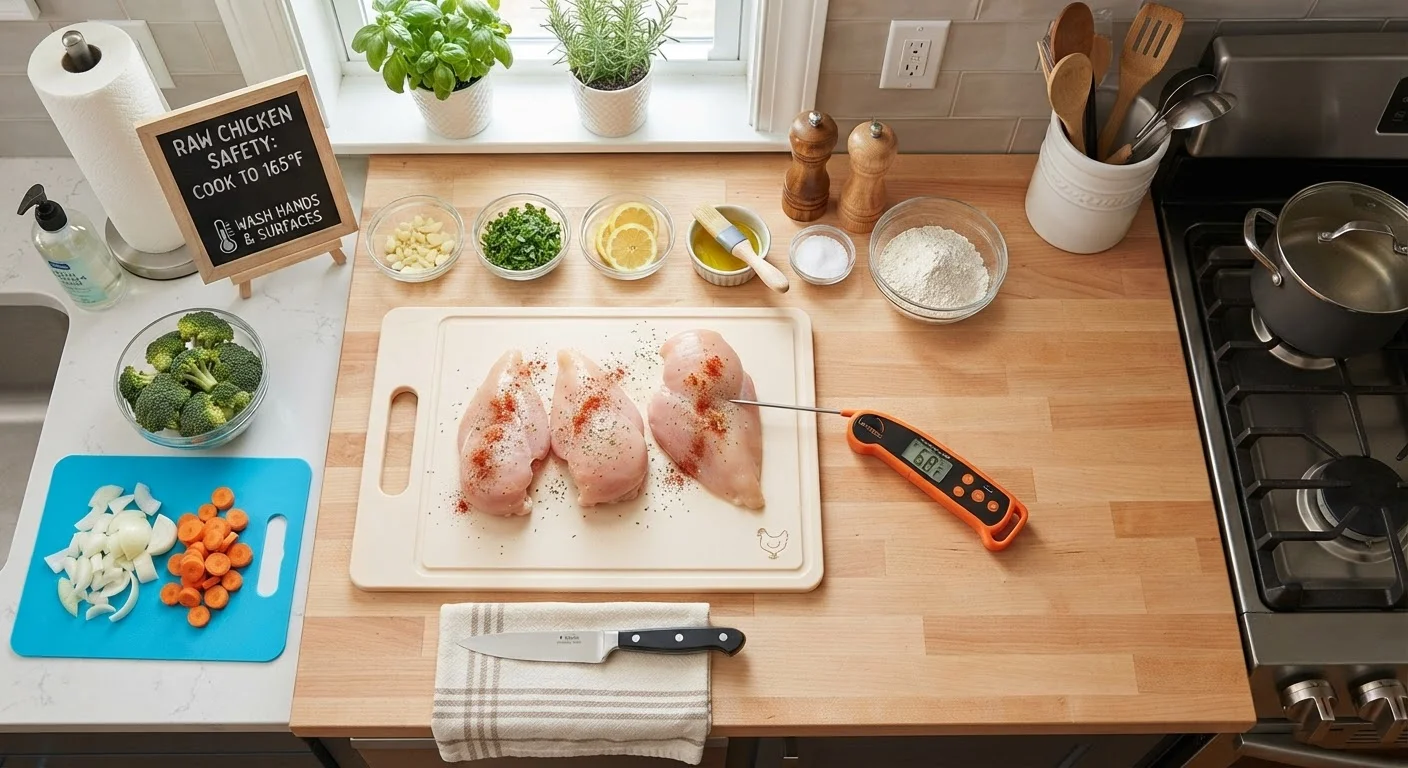
The USDA explicitly advises against washing raw poultry. Water splashing off the bird can carry bacteria up to three feet, contaminating countertops, sinks, and anything nearby. The only effective way to destroy pathogens on chicken is heat - cooking to an internal temperature of 165°F (74°C) throughout.
Myth
If food dropped on the floor is picked up within five seconds, it's still safe to eat.
Fact
Bacteria can transfer to food almost instantaneously upon contact with a contaminated surface - elapsed time is not a meaningful safety factor.
Research published in peer-reviewed food science journals has repeatedly shown that transfer of bacteria like Salmonella and E. coli begins the moment food touches a surface. Softer, wetter foods pick up more bacteria than dry ones, and certain floor surfaces harbor more pathogens than others. The five-second rule is a cultural habit, not a food safety principle.
Myth
You can tell meat is fully cooked by checking whether it has turned brown or the juices run clear.
Fact
Visual cues like color or juice clarity are unreliable guides to safe internal temperature - only a food thermometer provides accurate confirmation.
Myoglobin, the protein that gives meat its color, behaves differently depending on the animal's age, diet, pH, and how the meat was packaged. Ground beef can turn brown before reaching a safe temperature, and poultry can remain pink even when fully cooked. USDA-recommended safe minimums: 145°F (63°C) for whole cuts of beef, pork, lamb, and veal; 160°F (71°C) for ground meats; 165°F (74°C) for all poultry.
Myth
Leftovers should be left on the counter to cool completely before going into the refrigerator.
Fact
Cooked food should be refrigerated within two hours of cooking - or within one hour if ambient temperature exceeds 90°F (32°C).
The temperature range between 40°F and 140°F (4°C-60°C) is known as the 'danger zone' - the range in which bacteria multiply most rapidly. Waiting for food to cool fully on the counter can keep it in that range for far too long. Divide large portions into shallow containers to help them cool faster, and refrigerate promptly. Modern refrigerators are designed to handle warm food without raising the overall cabinet temperature dangerously.
Myth
Marinating meat on the kitchen counter is fine as long as it doesn't sit too long.
Fact
Raw meat should always be marinated in the refrigerator - countertop marinating allows bacterial growth in the danger zone.
Even a 30-minute marinade at room temperature gives bacteria an opportunity to multiply, especially in warm kitchens. Always marinate in the refrigerator. Additionally, any marinade that has been in contact with raw meat should be discarded or brought to a full boil before being used as a sauce.
Myth
Double-dipping in a shared dip or sauce is only a social concern, not a genuine food safety issue.
Fact
Double-dipping can introduce oral bacteria into shared food, which may pose a real contamination risk, particularly for people with compromised immunity.
Studies on double-dipping have found that it does transfer bacteria from saliva into the dip. While healthy adults are unlikely to fall ill from minor bacterial exposure, the risk is real enough to warrant caution - especially when serving food to young children, pregnant individuals, older adults, or those with weakened immune systems. Using a spoon to portion dip individually is a simple and effective workaround.
Color Is Not a Food Safety Indicator
A burger that looks brown in the center may still harbor harmful pathogens, while one that looks pink may actually be safe. The USDA confirms that meat color is influenced by many factors unrelated to doneness. Always use a calibrated meat thermometer inserted into the thickest part of the food - it is the only reliable method.
If you're working on building broader kitchen confidence, knife skills every home cook should know is another practical place to start. And for a deeper look at how popular nutrition claims fare under scrutiny, popular nutrition claims that don't hold up to science is worth reading alongside this piece.
Building Better Habits Without Overthinking It
You don't need a culinary degree or a food science background to cook safely. A few well-placed tools and a handful of corrected habits cover the vast majority of home kitchen risk:
- Own a meat thermometer. An instant-read thermometer removes guesswork from the most critical step in cooking protein.
- Refrigerate promptly. Set a two-hour mental timer when you finish cooking. Divide large pots into smaller containers to speed cooling.
- Wash hands and surfaces, not chicken. Soap and hot water on hands and countertops is the correct response to raw meat contact.
- Keep raw and cooked foods separate. Use different cutting boards for raw proteins and produce, and never return cooked meat to an unwashed surface that held it raw.
Food safety isn't about fear - it's about small, consistent habits that protect you and everyone at your table. Once these practices become automatic, they require almost no extra thought. And if you want to go further in the kitchen, understanding what resting meat really means and why it works adds another layer of practical cooking knowledge grounded in real food science.
This article is for general informational purposes only and is not a substitute for professional food safety guidance. Consult official food safety resources such as the USDA or your local health authority for the most current recommendations.