
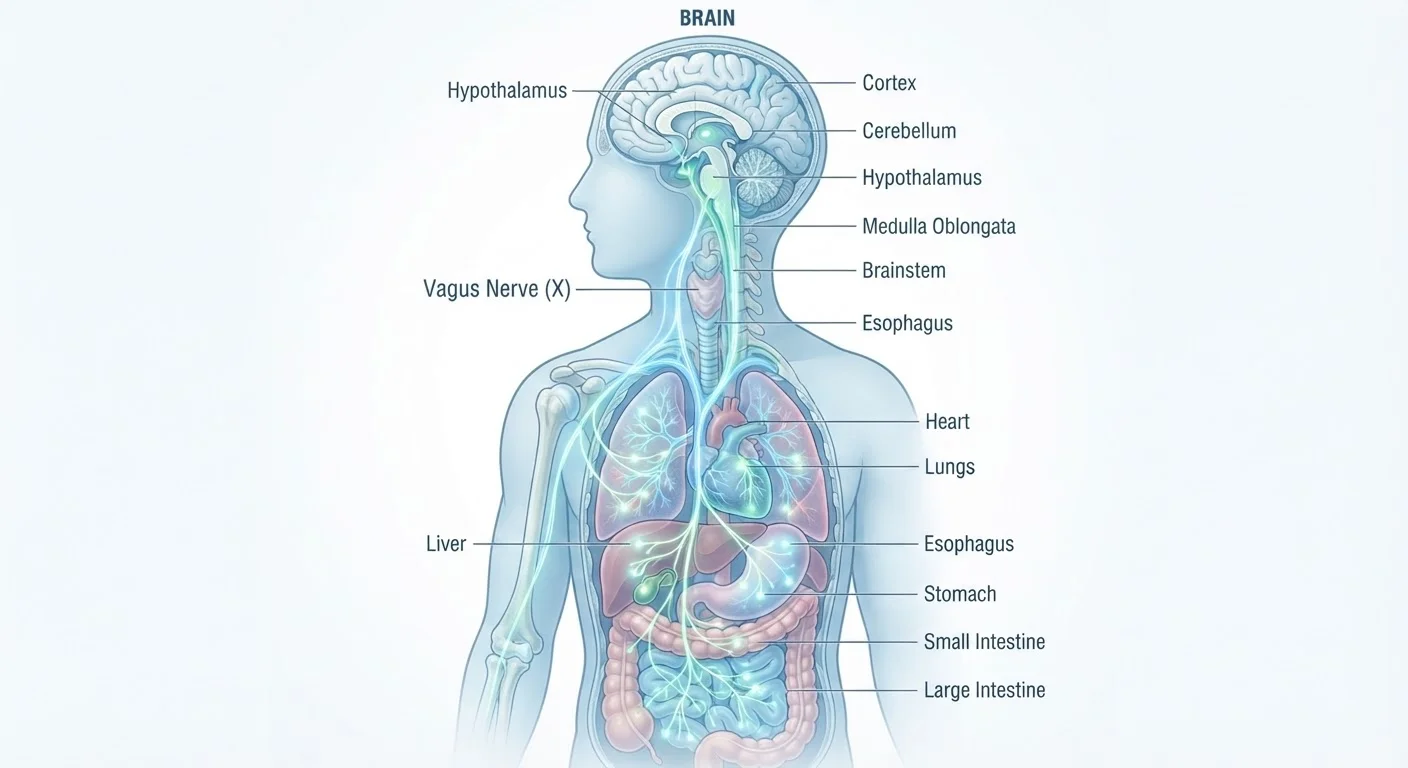
What the Gut-Brain Axis Actually Is
The gut-brain axis is a genuine biological communication network linking the gastrointestinal tract and the central nervous system. It operates through several overlapping channels: the vagus nerve (which carries signals in both directions), the enteric nervous system embedded in the gut wall, circulating hormones like serotonin and cortisol, and immune system messengers called cytokines.
This bidirectional signaling system is not a metaphor. Researchers have mapped its anatomy and documented its functional role in digestion, stress response, and immune regulation. When you feel nauseous before a stressful event or lose your appetite when anxious, you are experiencing the gut-brain axis in action - the brain is modulating gut motility and secretion in real time.
Understanding the actual science here matters, because popular coverage has dramatically overstated what is known - and understated how much remains uncertain. For a parallel look at how neuroscience myths spread, see common brain myths science has corrected.
Myth
The gut is literally a 'second brain' that thinks and makes decisions independently.
Fact
The enteric nervous system is sophisticated but does not think. It regulates digestion autonomously - it does not generate consciousness, reason, or decision-making.
The enteric nervous system (ENS) contains roughly 100-500 million neurons embedded in the gut wall, which is why science communicators coined the phrase 'second brain.' But this is an analogy about structural complexity, not functional equivalence. The ENS orchestrates muscular contractions, fluid secretion, and blood flow in the gut - tasks it can perform even when the vagus nerve is severed. It does not process abstract information, store memories, or produce emotions. Calling it a 'second brain' is a useful hook but a misleading description of its actual role.
Myth
About 90% of serotonin is made in the gut, which means the gut controls your mood.
Fact
While most serotonin is indeed produced in the gut, that serotonin primarily regulates intestinal movement and cannot cross the blood-brain barrier to directly affect mood.
Enterochromaffin cells in the gut lining produce approximately 90-95% of the body's serotonin. However, this peripheral serotonin acts locally - it regulates peristalsis (the wave-like muscle contractions that move food) and signals to the vagus nerve. It does not travel into the bloodstream and cross the blood-brain barrier to act as a mood neurotransmitter. Brain serotonin is synthesized separately within the central nervous system. The statistic is accurate; the causal leap from gut serotonin to mood regulation is not.
Myth
Taking probiotics can meaningfully treat or prevent depression and anxiety.
Fact
Current clinical evidence does not support probiotics as a treatment for any mental health condition; the research is intriguing but preliminary.
A number of small studies have found modest associations between certain probiotic strains and self-reported mood improvements. However, systematic reviews consistently note that these trials are short-term, use heterogeneous probiotic formulations, involve small sample sizes, and often lack rigorous controls. No regulatory body has approved a probiotic as a treatment for depression or anxiety. This does not mean the research direction is wrong - it means the evidence has not yet reached the bar required to make clinical recommendations. Anyone managing a mental health condition should work with a qualified healthcare professional rather than relying on supplements.
Myth
The gut-brain connection only flows one way - from gut to brain.
Fact
Communication along the gut-brain axis is bidirectional; the brain exerts significant top-down influence on gut function, not only the reverse.
Popular wellness content tends to emphasize the gut-to-brain direction - the idea that improving your microbiome will improve your mental state. In reality, the vagus nerve carries signals in both directions, and the brain's influence on the gut is well-documented and clinically recognized. Psychological stress activates the hypothalamic-pituitary-adrenal (HPA) axis, releasing cortisol that alters gut motility, permeability, and microbial composition. This is why stress commonly triggers irritable bowel symptoms, and why psychological therapies such as cognitive behavioral therapy have shown efficacy in managing functional gastrointestinal disorders.
Myth
Everyone has a unique 'gut type' that determines their health and personality.
Fact
There is no established science supporting categorized 'gut types'; individual microbiome variation is real but does not map to fixed personality or health profiles.
Microbiome composition does vary substantially between individuals, influenced by diet, geography, genetics, antibiotic history, and other factors. However, the idea that people fall into discrete gut-health 'types' - analogous to blood types - is not supported by peer-reviewed evidence. Microbiome science has not yet established reliable biomarkers that predict individual health trajectories, let alone personality traits. Commercial microbiome testing products that promise personalized health profiles based on gut type are offering interpretations that outrun the current science considerably.
What Research Has and Hasn't Established
The gut-brain axis is real. Its role as a primary driver of mental health conditions in humans is not yet established. Most microbiome-mood research in humans is observational - it can identify correlations between microbial composition and psychological states, but cannot confirm that one causes the other. Randomized controlled trials of probiotics for mood disorders have produced mixed results, with effect sizes generally modest and study populations small.
What is well-established is that chronic stress measurably alters gut permeability and microbiome composition, and that inflammatory gut conditions are associated with higher rates of anxiety and depression. The directionality and mechanisms behind those associations are still being worked out.
~500M
Neurons in the enteric nervous system
Estimates from gastroenterology research place the neuron count in the gut wall between 100 million and 500 million, exceeding the spinal cord.
80%
Vagus nerve fibers carrying gut-to-brain signals
Research indicates approximately 80% of vagus nerve fibers are afferent - transmitting information from the gut to the brain, not the other way around.
~90%
Body's serotonin produced in the gut
This widely cited figure reflects peripheral serotonin synthesis, but this serotonin regulates intestinal motility rather than directly influencing brain-based mood.
For a grounded look at which daily habits have credible links to gut health, the explainer gut health and daily habits is a useful companion. And for the diet-specific evidence, the gut microbiome and diet separates established findings from early-stage claims.
This article is for general informational and educational purposes only and does not constitute medical advice. If you have concerns about digestive health, mental health, or related symptoms, consult a qualified healthcare professional.