
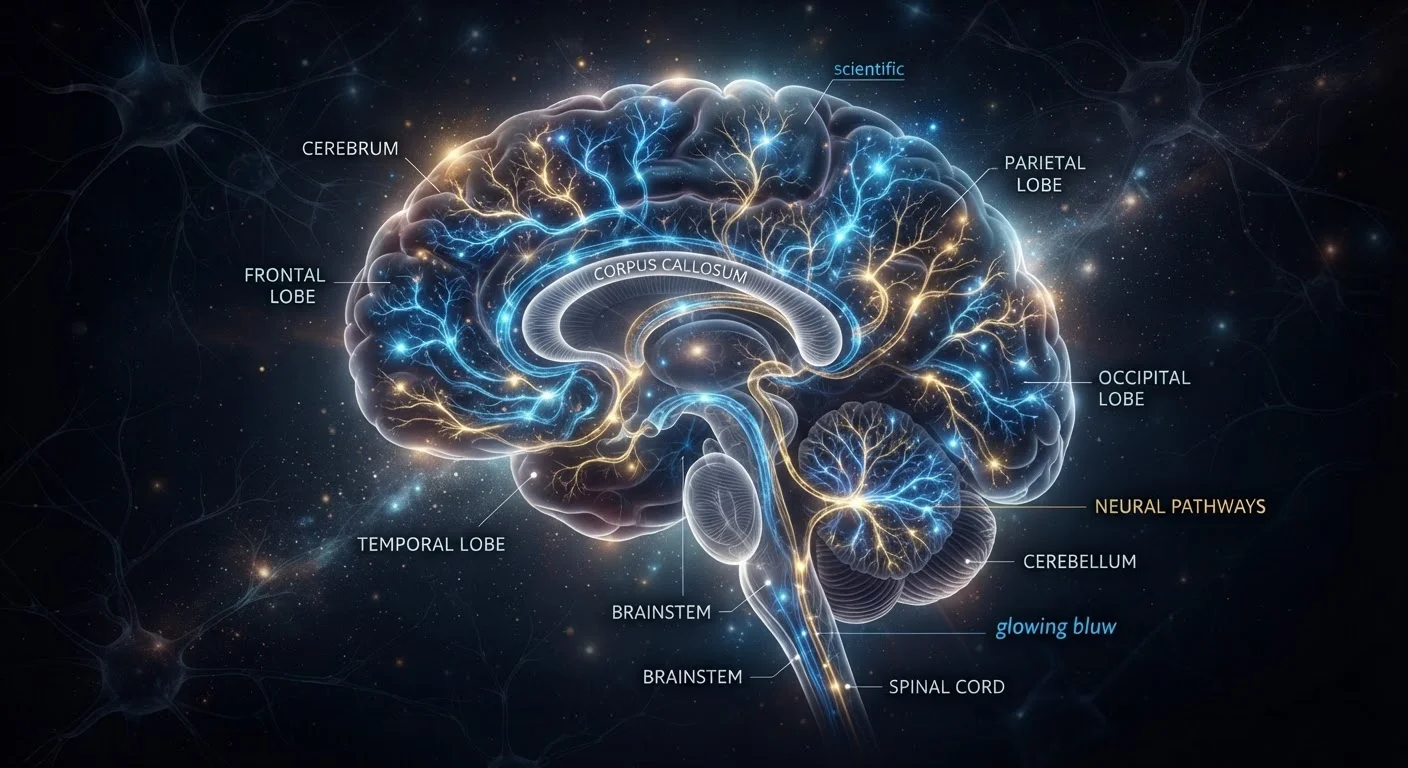
Why Brain Myths Persist - and Why They Matter
Myths about the human brain tend to be especially sticky. They often carry a surface plausibility, get amplified through popular media, and tap into something deeply appealing - the idea that we're operating below our potential, or that personality and ability are neatly sorted into biological categories. But when these myths go unexamined, they can distort how people think about learning, aging, mental health, and even personal identity.
The good news is that the actual science is more interesting than the myths. Neuroscience over the past several decades has revealed a brain that is dynamic, adaptive, and far more complex than earlier frameworks suggested. Understanding that complexity begins with clearing away what isn't true.
If myths about the mind interest you beyond biology, reading myths that everyday readers still believe follow a similar pattern of persistent misbeliefs that shape real behavior.
Myth
We only use 10% of our brains, and unlocking the rest could make us far more intelligent.
Fact
Neuroimaging studies consistently show that virtually all brain regions are active, though not all simultaneously - much like different muscle groups engage during different movements.
The 10% myth is perhaps the most durable neuroscience misconception in popular culture, appearing in self-help books, films, and advertisements. Its origin is murky - likely a misquote or misinterpretation of early psychology research - but its staying power is remarkable.
Functional MRI scans show activity across the entire brain over the course of a day. Even during sleep, large portions of the brain remain metabolically active. From an evolutionary standpoint, the brain consumes roughly 20% of the body's energy despite being about 2% of its mass. Maintaining idle neural tissue at that metabolic cost would be biologically nonsensical.
Myth
People are either "left-brained" (logical, analytical) or "right-brained" (creative, emotional) by nature.
Fact
A large-scale neuroimaging study analyzing over 1,000 brains found no evidence of individuals consistently favoring one hemisphere over the other for personality traits.
The left-brain/right-brain framework contains a kernel of truth - certain functions are lateralized, meaning they lean toward one hemisphere. Language production, for instance, is predominantly left-hemisphere in most right-handed people. But lateralization of specific functions is not the same as a person having a dominant side that shapes their entire personality or thinking style.
Research published in PLOS ONE by University of Utah scientists found that while task-specific networks activate particular regions, people do not show stronger left- or right-hemisphere networks overall. Creativity and logic both engage distributed networks spanning both hemispheres.
Myth
The adult brain is fixed and cannot generate new neurons or form meaningful new connections.
Fact
The brain exhibits neuroplasticity throughout life, and evidence suggests neurogenesis - the formation of new neurons - may continue in certain regions into adulthood.
For most of the 20th century, neuroscience held that adults were born with all the neurons they would ever have, and that loss was permanent. Research over the past few decades has fundamentally revised that view.
Neuroplasticity - the brain's ability to reorganize synaptic connections in response to learning, experience, and injury - is now well established across the lifespan. The hippocampus, a region central to memory and learning, has been a particular focus of neurogenesis research. While the degree and significance of adult neurogenesis in humans remains an active area of scientific debate, the broader principle that the adult brain retains substantial adaptive capacity is not seriously contested.
Myth
Humans can effectively multitask, processing two complex tasks at the same time.
Fact
The brain does not truly run complex tasks in parallel - it rapidly shifts attention between tasks, and each switch carries a cognitive cost.
What feels like multitasking is more accurately described as task-switching. Research in cognitive psychology consistently shows that alternating between tasks increases error rates and reduces efficiency compared with completing each task sequentially. The mental overhead of reorienting attention - sometimes called the "switch cost" - adds up significantly over time.
Simple automatic behaviors (walking while talking, for instance) can run in parallel because they draw on different neural systems. But two tasks that both demand working memory and focused attention compete for the same limited cognitive resources.
Myth
Memory works like a video recording - a reliable, fixed archive of past events.
Fact
Memory is reconstructive, not reproductive. Each time a memory is recalled, it is partially rebuilt and is susceptible to distortion, suggestion, and forgetting.
Decades of research by cognitive psychologists - including landmark work on eyewitness testimony - has demonstrated that human memory is far more malleable than intuition suggests. Recalling a memory is an active process that can subtly alter it, a phenomenon called reconsolidation.
False memories can be implanted under certain conditions, and details from post-event information frequently blend into original recollections. This has significant real-world implications, from legal testimony to how we understand our own life histories. It also doesn't mean memory is useless - rather, it is a sophisticated, adaptive system optimized for meaning rather than perfect accuracy.
What the Science Actually Supports
The corrected picture that emerges from modern neuroscience is one of a brain defined by connectivity, adaptability, and energy efficiency - not unused potential or fixed wiring. Neural networks supporting creativity, memory, and reasoning are distributed and overlapping, not neatly siloed by hemisphere or region.
Brain Health Information Is Not Medical Advice
This article is general science education, not a substitute for professional medical guidance. If you have concerns about brain health, memory, cognition, or neurological symptoms, consult a qualified healthcare professional. Early evaluation is always worthwhile when symptoms are present.
This matters practically. Understanding that memory is reconstructive, for example, can change how we evaluate our own recollections and those of others. Recognizing the limits of multitasking can lead to more effective work habits. And knowing the brain remains plastic into adulthood offers a genuinely evidence-based reason for continued learning at any age.
For a deeper look at one of the brain's most important - and often misunderstood - processes, see our companion article on what neuroscience has uncovered about the brain during sleep. And if you're curious about another frontier of brain science, the gut-brain axis explores what researchers have genuinely established about that connection - and where uncertainty remains.
Misconceptions don't only exist in neuroscience. If you're interested in how misinformation shapes other domains, persistent mental health myths examines beliefs that carry real consequences for how people seek care.
This article is for general informational and educational purposes only and does not constitute medical advice. Always consult a qualified healthcare professional regarding any concerns about neurological health or cognition.