
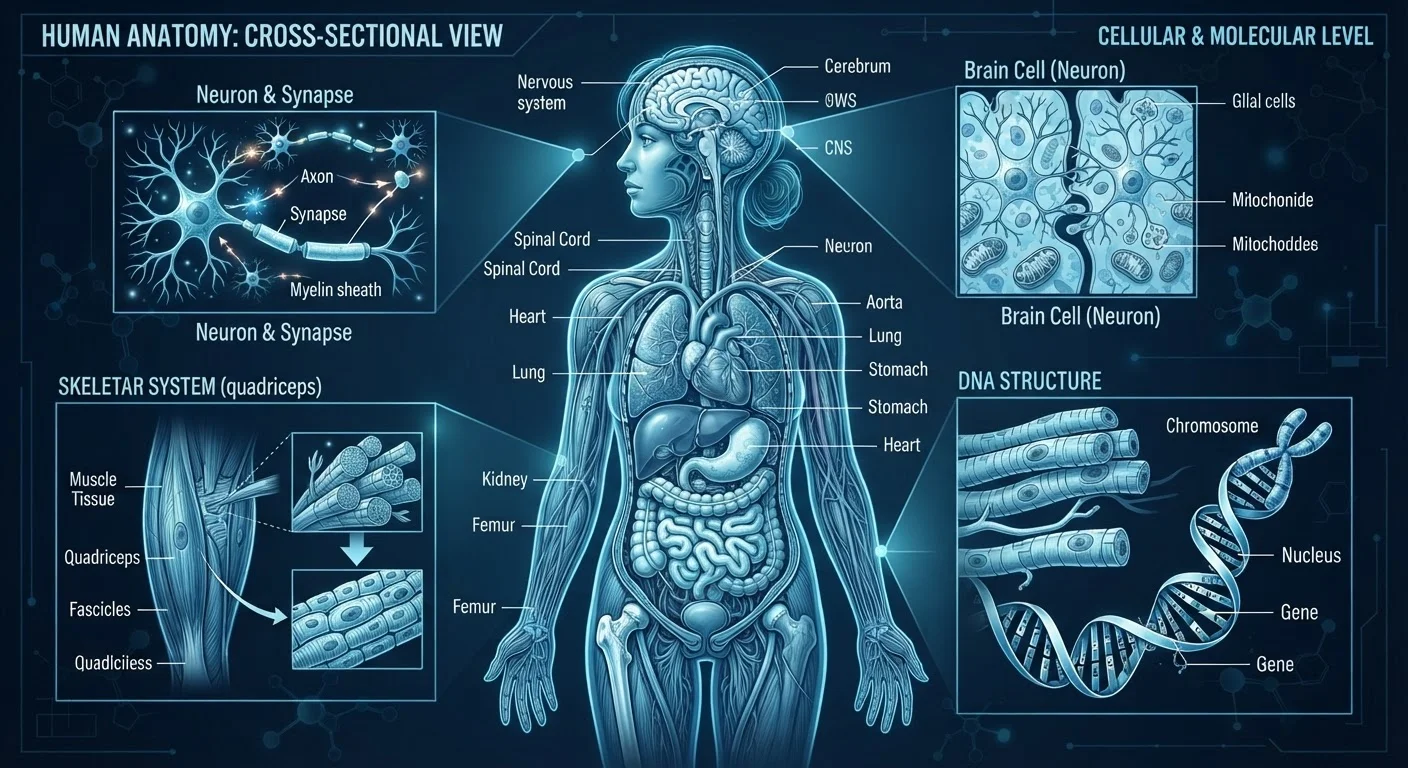
Why Biology Vocabulary Matters
Whether you're reading a health article, talking to a doctor, or trying to understand a news story about genetics, human biology vocabulary comes up constantly - and it can feel like a foreign language. This reference glossary defines the terms you're most likely to encounter, organized to build from the molecular level outward. No prior science background required.
Biology and neuroscience share considerable overlap with other fields. For instance, if you've explored nutritional terminology, you've already encountered terms like metabolism and bioavailability that originate in biology. Likewise, understanding the body's processes connects directly to topics covered in our companion piece on remarkable biological processes the body runs automatically.
ATP
Adenosine triphosphate - the molecule cells use to store and transfer energy. Nearly every biological process that requires energy runs on ATP.
Homeostasis
The body's ability to maintain a stable internal environment (temperature, pH, blood sugar) despite changes in external conditions. It is a foundational concept in physiology.
Mitosis
Cell division that produces two genetically identical daughter cells from one parent cell. It drives growth and tissue repair throughout the body.
Synapse
The junction between two nerve cells where chemical or electrical signals are transmitted. Synapses are the basic communication units of the nervous system.
Neuroplasticity
The brain's lifelong ability to reorganize neural pathways in response to learning, experience, or injury. It underpins how we learn new skills and adapt to damage.
Endocrine System
The collection of glands that produce hormones and release them into the bloodstream. It regulates metabolism, growth, reproduction, and stress response.
Neurotransmitter
A chemical messenger released at a synapse that carries signals between neurons or from neurons to muscles and glands. Examples include dopamine, serotonin, and acetylcholine.
Cortisol
A steroid hormone produced by the adrenal glands that regulates the stress response, metabolism, and immune function. Chronically elevated cortisol is linked to various health concerns.
Autonomic Nervous System
The part of the nervous system that controls involuntary functions such as heart rate, digestion, and breathing. It has two main branches: sympathetic and parasympathetic.
Genome
The complete set of genetic information in an organism, encoded in DNA. The human genome contains approximately 3 billion base pairs and roughly 20,000 protein-coding genes.
Metabolism
All the chemical reactions that occur in the body to maintain life, including breaking down nutrients for energy and building or repairing tissues.
Apoptosis
Programmed cell death - a controlled, orderly process by which the body eliminates damaged, unnecessary, or aging cells. It is essential for normal development and immune function.
Core Terms: From Molecules to Systems
Human biology operates across several scales simultaneously - from atoms and molecules, to cells and tissues, to organs and whole-body systems. The terms below are grouped loosely by that progression, though in real biology these levels are constantly interacting.
| Neurons in the human brain | ~86 billion (Azevedo et al., Journal of Comparative Neurology, 2009) |
| Human genome base pairs | ~3 billion (Human Genome Project reference sequence) |
| Protein-coding genes in the human genome | ~20,000 (Ensembl genome browser estimates) |
| Normal core body temperature (homeostasis target) | 98.6°F / 37°C (Standard physiological reference) |
| Types of neurotransmitters identified | 100+ (General neuroscience consensus) |
At the Molecular and Cellular Level
ATP (adenosine triphosphate) is the primary energy currency of the cell. When your body breaks down food, much of the released energy is stored in ATP molecules and later spent to power nearly every cellular process - from muscle contraction to protein synthesis.
Homeostasis refers to the body's tendency to maintain internal stability - keeping temperature, blood sugar, and pH within narrow, functional ranges - despite changing external conditions. Disruption of homeostasis underlies many disease states.
Mitosis is the process by which one cell divides into two genetically identical daughter cells. It underlies growth, tissue repair, and maintenance throughout life. This is distinct from meiosis, which produces reproductive cells with half the normal chromosome count.
At the Organ and System Level
The autonomic nervous system governs involuntary functions - heart rate, digestion, breathing rate, and more. It branches into the sympathetic division (associated with stress and activity) and the parasympathetic division (associated with rest and recovery).
Endocrine system refers to the network of glands that produce and secrete hormones directly into the bloodstream. The thyroid, adrenal glands, and pancreas are all part of this system, regulating everything from metabolism to stress response.
For a deeper look at how DNA fits into this biological picture, see our guide on DNA, genes, and genomes.
Neuroscience Terms You'll Actually Encounter
Neuroscience vocabulary shows up frequently in health journalism, mental wellness discussions, and everyday conversation. These definitions clarify the most commonly misused or misunderstood terms.
Neuron - the fundamental functional unit of the nervous system. Neurons transmit electrical and chemical signals throughout the brain and body. The human brain contains roughly 86 billion neurons, each forming thousands of connections.
Synapse - the junction between two neurons where information is passed. Most synapses are chemical: the sending neuron releases neurotransmitters into a gap, and the receiving neuron detects them. This is the mechanism behind much of how mood, memory, and movement are regulated.
Neuroplasticity - the brain's capacity to reorganize itself by forming new neural connections throughout life. This underlies learning and recovery from brain injury. The term is sometimes overstated in popular media, but the fundamental principle is well established in neuroscience research.
Cortisol - a hormone released by the adrenal glands in response to stress. It plays a genuine and important regulatory role, but chronically elevated cortisol is associated with negative health effects across multiple systems.
Biology vocabulary intersects meaningfully with mental health language too. Our reference on mental health terminology covers terms like cognitive distortions and burnout in the same plain-language format.
This article is for informational and educational purposes only and is not a substitute for professional medical advice. Always consult a qualified healthcare provider with questions about your health.