
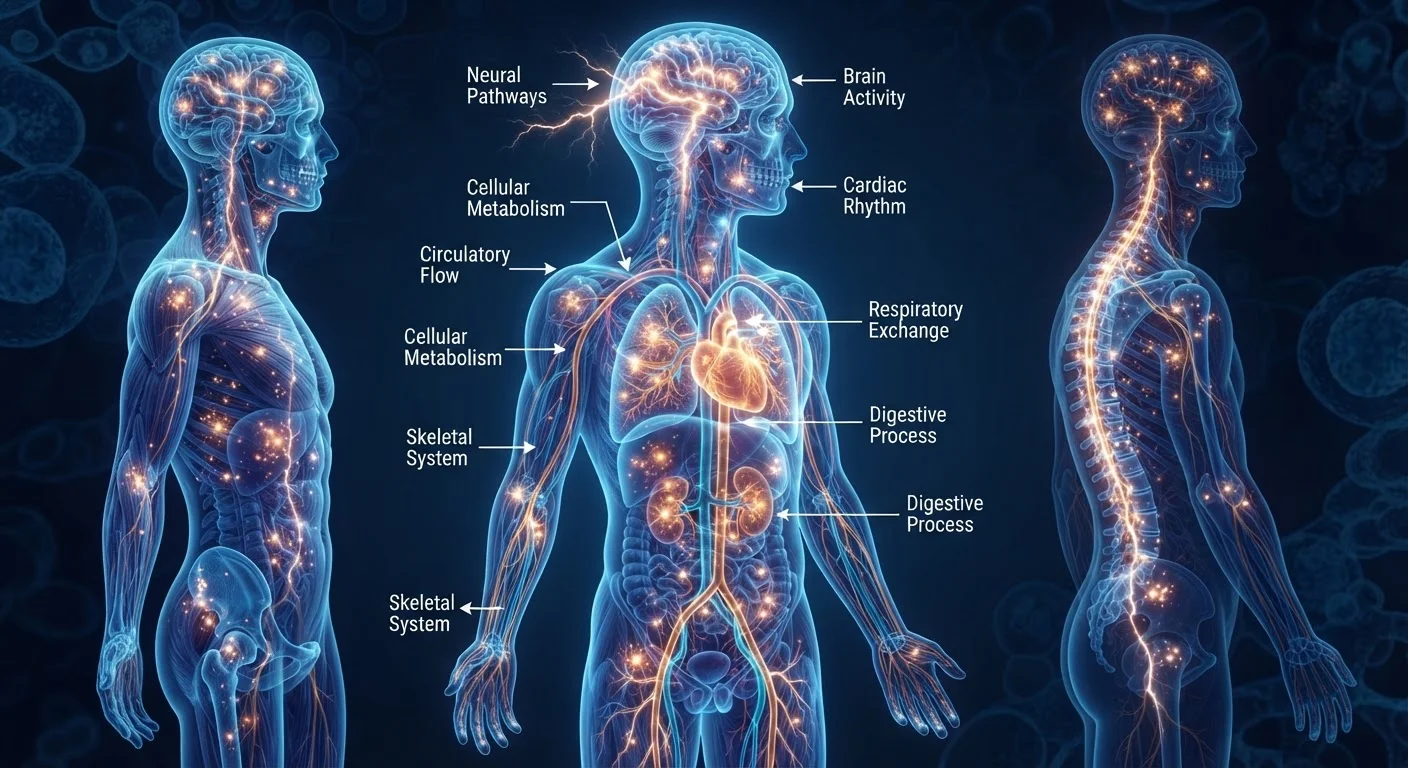
Your body is its own operating system
The human body is often described in mechanical terms - pumps, levers, electrical signals - but that framing undersells the sophistication involved. Unlike any machine, the body runs continuous, adaptive, self-correcting processes that respond to internal signals at a molecular level, all without requiring a single conscious thought from you. Most people are vaguely aware that the heart beats and the lungs breathe on autopilot. Far fewer appreciate the depth of what else is happening - processes that have been refined across hundreds of millions of years of evolution and that remain active every second of your life.
The seven processes below represent some of the most consequential and least discussed. Understanding them won't change how they work - they'll run regardless - but it will change how you think about the extraordinary biology you carry.
This article is general health information
The biological processes described here are presented for educational purposes only and do not constitute medical advice. If you have concerns about any health condition, symptom, or bodily function, please consult a qualified healthcare professional. Do not use this content to self-diagnose or self-treat.
Seven processes running right now
Apoptosis - the body's built-in self-destruct system
Every day, somewhere between 50 and 70 billion cells in the human body deliberately destroy themselves. This programmed cell death, called apoptosis, is not a sign of damage - it is essential maintenance. Cells that have served their purpose, accumulated DNA errors, or become potentially cancerous are systematically dismantled from within, their components recycled for reuse.
The process involves a cascade of proteins called caspases that essentially disassemble the cell in an orderly fashion, preventing the kind of inflammatory debris that uncontrolled cell death would cause. Without apoptosis, the risk of unchecked cell proliferation - a hallmark of cancer - would be significantly higher.
Billions of cells deliberately destroy themselves daily to keep the body safe and functional.
Autophagy - cellular housekeeping at the molecular level
Autophagy (from the Greek for "self-eating") is the process by which cells break down and recycle their own damaged or dysfunctional components. Think of it as an internal waste management and parts-salvage operation running continuously inside virtually every cell in your body.
Specialized structures called autophagosomes engulf broken proteins, worn-out organelles, and microbial invaders, delivering them to lysosomes for digestion. Research has linked impaired autophagy to neurodegenerative diseases, metabolic disorders, and accelerated aging - underscoring just how critical this invisible housekeeping is to long-term health.
Autophagy recycles damaged cellular components, and its impairment is linked to neurodegenerative disease.
Thermoregulation - precision temperature control
The human body maintains a core temperature within a remarkably narrow range - roughly 97°F to 99°F - regardless of whether you are standing in a Minnesota winter or a Phoenix summer. This continuous balancing act is called thermoregulation, and it involves the hypothalamus acting as a biological thermostat.
When body temperature rises, blood vessels near the skin dilate and sweat glands activate. When it drops, muscles shiver to generate heat and blood is redirected toward core organs. This system operates entirely below conscious awareness, making thousands of micro-adjustments per hour.
The hypothalamus makes thousands of unconscious temperature adjustments every hour to protect core organs.
The glymphatic system - overnight brain waste clearance
Discovered only in the early 2010s, the glymphatic system is the brain's dedicated waste-clearance network. During sleep, cerebrospinal fluid is pumped through channels surrounding blood vessels in the brain, flushing out metabolic byproducts - including amyloid-beta proteins associated with Alzheimer's disease.
The system is dramatically more active during sleep than during waking hours, which helps explain why chronic sleep deprivation has been linked in research to elevated levels of these potentially harmful proteins. For more on what the brain does while you rest, see what neuroscience has uncovered about the sleeping brain.
The glymphatic system flushes neurotoxic waste from the brain primarily during sleep.
Interoception - sensing the body from the inside
Interoception refers to the nervous system's ability to sense internal body states - hunger, thirst, heartbeat, bladder fullness, and even subtle shifts in blood chemistry. Unlike the five classical senses, interoception turns perception inward, using a dense network of sensory neurons to relay information from organs to the brain.
Research in neuroscience suggests interoceptive signals play a significant role in emotional regulation, decision-making, and overall wellbeing. The feeling of anxiety often has a measurable physiological substrate - elevated heart rate, gut motility changes - that the brain interprets and labels as an emotion.
Interoception connects organ-level physiology to emotion, influencing how we feel and decide.
DNA repair - constant correction of genetic errors
Every cell in your body experiences thousands of DNA lesions - breaks, mismatches, and chemical modifications - each day, caused by metabolic byproducts, UV exposure, and random replication errors. Remarkably, specialized enzyme systems detect and repair the vast majority of these errors before they can propagate.
Multiple distinct repair pathways exist, each targeting different types of damage: base excision repair, nucleotide excision repair, and double-strand break repair, among others. When these systems are inherited in a compromised form, cancer risk rises substantially - illustrating just how much silent protective work they perform in healthy individuals. If you'd like a plain-language explanation of these and other biological terms, the human biology reference glossary offers clear definitions.
Enzyme systems silently repair thousands of DNA errors in every cell, every single day.
Gut motility - the coordinated movement of digestion
The digestive tract moves food and waste through roughly 25 feet of tubing using coordinated muscular contractions called peristalsis. This process is governed largely by the enteric nervous system - sometimes called the "second brain" - a network of more than 500 million neurons embedded in the gut wall that operates largely independently of the central nervous system.
Gut motility regulates how nutrients are absorbed, how quickly waste is eliminated, and even influences immune function, since roughly 70% of immune cells reside in the gut-associated lymphoid tissue. Disruptions to motility underlie many gastrointestinal conditions, making this invisible choreography far more consequential than most people realize.
The enteric nervous system controls digestion independently, housing over 500 million neurons in the gut wall.
Why these processes matter beyond the science
None of these processes require your participation - but many of them are influenced by the choices you make. Sleep quality affects the glymphatic system's ability to clear neurotoxic waste. Chronic stress can impair apoptosis and autophagy. Hydration and dietary patterns influence gut motility and the enteric nervous system. The biology is autonomous; the conditions you create for it are not.
The takeaway isn't a prescription - it's a perspective shift. Your body is not simply responding to your lived experience; it is actively working, repairing, and regulating itself in ways science is still uncovering. Recognizing that complexity is a reasonable place to start.
This article provides general educational information about human biology and is not intended as medical advice. Always consult a qualified healthcare professional for guidance on personal health concerns.