Why the Confusion Exists
Open any science headline and you will find DNA, genes, and genomes used almost interchangeably. A story about cancer research might say scientists "identified the DNA responsible," while another frames the same discovery as a "gene mutation" or a "genomic breakthrough." Each phrasing points at a real concept - but they are not synonyms.
The confusion is understandable. All three terms refer to parts of the same biological system, and in casual conversation the distinctions rarely matter. In the context of understanding medical research, evolutionary biology, or genetic testing, however, each term has a precise meaning that changes what a finding actually tells you.
This guide untangles all three from the ground up - no prior biology required. For a similar plain-language approach applied to another scientific field, see our human biology reference glossary, which covers terms from ATP to synapses in accessible language.
What DNA Actually Is
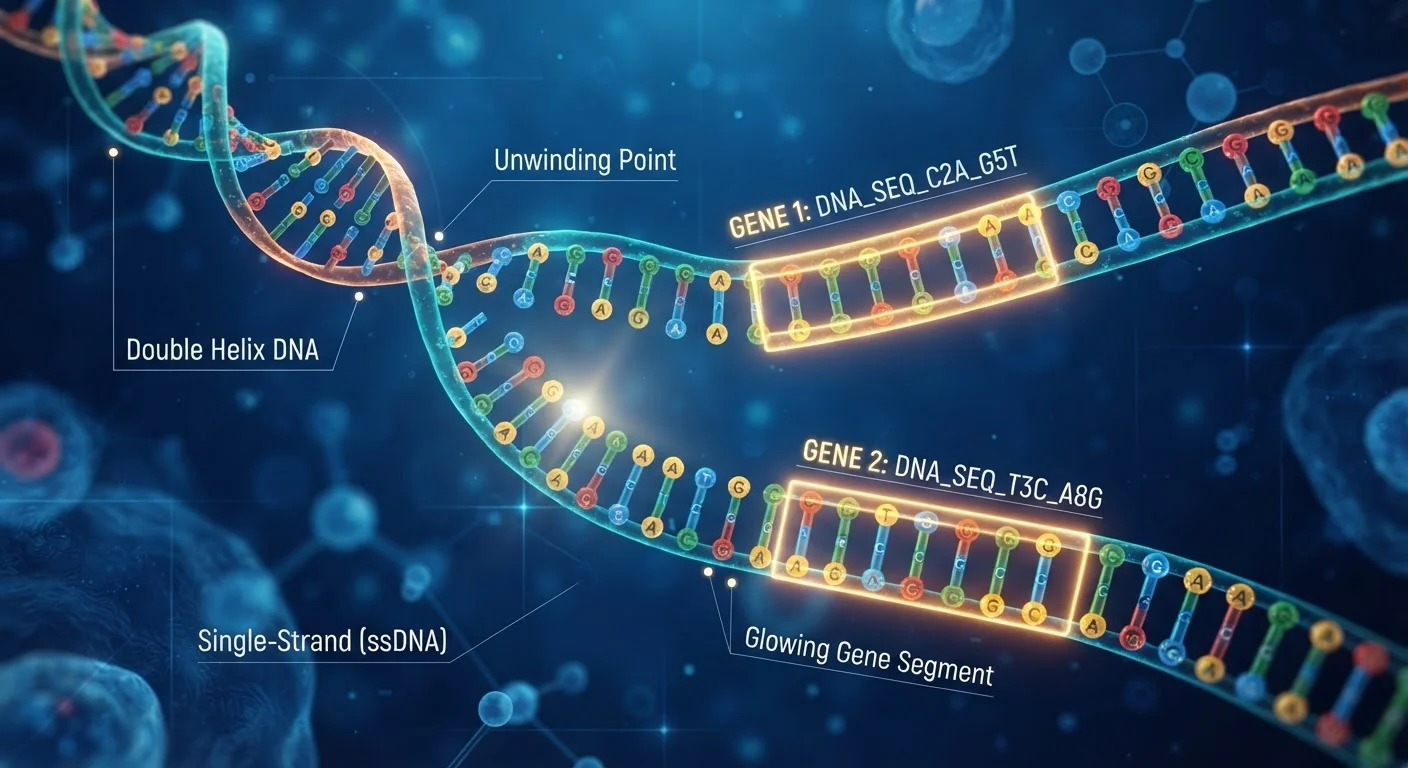
DNA - deoxyribonucleic acid - is a molecule. Specifically, it is a long, double-stranded molecule shaped like a twisted ladder, the now-famous double helix described by Watson, Crick, Franklin, and Wilkins in the 1950s. The rungs of that ladder are pairs of chemical units called nucleotide bases, and there are only four of them: adenine (A), thymine (T), guanine (G), and cytosine (C).
Every biological instruction your body uses - how to build a protein, when to trigger cell division, how to repair damage - is ultimately encoded in the sequence of these four bases. In a human cell, the full DNA strand contains roughly 3 billion base pairs. That entire length is coiled tightly around proteins called histones and packed into chromosomes, which are housed inside the cell's nucleus.
Nucleotide base
One of four chemical units (A, T, G, C) that make up the rungs of the DNA ladder. Their sequence encodes all biological information.
Double helix
The twisted-ladder shape of the DNA molecule, formed by two complementary strands wound around each other.
Chromosome
A tightly coiled package of DNA and protein found in the cell nucleus. Humans have 46 chromosomes arranged in 23 pairs.
Protein-coding gene
A segment of DNA that provides instructions for building a specific protein - the functional molecules that carry out most biological tasks.
Non-coding DNA
DNA sequences that do not encode proteins but often serve regulatory, structural, or other functions that researchers are still characterizing.
Epigenetics
The study of changes in gene expression that do not alter the DNA sequence itself, often involving chemical tags added to DNA or its associated proteins.
It helps to think of DNA as a very long text written in a four-letter alphabet. The molecule itself is chemically unremarkable - what matters is the order of the letters.
What a Gene Is - and Is Not
A gene is a specific, functional segment of the DNA molecule. If DNA is the entire text of an encyclopedia, a gene is one entry - a defined stretch of sequence that carries instructions for a particular task, most commonly the production of a specific protein.
Proteins do almost everything in biology: they form structures (like collagen in skin), catalyze chemical reactions (enzymes), carry signals (like insulin), and defend the body (antibodies). A gene for hemoglobin, for instance, encodes instructions that cells in bone marrow use to manufacture the protein that carries oxygen in red blood cells.
Critically, genes account for only a fraction of total DNA. Current research estimates that protein-coding genes make up roughly 1-2% of the human genome. This surprised scientists when it was first confirmed, leading to decades of investigation into what the rest of the genome actually does - a question still being actively answered.
A Practical Way to Remember the Difference
Try this shorthand: DNA is the medium, genes are the messages, and the genome is the entire library. Whenever a headline uses one of these terms, ask yourself which level of the biological system is actually being described - that single question will sharpen your reading of most science news.
It is also worth noting that the word "gene" is itself contested in modern biology. Researchers debate whether to count only protein-coding sequences, or also include segments that produce functional RNA molecules without ever making a protein. The working definition has evolved substantially over the past two decades.
The Genome: The Full Picture
The genome is the totality - every single base pair of DNA an organism carries, in every chromosome. For humans, that means approximately 3.2 billion base pairs organized across 23 pairs of chromosomes, all present in nearly every cell of the body.
The genome includes genes, but it is far larger than the sum of its genes. The non-gene portions include regulatory sequences that control when genes switch on or off, structural elements that organize chromosomes, sequences copied from ancient viral infections, and large stretches whose function is still being characterized. Calling all of this "non-coding junk" - a term that was popular in earlier decades - has proven to be an oversimplification. Projects like ENCODE (Encyclopedia of DNA Elements) have shown that a substantial portion of the genome is biochemically active in ways researchers are still mapping.
Different organisms have vastly different genome sizes, and larger genomes do not necessarily mean more complexity. Some ferns carry genomes many times larger than the human genome, a puzzle biologists call the C-value paradox.
How the Three Relate to Each Other
The relationship is one of scale and nesting. DNA is the molecule. Genes are functional segments within that molecule. The genome is the complete collection of all DNA - genes and everything else - in a given organism.
A useful analogy: imagine the genome as an entire city's worth of text - every book, document, and sign. DNA is the paper all of it is printed on. Genes are the specific paragraphs that contain operational instructions. The rest of the text may consist of formatting codes, historical archives, and passages whose purpose is only now being decoded.
When a headline reports that scientists "found a gene linked to" a disease, it means they identified a specific segment of DNA whose sequence variant correlates with increased risk. When it says researchers "sequenced the genome" of a species, it means they determined the order of every base pair across the entire DNA complement - a feat that took over a decade and billions of dollars for the first human genome, and now takes hours with modern sequencing technology.
Understanding these distinctions makes science reporting significantly more interpretable. Just as knowing the difference between a nutrient and a calorie changes how you read food labels - see our guide to common nutritional terms for that kind of plain-language breakdown - knowing the difference between a gene and a genome changes how you read a genetics study.