What Sets These Two Families Apart
Every cooking technique - from a five-minute sauté to a six-hour braise - transfers heat to food through one of two mechanisms. Dry heat methods rely on hot air, direct flame, or fat to cook food without added water. Moist heat methods use water, broth, steam, or another liquid as the heat-carrying medium. That single distinction shapes everything: texture, color, flavor, and which cuts of meat or vegetables make sense to use.
If you've ever wondered why a pot roast falls apart while a grilled steak stays firm, or why bread gets a crust while steamed dumplings stay soft, the answer lies in this foundational divide. For a broader reference on cooking vocabulary, see our plain-language glossary of essential cooking terms.
Dry Heat: Browning, Crunch, and Concentration
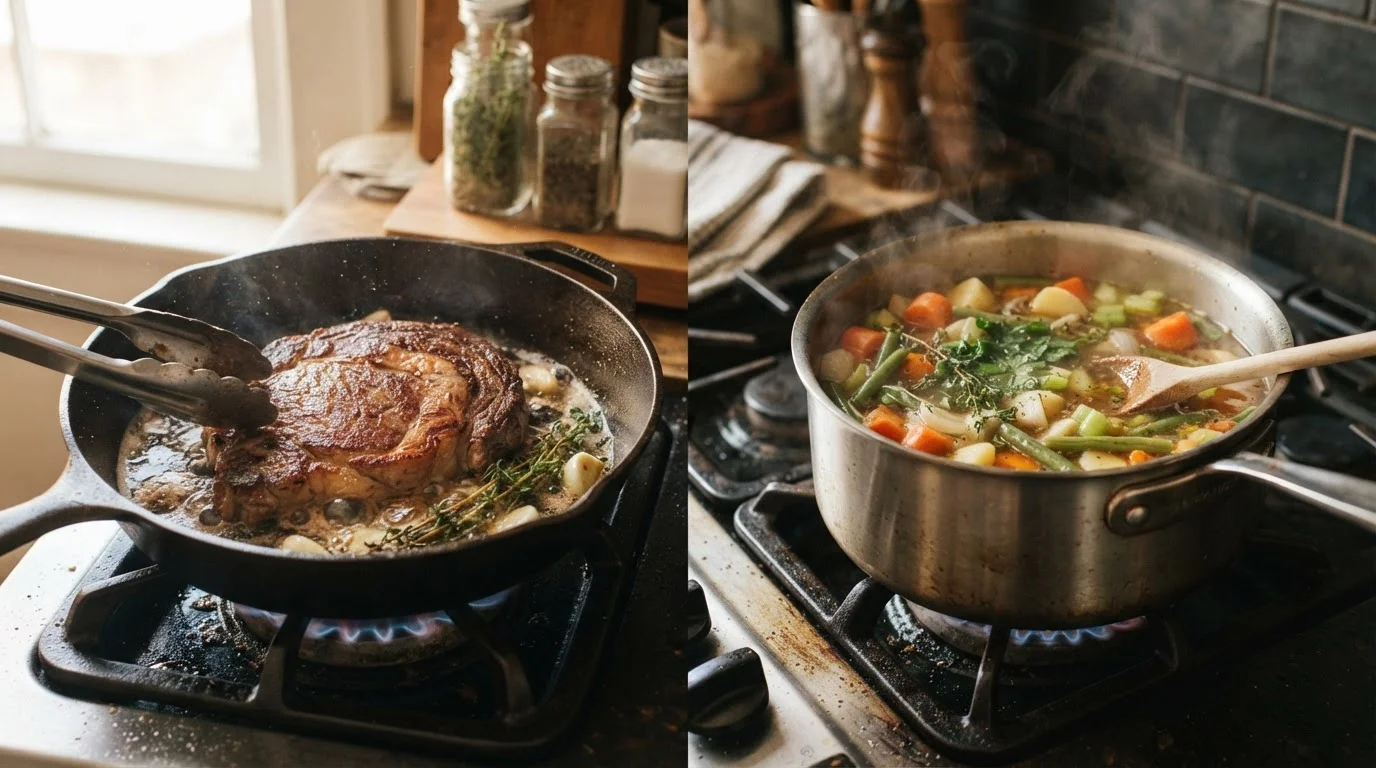
Dry heat methods work at high temperatures - typically above 300°F - and they trigger a chemical process called the Maillard reaction, where proteins and sugars on the food's surface react to form hundreds of new flavor compounds. The result is the golden crust on a seared steak, the toasted exterior of roasted vegetables, and the crackling skin on a roast chicken. No liquid, no browning.
Common dry heat techniques include:
- Roasting and baking - surrounding food with dry, hot oven air
- Grilling and broiling - using direct radiant heat from flame or an element
- Sautéing and pan-frying - cooking in a small amount of hot fat in direct contact with a pan
- Deep frying - submerging food in hot oil (fat conducts heat efficiently without adding moisture)
Dry heat generally works best with naturally tender cuts of meat, fish fillets, most vegetables, and dough. Because moisture evaporates during cooking, flavors concentrate and surfaces crisp. Pan temperature plays a critical role in dry heat cooking - too low and you steam rather than sear.
| Dry Heat | Moist Heat | |
|---|---|---|
| Heat medium | Air, fat, or direct flame | Water, broth, or steam |
| Typical temperature range | 300°F-500°F+ | Up to 212°F |
| Surface browning | Yes - Maillard reaction occurs | No - liquid prevents browning |
| Best for | Tender cuts, vegetables, dough | Tough, collagen-rich cuts |
| Texture outcome | Crisp, firm, concentrated | Soft, silky, tender |
| Common techniques | Roasting, grilling, sautéing | Braising, steaming, poaching |
| Speed | Often faster at high heat | Usually slower, low-and-slow |
Moist Heat: Tenderness and Depth of Flavor
Moist heat methods cook food at or below the boiling point of water - 212°F at sea level - which is significantly lower than most dry heat environments. That lower temperature ceiling is actually an advantage when working with tough, collagen-rich cuts. Over time, the collagen in connective tissue converts to gelatin, producing that characteristic fall-off-the-bone tenderness you get from braised short ribs or a slow-simmered stew.
Common moist heat techniques include:
- Boiling and simmering - submerging food directly in liquid at high or moderate heat
- Steaming - cooking with vapor rising from boiling water, without direct contact
- Braising - partially submerging food in liquid in a covered pot, often after an initial sear
- Poaching - gently cooking delicate foods (eggs, fish) in barely simmering liquid
Moist heat is forgiving and hard to rush - it's the foundation of soups, stews, beans, grains, and many slow-cooked dishes. One trade-off: you won't get surface browning through liquid alone, which is why many recipes sear first, then braise.
Choosing the Right Method for Your Ingredient
The most practical way to apply this knowledge is to start with the ingredient and work backward. Ask two questions: Is this cut or item naturally tender or tough? And Do I want a browned exterior or a soft texture?
Tender proteins - chicken breast, fish, pork tenderloin, most vegetables - respond well to dry heat. They cook quickly and benefit from caramelization. Tougher cuts - chuck roast, lamb shoulder, pork belly - contain more connective tissue and need the slow, low, moist environment of braising or simmering to become palatable.
Many great dishes use both methods in sequence. Searing a pot roast in a hot, dry pan before adding liquid is a classic combination: you get browning (dry heat) and tenderness (moist heat) in the same dish. After cooking with dry heat, it's worth knowing why resting your meat matters before slicing - the carry-over cooking process applies primarily to dry heat methods.
Once you understand these two families, you'll start reading recipes differently - not as rigid instructions, but as a set of choices you can evaluate and adapt based on what you have and what result you want.
This article is for general informational and educational purposes only and is not a substitute for professional culinary training or personalized dietary guidance.