Space Is Not a Highway
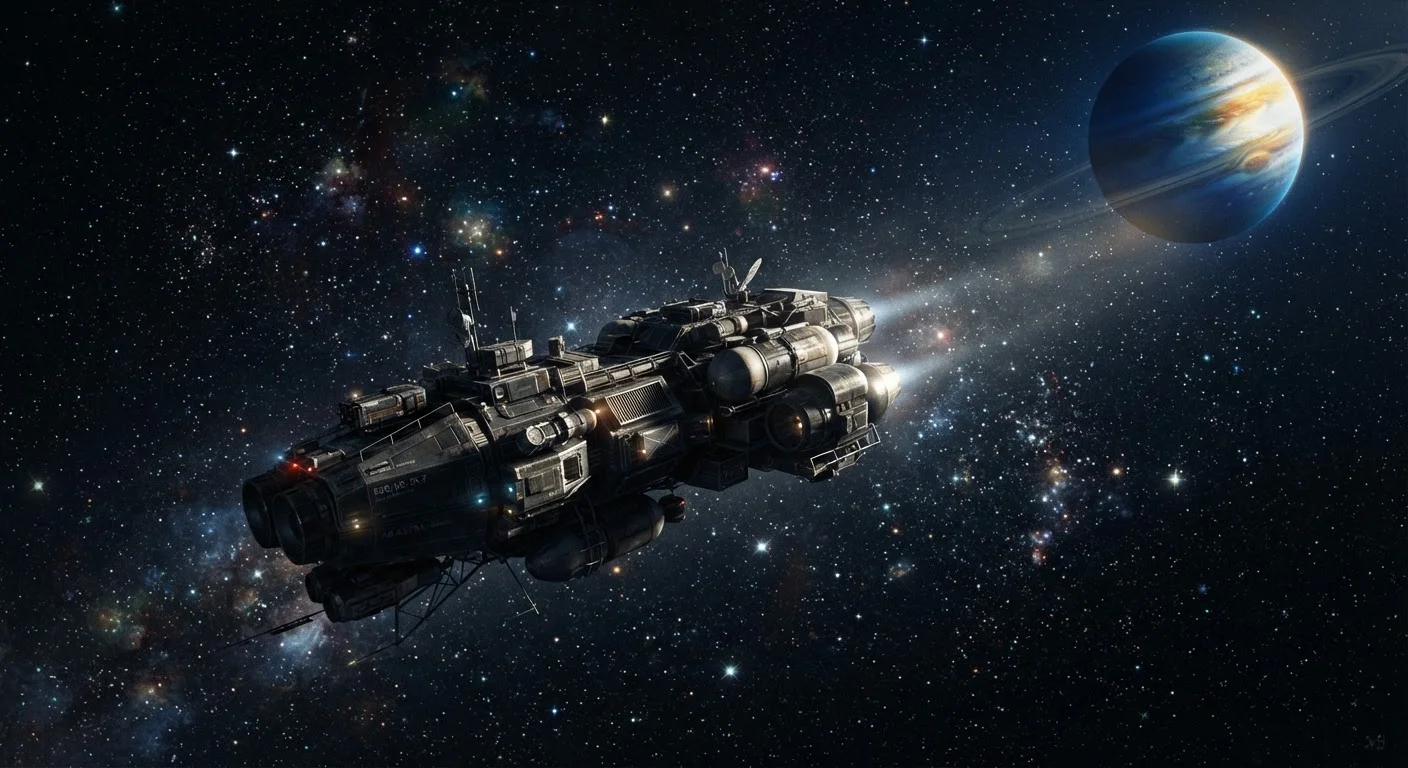
When people picture a spacecraft heading to Mars or Jupiter, many imagine something like a car trip - point in the right direction, press the accelerator, and drive. In reality, space travel is governed by a completely different set of rules. Everything in the solar system is in constant motion, orbiting the Sun at different speeds, and a spacecraft released from Earth immediately becomes a small object in its own orbit as well.
This means mission planners cannot aim at where a planet currently sits. They must calculate where that planet will be when the spacecraft finally arrives - sometimes years later. The result is a curved, arcing path that follows the geometry of orbital mechanics rather than human intuition about straight lines.
Understanding this is the key to understanding why even our most powerful rockets still require years to reach the outer planets - and why that timeline is unlikely to shrink dramatically without revolutionary new propulsion technology.
The Tyranny of Fuel
The single greatest constraint on space travel speed is propellant. Every kilogram of fuel a spacecraft carries requires additional fuel to accelerate that fuel off Earth - a compounding problem known as the Tsiolkovsky rocket equation. This mathematical reality means there is a hard practical ceiling on how much propellant any mission can carry.
Because of this, engineers favor trajectories that minimize fuel use over those that minimize travel time. The most common approach is the Hohmann transfer orbit - an elliptical path that intersects the orbit of the destination planet at exactly the right moment. It is not the fastest route mathematically possible, but it is the most fuel-efficient one available with current chemical propulsion technology.
Choosing a faster trajectory would require exponentially more fuel, increasing the spacecraft's launch mass beyond what existing rockets can lift. This is why both government agencies and private spaceflight programs continue to invest heavily in advanced propulsion research - the fuel problem is the central bottleneck of deep space exploration.
How Mission Planners Think About Speed
When evaluating a trajectory, mission designers weigh travel time against fuel cost, launch mass, and the spacecraft's arrival speed. Arriving too fast can make orbital insertion impossible without more fuel to slow down. The optimal trajectory balances all these factors, not just getting there quickly.
Gravity Assists: Free Speed With a Catch
One of the most elegant tools in mission planning is the gravity assist, sometimes called a gravitational slingshot. By flying close to a planet, a spacecraft can steal a tiny amount of the planet's orbital energy, dramatically changing its own speed and direction - all without burning a drop of fuel.
NASA's Voyager missions used this technique brilliantly, swinging past Jupiter and Saturn to gain the velocity needed to escape the solar system entirely. The New Horizons probe, which reached Pluto, used a Jupiter flyby to shave years off its journey.
The catch is that flying toward an assisting planet often means traveling away from the ultimate destination first. The path becomes longer and more complex. A mission that uses multiple gravity assists may travel billions of additional miles compared to a direct route. The Cassini spacecraft, for example, took nearly seven years to reach Saturn partly because its trajectory looped past Venus twice and Earth once before heading outward.
~8 min
Light travel time from Sun to Earth
This baseline illustrates the minimum electromagnetic travel time across one astronomical unit - the fundamental unit of solar system distance.
26 months
Time between Mars launch windows
Earth and Mars align for efficient transfer orbits approximately every 26 months, making missed launch windows costly for mission schedules.
22+ hours
One-way signal travel time to Voyager 1
As of recent measurements, radio signals traveling at the speed of light take more than 22 hours to reach the Voyager 1 probe from Earth.
~7 years
Cassini's travel time to Saturn
The Cassini spacecraft, launched in 1997, required nearly seven years and multiple planetary gravity assists to reach Saturn's orbit.
The Launch Window Problem
Space missions cannot depart on any given day. The positions of Earth and the target body must align within a specific range for the chosen transfer orbit to work efficiently. These alignment periods - called launch windows - can be as narrow as a few weeks and repeat only when the orbital geometry repeats.
For Mars, favorable launch windows occur roughly every 26 months. Miss a window, and the next mission opportunity is more than two years away. For more distant destinations like Jupiter or Neptune, windows may be far rarer and shaped by even more complex multi-planet alignments.
This constraint also means that when a mission is delayed - by engineering problems, funding gaps, or weather - the entire timeline can shift dramatically. A two-week launch delay might not just mean a two-week-later arrival; it could mean waiting for the next window and arriving years behind the original schedule.
The Scale That Defies Intuition
Perhaps the most important thing to understand about interplanetary distances is that human intuition is simply not equipped to grasp them. Light - the fastest thing in the universe - takes about eight minutes to travel from the Sun to Earth. It takes roughly 43 minutes to reach Jupiter and more than four hours to reach Neptune.
Radio signals from the Voyager 1 probe, now more than 15 billion miles from Earth, take over 22 hours to arrive. A spacecraft traveling at 40,000 miles per hour - far faster than any crewed vehicle ever flown - would still take tens of thousands of years to reach the nearest star system.
Within our own solar system, current chemical rockets are genuinely impressive engineering achievements. But the distances involved mean that even optimized trajectories and gravity assists cannot reduce travel times to the kind of timescales humans find comfortable. That reality drives ongoing research into ion drives, nuclear propulsion, and solar sails - technologies that could one day reshape what's possible in deep space exploration.