Why Black Hole Myths Are So Persistent
Black holes sit at the intersection of everything our intuitions struggle with: invisibility, extreme gravity, warped time, and distances almost too vast to comprehend. That makes them fertile ground for misconceptions, some of which have lodged themselves even in the minds of otherwise scientifically literate people. Pop culture, loose analogies, and simplified textbook descriptions all share some of the blame.
Correcting these myths isn't just academic housekeeping. Understanding what black holes actually are - and how they actually behave - reveals some of the most astonishing truths modern physics has uncovered. Much like the persistent myths about the human brain, black hole misconceptions tend to survive because the real science sounds almost as strange as the fiction.
Myth
Black holes act like cosmic vacuum cleaners, sucking in everything around them.
Fact
Black holes attract matter through gravity exactly as any other massive object does - they do not generate suction.
The word "sucking" implies a pressure difference drawing material inward, like a vacuum cleaner. Gravity does not work that way. A black hole's gravitational pull follows the same inverse-square law as the Sun or Earth. Objects only fall in if they venture close enough to lose the orbital energy needed to stay in a stable path. Distant stars and gas clouds orbit supermassive black holes at galactic centers quite safely, the same way Earth orbits the Sun.
Myth
If the Sun were replaced by a black hole of the same mass, Earth would be pulled in immediately.
Fact
Earth's orbit would remain essentially unchanged because the gravitational force at that distance would be identical.
Gravity depends on mass and distance - not on whether an object is a star or a black hole. A black hole with the Sun's mass would exert exactly the same gravitational pull on Earth at 93 million miles as the Sun does today. Earth would continue orbiting at roughly the same path. The planet would, of course, become extremely cold without solar radiation, but it would not spiral inward.
Myth
Black holes are holes - empty gaps or tunnels in the fabric of space.
Fact
Black holes are extraordinarily dense concentrations of matter, not empty regions of space.
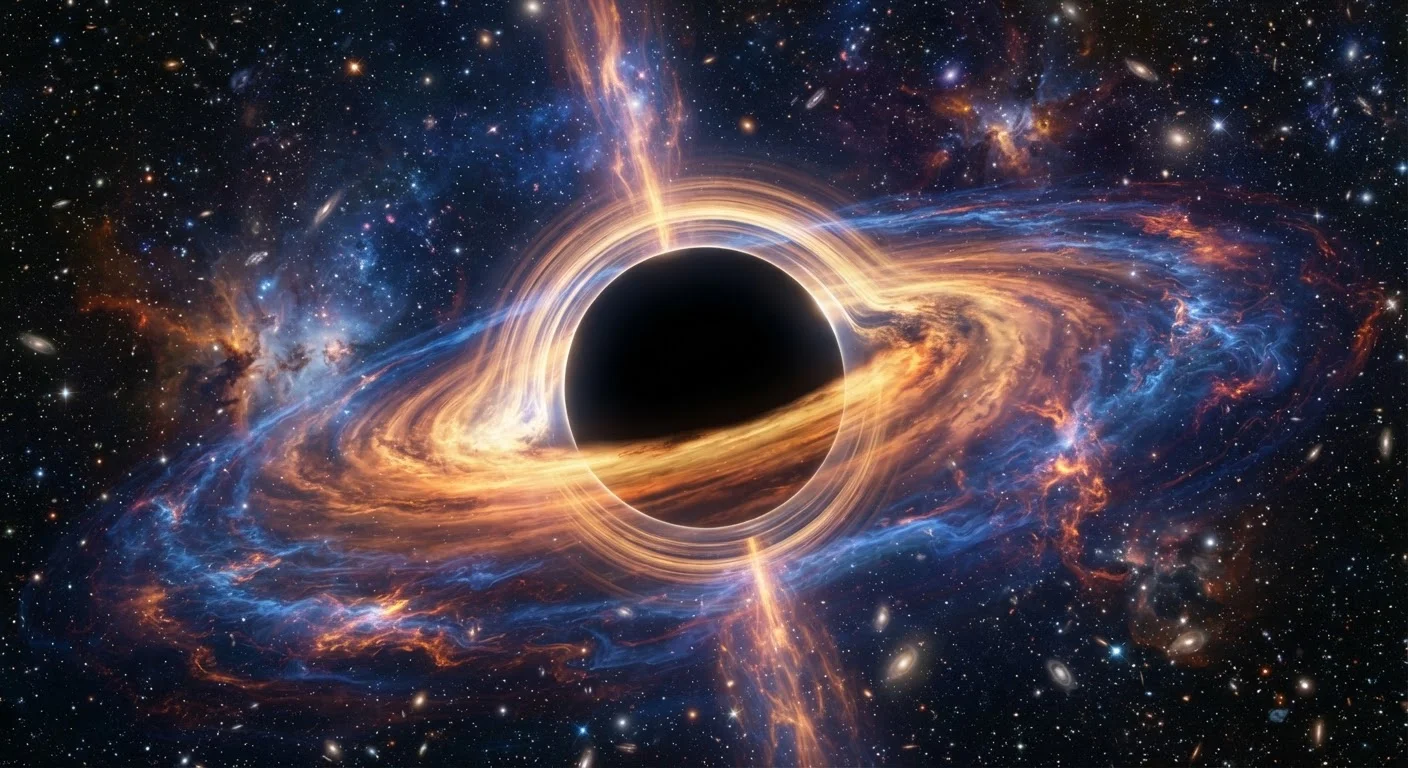
The term "hole" is misleading. A black hole forms when a sufficient mass collapses into a small enough volume that its escape velocity exceeds the speed of light. The matter doesn't vanish - it is compressed, likely into an extreme singularity at the center. The "hole" aspect refers to the event horizon, the boundary beyond which light cannot escape, making the region appear dark. Inside is not emptiness; it is a region where the known laws of physics break down under conditions of near-infinite density.
Myth
Nothing - not even time - behaves differently near a black hole.
Fact
Time measurably slows in stronger gravitational fields, a phenomenon called gravitational time dilation confirmed by experiment.
General relativity predicts, and experiments confirm, that clocks in stronger gravitational fields tick slower relative to those in weaker fields. Near a black hole's event horizon, this effect becomes extreme. An observer far away would watch a clock falling toward the horizon appear to slow and eventually freeze at the horizon - though the infalling observer would experience time normally. This is not science fiction; atomic clocks on Earth's surface run slightly slower than those in orbit due to Earth's comparatively mild gravity, a discrepancy that GPS systems correct for continuously.
Myth
Once something falls into a black hole, its information is gone forever.
Fact
Most theoretical physicists now believe information is preserved, though precisely how remains an open and actively debated question.
The black hole information paradox - whether quantum information is destroyed when matter crosses the event horizon - has been one of the most contested problems in physics for decades. Hawking radiation, the theoretical process by which black holes slowly lose mass over time, raises the possibility that information leaks back out in encoded form. Research since the 1990s, including work on holographic principles and quantum entanglement, has increasingly supported information preservation, though a complete, consensus proof does not yet exist.
What the Science Actually Tells Us
Modern astrophysics has refined our picture of black holes dramatically, particularly following the first direct image of a black hole captured by the Event Horizon Telescope collaboration in 2019. That image - showing the supermassive black hole at the center of galaxy M87 - confirmed predictions from general relativity with striking precision.
One of the most counterintuitive validated predictions is gravitational time dilation. Clocks closer to a black hole's event horizon run measurably slower relative to clocks farther away. This is not a thought experiment - it is a quantifiable, tested consequence of Einstein's equations that GPS satellite systems must already account for at far milder gravitational gradients.
6.5 billion
Solar masses of M87's central black hole
The Event Horizon Telescope collaboration published this mass estimate in 2019, based on the first direct image of a black hole's shadow.
10⁶⁷ years
Estimated evaporation time for a stellar-mass black hole
Theoretical calculations based on Hawking radiation suggest stellar-mass black holes would take far longer than the current age of the universe to evaporate completely.
4 million
Solar masses of the Milky Way's central black hole
Sagittarius A*, the supermassive black hole at the center of our galaxy, was directly imaged by the Event Horizon Telescope collaboration in 2022.
The most actively debated frontier involves what happens to information that crosses the event horizon - the so-called black hole information paradox. Stephen Hawking's theoretical work in the 1970s demonstrated that black holes gradually emit radiation and lose mass over enormous timescales. Whether the information encoded in matter that falls in is truly lost or is somehow preserved in that outgoing radiation remains one of the deepest unsolved problems in theoretical physics. The consensus is shifting toward preservation, but the mechanism is not yet fully understood.
Science, of course, thrives on exactly this kind of productive uncertainty. Just as reading myths persist because they feel intuitive, black hole myths endure because the corrections require us to trust equations over instinct. The equations, in this case, are worth trusting.