
How Forests Store and Release Carbon
Forests are not simply collections of trees - they are complex carbon reservoirs. Through photosynthesis, trees pull carbon dioxide (CO₂) from the atmosphere and lock it into wood, roots, leaf litter, and soil. A mature tropical forest can store upward of 200 tonnes of carbon per hectare, with a significant portion held in the soil itself rather than in living biomass.
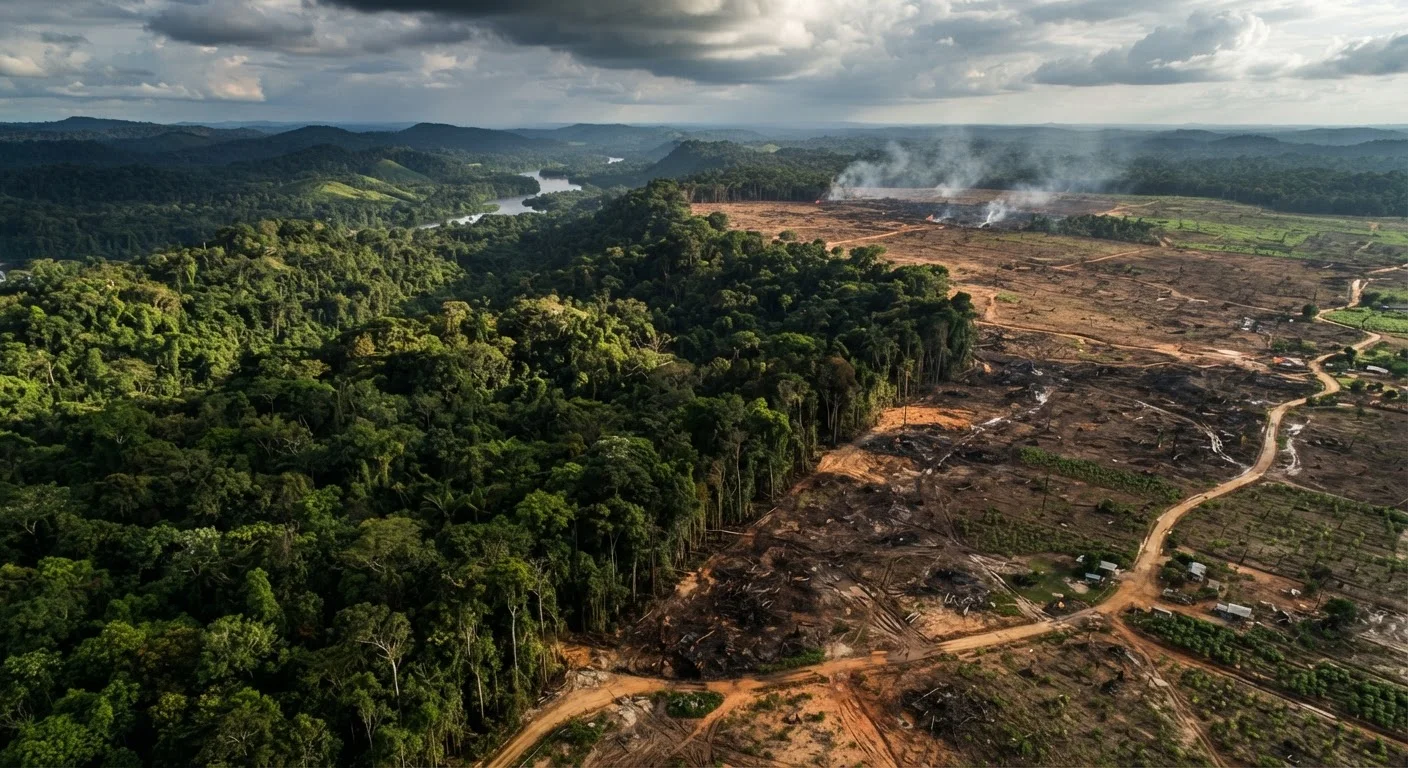
When forests are cleared - whether by logging, agriculture, or burning - that stored carbon is released back into the atmosphere, often rapidly. Burning releases carbon almost immediately; decay of remaining organic matter releases it over years to decades. To understand the full picture of how carbon moves through these systems, see our overview of the carbon cycle.
This distinction between carbon stocks (what is already stored) and carbon fluxes (what is being absorbed or released) is central to evaluating any forest-based climate strategy.
The Science Case for Preventing Deforestation
Deforestation accounts for roughly 10-15% of global annual CO₂ emissions, according to estimates from the Intergovernmental Panel on Climate Change (IPCC). Tropical forests - particularly in the Amazon basin, the Congo basin, and Southeast Asia - represent the densest carbon stores and are being cleared at the highest rates.
The core scientific argument for prioritizing deforestation prevention is straightforward: you cannot easily rebuild what took centuries to accumulate. Old-growth forests contain deep, carbon-rich soils, intricate fungal networks, and layered canopies that newly planted forests lack entirely. Research published in Nature and other peer-reviewed journals consistently shows that intact primary forests sequester and store more carbon per unit area than any planted or recovering forest of equivalent size.
There is also an irreversibility concern. Some deforested tropical soils, once exposed, degrade rapidly - losing their capacity to support high-biomass forests even if replanting is attempted. Protecting what remains is categorically easier than restoration.
| Preventing Deforestation | Reforestation | |
|---|---|---|
| Speed of climate benefit | Immediate - carbon stays locked in place | Delayed - decades to build meaningful stocks |
| Carbon storage per hectare | Very high (centuries of accumulation) | Lower, increases slowly over time |
| Biodiversity impact | Preserves complex, irreplaceable ecosystems | Variable - depends on species and method |
| Reversibility risk | High if deforestation continues | High if plantings are not maintained long-term |
| Soil carbon protection | Intact soil carbon preserved | Degraded soils may not recover fully |
| Implementation complexity | Political and economic - requires halting land clearing | Technical and ecological - species, site, and scale matter |
What Reforestation Can - and Cannot - Deliver
Reforestation has genuine climate value, but the science demands nuance. A landmark 2019 study in Science drew wide attention by suggesting that restoring tree cover across available land could store hundreds of gigatons of carbon. However, subsequent peer review identified significant methodological concerns, including overestimation of carbon storage potential and failure to account for land already used by communities or ecosystems better suited to grasslands or savannas.
The scientific consensus that has emerged is more measured: reforestation works when it involves native species, diverse ecosystems, and long-term land protection. Monoculture tree plantations - often planted for timber - absorb carbon during growth but store far less than natural forests and are vulnerable to pests, disease, and fire.
Critically, reforestation takes time. A newly planted forest may take 50 to 100 years to approach the carbon storage of a mature natural forest, meaning the climate benefit is delayed precisely when the need is most urgent. Reforestation should be understood as a complement to - not a replacement for - deep cuts in fossil fuel emissions. This point is echoed in analyses of common climate misconceptions, including the idea that tree planting alone can solve the climate crisis.
Making Informed Sense of the Evidence
Both deforestation prevention and reforestation have roles in a science-based climate strategy, but they are not equivalent tools. Preventing deforestation acts immediately on existing, large carbon stocks. Reforestation rebuilds carbon capacity gradually, and its effectiveness depends heavily on implementation quality.
Policymakers and conservation scientists generally agree on several evidence-based principles: protect remaining primary forests first; restore degraded land using diverse, native species; ensure local communities have rights and incentives to maintain forests long-term; and never treat reforestation as a license to continue emitting carbon elsewhere.
For everyday readers trying to evaluate news about forest-based climate pledges, the most useful question to ask is: does this plan protect what already exists, or does it propose to plant trees as an offset for ongoing emissions? The science suggests those are very different propositions with very different climate outcomes.