
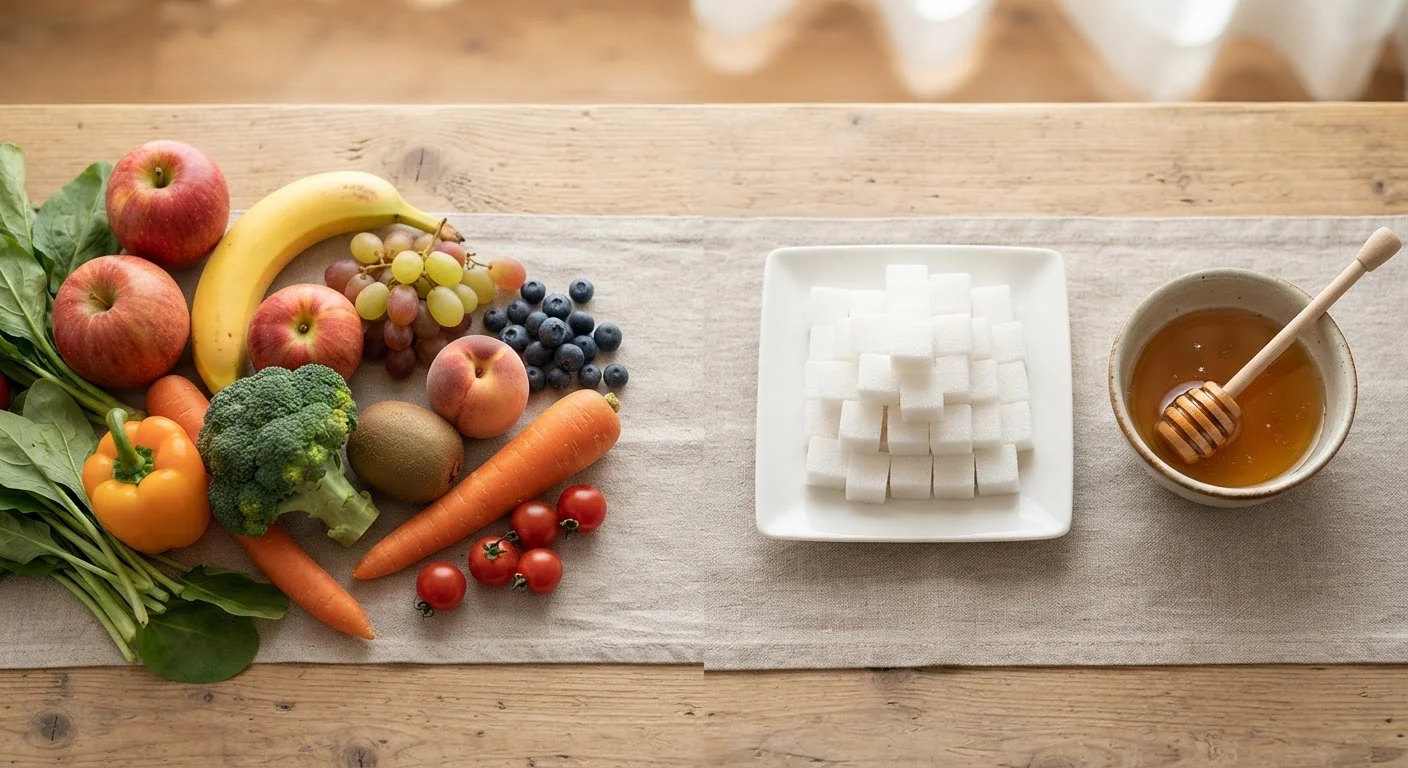
What Sets Natural and Added Sugars Apart
At the chemical level, the glucose and fructose in a strawberry are molecularly identical to those in a spoonful of table sugar. The distinction is not chemical - it is contextual. Natural sugars are those present in a food as it exists in nature: the lactose in milk, the fructose and glucose in fruit, the small amounts of sugars in some vegetables. Added sugars are any sugars or caloric sweeteners incorporated during manufacturing, cooking, or preparation - think cane sugar stirred into yogurt, high-fructose corn syrup in a soft drink, or honey drizzled onto a packaged granola bar.
This distinction matters because food is more than the sum of its nutrients. When you eat an apple, its sugar arrives alongside dietary fiber, water, vitamin C, and a range of phytochemicals. That bundle changes everything about digestion. As explained in our article on how dietary fiber affects blood sugar, fiber slows gastric emptying and blunts the rate at which sugars are absorbed into the bloodstream. Stripped of this matrix, the same grams of sugar behave very differently in the body.
How the Body Responds Differently
The concept of the food matrix - the physical and chemical structure of a whole food - is central to understanding why source matters. Research published in nutrition journals consistently shows that whole fruit consumption is associated with favorable metabolic outcomes, while sugar-sweetened beverage intake is linked to increased risk of weight gain and type 2 diabetes. The sugar content of each can be comparable in grams, yet the physiological effects diverge.
Liquid added sugars are particularly notable: without fiber to slow absorption, they reach the bloodstream rapidly, producing a sharper blood glucose and insulin response. Over time, chronically elevated insulin signaling is associated with insulin resistance. Whole foods containing natural sugars rarely produce the same spike because the food's structure acts as a built-in buffer.
| Criterion | Natural Sugars | Added Sugars |
|---|---|---|
| Source | Inherent in whole foods | Added during processing or cooking |
| Common examples | Fructose in fruit, lactose in milk | Cane sugar, high-fructose corn syrup, honey in products |
| Accompanying nutrients | Fiber, vitamins, minerals, water | Minimal to none ('empty calories') |
| Blood glucose response | Generally slower, buffered by food matrix | Often faster, especially in liquid form |
| Listed on Nutrition Facts label | Included in 'Total Sugars' | Separately under 'Added Sugars' |
| Dietary guidance | No specific limit for whole-food sources | Keep below 10% of daily calories (U.S. guidelines) |
For a practical guide to spotting added sugars in everyday products, see how to read a Nutrition Facts label. Since 2020, U.S. labels are required to list added sugars as a separate line item, making it easier to distinguish them from total sugars.
Practical Guidance for Everyday Eating
Current U.S. Dietary Guidelines advise limiting added sugars to fewer than 10% of total daily calories. For a 2,000-calorie diet, that translates to roughly 50 grams - an amount easily exceeded by a single large sweetened coffee drink or a bottle of sports beverage. The American Heart Association recommends even stricter limits for most adults.
17 tsp
Average daily added sugar intake, U.S. adults
CDC data indicate many American adults consume well above the recommended limit of about 12 teaspoons per day on a 2,000-calorie diet.
~47%
Share of added sugars coming from beverages
According to dietary intake analyses, sweetened drinks - including sodas, energy drinks, and sweetened coffees - represent the largest single source of added sugars in the American diet.
10%
Recommended added sugar ceiling (% of daily calories)
The 2020-2025 U.S. Dietary Guidelines for Americans recommend that added sugars account for less than 10% of total daily caloric intake.
Rather than avoiding all sweet foods, a more practical strategy is to differentiate sources. Whole fruits, plain dairy, and vegetables with natural sweetness can remain part of a balanced diet. The bigger lever is reducing ultra-processed foods and beverages where added sugars are concentrated. Our overview of whole foods versus ultra-processed foods offers useful context for identifying which products to limit.
Reading ingredient lists helps too: added sugars appear under dozens of names - corn syrup, dextrose, evaporated cane juice, maltose, and more. Spotting them takes practice but becomes straightforward over time. If you have specific health conditions, blood sugar concerns, or dietary restrictions, consult a registered dietitian or your primary care provider before making significant changes to your eating patterns.
This article is for general informational and educational purposes only and does not constitute medical or nutritional advice. Always consult a qualified healthcare professional for guidance tailored to your individual health needs.