
Why Our Brains Misjudge Portions
Portion perception isn't primarily a knowledge problem - it's a perceptual one. Human vision is heavily influenced by context: the size of a container, the shape of a plate, the amount eaten by those around us. These cues evolved to help us navigate a world where food scarcity was the main concern. In an environment of abundance, the same shortcuts push us to routinely underestimate how much we consume.
Research on what scientists call the 'unit bias' suggests people instinctively treat a single presented unit - one bowl, one muffin, one package - as the socially and nutritionally appropriate amount to eat, regardless of actual size. This isn't a failure of willpower; it's a predictable cognitive pattern that applies to virtually everyone, including nutrition professionals.
Understanding where the distortions come from is the first step toward making more informed choices. For a broader picture of how nutritional information can be misread, see common patterns that lead home cooks astray.
The Most Common Portion Perception Mistakes
Treating restaurant portions as a normal serving size.
Why it happens: We eat out frequently, and what arrives on the plate becomes an unconscious reference point for 'how much a meal is.' Research published in the American Journal of Public Health has documented that restaurant entrees routinely contain two to four times a standard serving.
Assuming the whole package equals one serving.
Why it happens: Single-serve-looking packages often contain two or more servings. Consumers tend to eat the full container without checking the label, effectively doubling or tripling the calories, sodium, or sugar they intended to consume.
Relying on visual estimation without any calibration.
Why it happens: Most people believe they can accurately eyeball a cup of pasta or three ounces of protein. Studies consistently show that untrained visual estimates tend to underestimate actual amounts, especially for energy-dense foods like nuts, oils, and cheese.
Confusing 'serving size' on a label with a dietary recommendation.
Why it happens: The serving sizes printed on Nutrition Facts labels are standardized reference amounts set by the FDA to reflect typical consumption patterns - they are not prescriptions for how much you should eat.
Letting plate and bowl size silently control intake.
Why it happens: Research by Cornell University's Food and Brand Lab found that larger dishware leads people to serve and consume more food without noticing. The visual proportion of food to plate creates an illusion of adequacy or scarcity.
Ignoring the caloric density of liquids and condiments.
Why it happens: Drinks, dressings, and sauces are rarely measured or considered part of a 'portion,' yet oils, alcohol, and sweetened beverages can contribute several hundred calories to a meal invisibly.
Each of these errors shares a common thread: an external cue - a plate, a package, a restaurant norm - overrides internal judgment. Recognizing which cues affect you most is more actionable than trying to achieve perfect accuracy on every food, every meal.
It's also worth noting that portion awareness is only one dimension of how we eat. Calorie counts alone don't capture the full picture of food quality, satiety, or nutritional value.
Practical Ways to Recalibrate Your Portion Sense
This Is General Information, Not Medical Advice
The information in this article is intended for general educational purposes only. It is not a substitute for personalized guidance from a registered dietitian, physician, or other qualified healthcare professional. If you have specific dietary needs, a health condition, or concerns about your eating patterns, please consult a qualified professional.
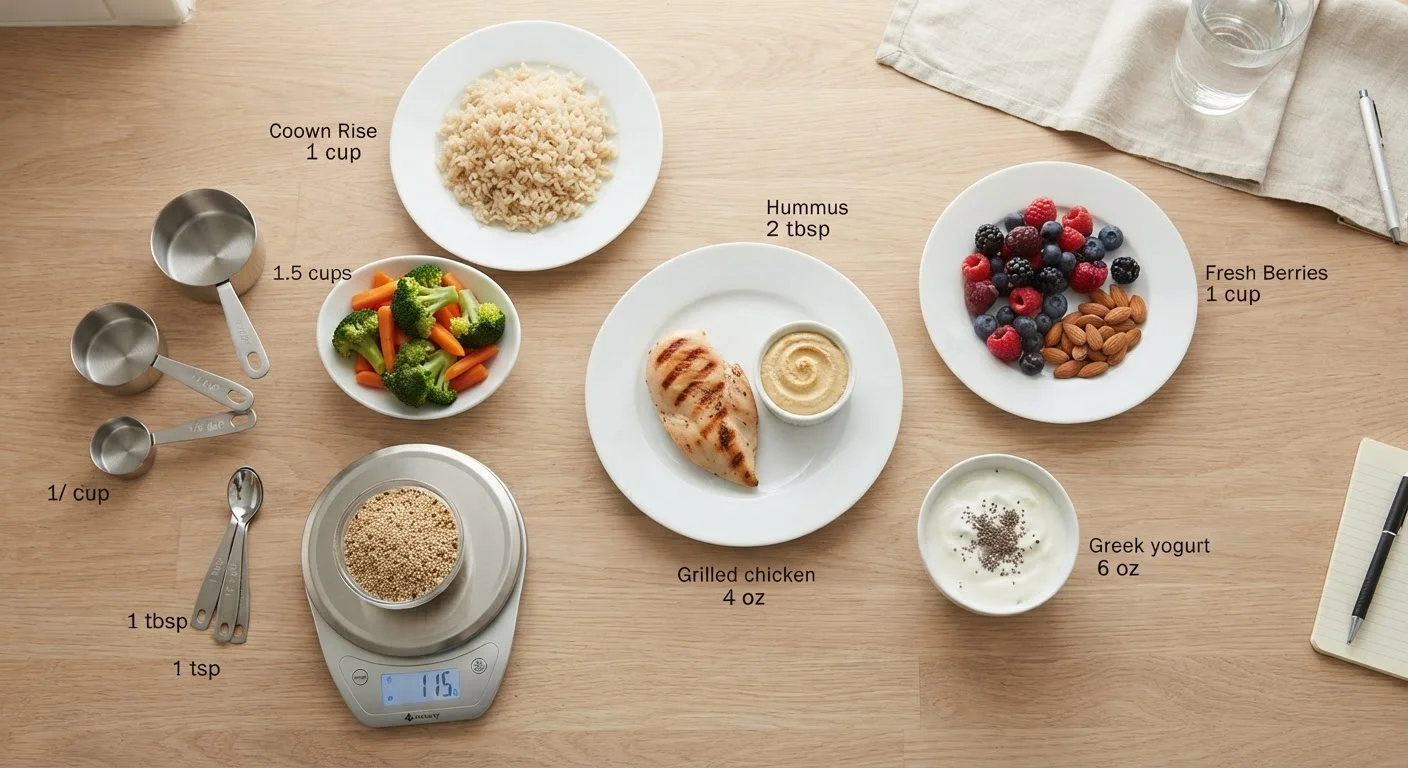
You don't need to measure every meal indefinitely. The goal is periodic recalibration - spending a week or two measuring common foods to reset your visual anchor, then revisiting that process when eating habits shift significantly.
Environmental design is often more reliable than moment-to-moment vigilance. Smaller bowls, pre-portioned snack containers, and placing vegetables before energy-dense foods in a serving line are all strategies supported by behavioral nutrition research. These changes reduce the cognitive load of food decisions rather than adding to it.
Understanding how labels work is an essential complement to portion awareness. Decoding a Nutrition Facts panel accurately gives you the reference data needed to translate serving sizes into meaningful context at a glance.
This article is for general informational and educational purposes only and does not constitute medical or dietary advice. Consult a qualified healthcare professional or registered dietitian for personalized guidance.