
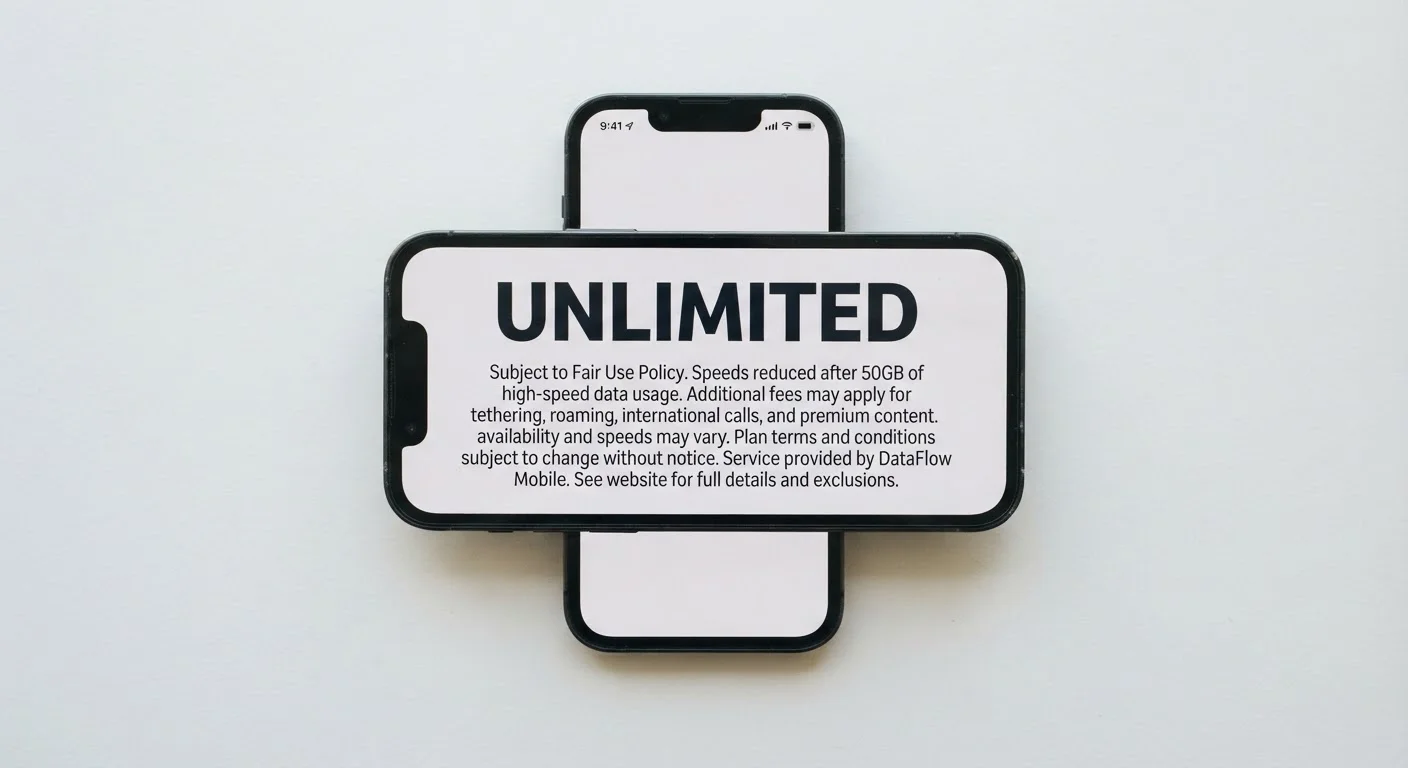
Why 'Unlimited' Is a Marketing Word, Not a Technical Guarantee
If you've shopped for a wireless plan in the US, you've seen the word unlimited plastered on virtually every option. It sounds simple: you use as much data as you want, whenever you want. The reality is more complicated - and understanding the difference could save you real frustration and money.
The Federal Trade Commission has raised concerns about the term over the years, and carriers have faced scrutiny for advertising unlimited plans that throttled speeds after a certain usage point. The word itself is not regulated to mean a specific thing, which gives carriers significant room to define it on their own terms - buried in the service agreement most customers never read.
For a clearer breakdown of what each charge and feature on your bill actually covers, see our full bill decoder.
Myth
An unlimited plan means you can use as much data as you want at full speed, all month long.
Fact
All major US unlimited plans reduce speeds - either through throttling or deprioritization - under certain conditions.
Carriers use two distinct mechanisms to manage data on "unlimited" plans. Throttling cuts your speed after you hit a specific data threshold for the billing cycle. Deprioritization slows your connection during network congestion - it can happen at any point in the month, not just after you've used a lot of data. Entry-level unlimited tiers are typically subject to both; premium tiers usually protect against throttling but still allow deprioritization.
Myth
Unlimited data includes unlimited hotspot use at full speed.
Fact
Hotspot data is almost always capped at a set number of gigabytes at full speed, then slowed dramatically.
Carriers distinguish between data used directly on your phone and data shared through a mobile hotspot. Even on plans that advertise unlimited everything, the full-speed hotspot allotment is a fixed number of gigabytes - often ranging from around 5 GB to 50 GB depending on the tier. After that cap, hotspot speeds typically drop to 3G-level performance or slower, which makes activities like video calls or streaming on a laptop difficult or impossible.
Myth
Unlimited plans work the same way everywhere, including when you travel internationally.
Fact
International data on unlimited plans is almost always restricted to very slow speeds by default.
Most US unlimited plans include some form of international roaming, but the fine print usually specifies speeds as low as 128 kbps in covered countries - roughly comparable to a slow 2G connection. That's generally fast enough for basic text messaging but not for maps, email attachments, or anything requiring a real data connection. Full-speed international data typically requires purchasing a daily or weekly add-on, or subscribing to a higher plan tier.
Myth
If a plan is more expensive, it must be truly unlimited with no restrictions.
Fact
Premium tiers have fewer restrictions, but still include network management policies that affect speeds.
Higher-cost unlimited tiers do offer meaningful improvements: more full-speed hotspot data, higher video streaming quality, and protection from usage-based throttling. However, even the most premium consumer plans include some form of network management. In practice, this typically means that during periods of significant congestion, even premium customers may experience slower speeds than the advertised maximum. The difference between tiers is a matter of degree, not the presence or absence of limits.
The Specific Limits Hidden Inside Unlimited Plans
Once you move past the marketing headline, four specific restrictions show up consistently across US carrier plans. Knowing these will help you match a plan to how you actually use your phone.
128 kbps
Typical international roaming speed on basic unlimited plans
Many US carrier terms of service specify this speed cap for international data use on standard unlimited tiers.
~50 GB
Common premium hotspot threshold before speed reduction
Hotspot allotments on top-tier unlimited plans from major US carriers often cap full-speed tethering around this level.
Deprioritization During Congestion
Deprioritization means that when a cell tower is handling heavy traffic, customers on certain plan tiers get pushed to the back of the line. This isn't throttling based on how much data you've used - it can happen at any point, even at the start of your billing cycle, if the tower is congested. Premium unlimited tiers on most carriers advertise "prioritized" data precisely to distinguish themselves from this practice on lower-cost plans.
Mobile Hotspot Caps
Using your phone as a Wi-Fi hotspot - sharing your cellular connection with a laptop or tablet - is technically data usage, but carriers treat it differently. Even plans marketed as unlimited almost always cap full-speed hotspot data at a specific gigabyte threshold, after which hotspot speeds drop significantly. The cap varies widely by plan tier.
Video Streaming Quality Limits
Many unlimited plans restrict video streaming resolution by default, often to 480p (standard definition) or 720p (HD), regardless of what your device or the streaming service could support. Upgrading to higher-definition streaming sometimes requires a pricier tier or an add-on.
International Data Restrictions
The word unlimited rarely extends abroad. Most plans default to very slow data speeds - sometimes as low as 128 kbps - when roaming internationally. Full-speed international data usually requires a separate add-on or a higher plan tier. For a thorough look at how this works, see how international roaming actually works on US plans.
These restrictions aren't illegal or necessarily unreasonable - networks have finite capacity. But they should be disclosed prominently, not only in fine print. Our companion piece on what carriers don't spell out at sign-up covers more of these disclosure gaps in detail.
How to Read a Plan Before You Commit
The most useful habit you can build when evaluating any unlimited plan is to look for the plan's terms of service or network management policy - not the summary card on the website. Specifically, look for answers to these questions:
- At what data threshold does deprioritization apply? This is often listed in gigabytes per billing cycle on premium tiers, or as an "all traffic" policy on entry-level unlimited plans.
- How many gigabytes of full-speed hotspot are included? And what speed does hotspot drop to after the cap?
- What video streaming resolution does the plan default to?
- What data speed applies when roaming internationally?
If you're new to telecom terminology, our mobile plan glossary defines the key terms - like QCI, MVNO, and deprioritization - in plain language so you can parse those policy documents without a law degree.
Coverage is another variable that marketing materials can obscure. The plan might be genuinely unlimited in technical terms, but if signal is weak in areas where you live or work, the speed restrictions matter less than you'd think. Our explainer on why coverage maps don't always reflect real-world conditions is worth reading alongside any plan comparison.
The bottom line: unlimited plans can be good value - they just require you to look past the headline to understand what you're actually paying for.