
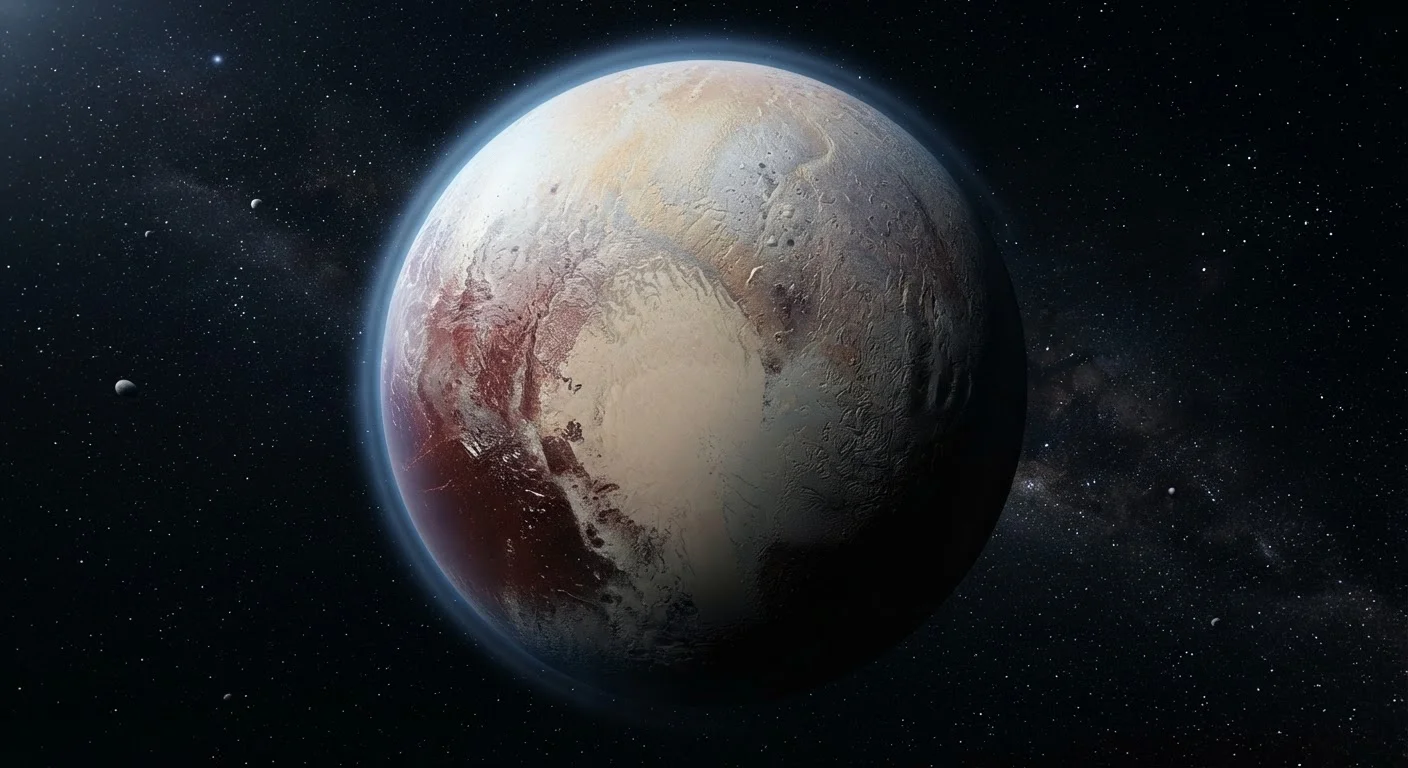
The Moment Everything Changed for Pluto
On August 24, 2006, a show of hands at an IAU General Assembly in Prague officially stripped Pluto of the planetary status it had held since astronomer Clyde Tombaugh discovered it in 1930. The vote wasn't close - 424 members supported the new definition, while 83 opposed it. For many Americans who had grown up memorizing nine planets, the news felt jarring, even personal.
But the reclassification wasn't arbitrary. It emerged from a genuine scientific crisis that had been building for over a decade as astronomers discovered more and more large, icy bodies lurking in the outer solar system - objects uncomfortably similar to Pluto in size and composition.
The Discovery That Forced the Question
The immediate trigger was Eris, a distant object discovered in 2005 by astronomer Mike Brown and his team at Caltech. Initial measurements suggested Eris was actually larger than Pluto. Astronomers faced an uncomfortable fork in the road: either welcome Eris - and potentially dozens of similar bodies - as full planets, or revisit what the word 'planet' actually means.
The IAU chose the latter. After considerable debate, it settled on a three-part definition: a planet must orbit the Sun, have sufficient mass for gravity to pull it into a roughly spherical shape, and - the decisive criterion - have gravitationally dominated and cleared the neighborhood around its orbit. Pluto, embedded in the densely populated Kuiper Belt, clearly fails that last test.
“The definition of planet is a matter of science, and science is not a democracy. But the IAU vote showed that even scientists must agree on shared language before they can make progress.”
— Neil deGrasse Tyson, Astrophysicist and Director of the Hayden Planetarium, public science communicator
Why the 'Orbital Clearing' Rule Is Controversial
Critics of the IAU definition - including a number of prominent planetary scientists - argue that 'clearing the orbital neighborhood' is a poorly defined and inconsistently applied standard. Some researchers have pointed out that under strict application, even Earth might not fully satisfy the criterion if placed at Pluto's distance from the Sun.
A competing definition, sometimes called the geophysical planet definition, has been proposed by researchers including Alan Stern, the principal investigator of NASA's New Horizons mission. Under this framework, any body large enough for gravity to shape it into a sphere would qualify as a planet - a standard that would restore Pluto's status and dramatically expand the planet count to well over 100 bodies.
The IAU Vote Had Limitations
Of the roughly 10,000 professional astronomers who are IAU members, only about 424 cast votes on the planet definition in 2006 - less than 5% of the full membership. Many planetary scientists were absent or abstained, and a subsequent petition signed by over 300 astronomers protested the decision. This context matters when evaluating how definitive the classification truly is.
The debate ultimately reflects a deeper tension in science between tidy classification systems and the messy reality of nature, which rarely organizes itself into clean categories.
What New Horizons Taught Us About Pluto
Whatever its label, Pluto proved to be anything but a boring, frozen rock when New Horizons completed its historic flyby in July 2015. Images revealed towering water-ice mountains reaching up to 11,000 feet, a vast nitrogen ice plain informally called Tombaugh Regio (the heart-shaped feature visible in almost every image of Pluto), and evidence of active geological processes driven by internal heat.
Scientists also confirmed Pluto has a thin atmosphere of nitrogen, methane, and carbon monoxide that expands when it draws closer to the Sun in its elliptical orbit and partially collapses as it recedes. These findings positioned Pluto as one of the most geologically complex worlds in the outer solar system - a fact entirely independent of how we choose to classify it.
11,000 ft
Height of Pluto's water-ice mountain ranges
NASA's New Horizons mission revealed mountain ranges on Pluto rivaling the Rockies in height, discovered during the July 2015 flyby.
424 to 83
IAU vote margin reclassifying Pluto
At the 2006 IAU General Assembly in Prague, 424 members voted in favor of the new planet definition while 83 opposed, finalizing Pluto's dwarf planet status.
5
Officially recognized dwarf planets
The IAU formally recognizes Pluto, Eris, Haumea, Makemake, and Ceres as dwarf planets, though researchers estimate the true count could be in the hundreds.
Could the Definition Change?
Scientifically, the definition could change - the IAU has revised astronomical classifications before. But any formal reclassification would require a new proposal, debate, and vote at an IAU General Assembly, a process that unfolds on the timescale of years and requires broad international consensus.
Several researchers continue to publish arguments for revised planet definitions, and the question resurfaces regularly in the scientific literature. Public interest in Pluto's status has also kept the debate culturally alive in ways unusual for technical taxonomic disputes. Whether Pluto ever regains full planetary status remains genuinely uncertain - but the scientific conversation about what makes a planet is richer and more rigorous for having asked the question in the first place.