The Stellar Nursery: Birth Inside a Nebula
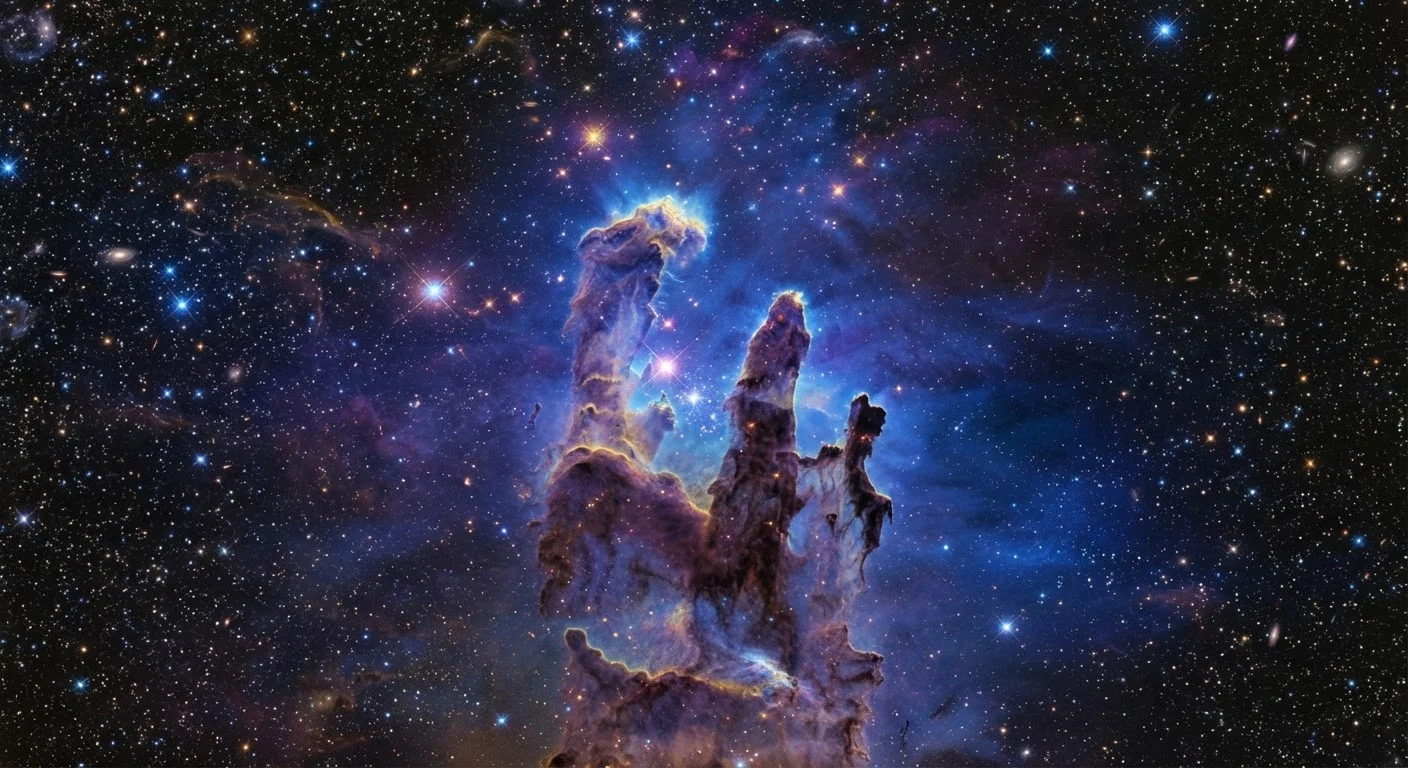
Every star begins as a vast, cold cloud of hydrogen gas and dust called a nebula. These molecular clouds can stretch across hundreds of light-years, containing enough material to birth thousands of stars. The process begins when something disturbs the cloud - a nearby supernova shockwave, a gravitational nudge from a passing galaxy, or simple density fluctuations - causing pockets of gas to contract under their own gravity.
As a pocket collapses, it heats up and spins faster, much like a figure skater drawing in their arms. Over tens of thousands of years, this collapsing core becomes a protostar - not yet fusing hydrogen, but radiating heat from the energy of compression. When the core temperature reaches roughly 10 million degrees Celsius, nuclear fusion ignites. Hydrogen nuclei fuse into helium, releasing enormous amounts of energy. At that moment, a true star is born.
~10 million °C
Core temperature required to ignite fusion
This threshold, established through nuclear physics research, marks the precise moment a protostar becomes a true star.
4.6 billion years
Age of our Sun on the main sequence
According to solar models supported by radiometric dating of meteorites and helioseismology data.
~100 billion years
Estimated lifespan of the smallest red dwarf stars
Low-mass red dwarfs burn hydrogen so efficiently that they far outlive larger stars like our Sun.
1 billion tons
Weight of one teaspoon of neutron star material
Neutron stars pack more than a solar mass into a sphere roughly 20 kilometers across, per astrophysical models.
The Main Sequence: A Star's Long Middle Age
Once fusion is stable, a star enters the longest phase of its existence: the main sequence. This is the period of equilibrium, where the outward pressure of nuclear fusion precisely balances the inward pull of gravity. Our own Sun has been in this stable phase for about 4.6 billion years and is expected to remain there for another 5 billion years.
A star's mass governs almost everything about its main sequence life. Low-mass stars burn hydrogen slowly and can shine for tens to hundreds of billions of years. Massive stars - those with ten or more times the Sun's mass - burn through their fuel so furiously that they exhaust it in just a few million years. This inverse relationship between mass and longevity is one of the most counterintuitive facts in stellar astronomy: the bigger the star, the shorter its life.
Stars are also classified by surface temperature and luminosity on the Hertzsprung-Russell diagram, a foundational tool in astrophysics that maps where stars sit at any point in their lives. The main sequence appears as a diagonal band across this diagram, with hot, massive blue stars at one end and cool, dim red dwarfs at the other.
Giants and Supergiants: Stars in Their Final Act
When a star depletes the hydrogen fuel in its core, the balance tips. The core contracts under gravity and heats up, while the outer layers expand dramatically - the star swells into a red giant (for Sun-like stars) or a red supergiant (for massive stars). Our Sun will eventually expand so far that it could engulf the orbit of Mercury and possibly Venus or Earth.
Inside the swelling star, fusion continues in shells around the core, fusing progressively heavier elements. Sun-like stars fuse helium into carbon and oxygen. Massive stars build up a layered interior - carbon, neon, oxygen, silicon - each shell fusing a heavier element, until iron accumulates at the core. Iron cannot release energy through fusion; it absorbs it. At that point, the star's fate is sealed.
When visualizing stellar evolution, anchor everything to the star's mass - it is the master variable that determines temperature, color, lifespan, and death.
Every other property of a star flows from its mass. Keeping this mental model front and center makes the rest of stellar physics far more intuitive.
Look up the Hertzsprung-Russell diagram when reading about any star - it instantly places that star in context among the full stellar population.
The H-R diagram is the single most powerful summary tool in stellar astronomy, showing at a glance where a star is in its life cycle relative to others.
Stellar Death: White Dwarfs, Neutron Stars, and Black Holes
How a star dies depends, again, almost entirely on mass.
Low- to medium-mass stars (up to about eight times the Sun's mass) end relatively gently. The outer layers drift away as a glowing shell of gas called a planetary nebula - one of the most visually striking phenomena in astronomy. What remains is the collapsed core: a white dwarf, roughly Earth-sized but containing roughly half the original star's mass. White dwarfs cool slowly over billions of years, eventually fading to a theoretical cold black dwarf - though the universe is not yet old enough for any to have reached that state.
Massive stars meet a far more violent end. When the iron core grows too heavy, gravity overwhelms it in milliseconds, triggering a catastrophic collapse and a supernova explosion - one of the most energetic events in the universe. In seconds, a supernova can outshine an entire galaxy. What remains depends on how massive the original star was. A core between roughly 1.4 and 3 solar masses becomes a neutron star: an extraordinarily dense object where a teaspoon of material would weigh a billion tons. A core exceeding that threshold collapses into a black hole, an object whose gravity is so intense that not even light can escape.
Why Stellar Life Cycles Matter to Us
The life and death of stars is not a distant, abstract spectacle - it is the direct cause of our existence. When massive stars explode as supernovae, they scatter into space all the heavy elements forged in their cores: carbon, oxygen, iron, calcium, and more. Those elements are swept into new nebulae, incorporated into new star systems, and eventually into planets and living organisms.
The calcium in your bones and the iron in your blood were synthesized inside stars that died before our solar system formed. Astronomers sometimes encapsulate this with a phrase that is scientifically precise and philosophically striking: we are stardust.
Understanding stellar evolution also gives astronomers a window into the history and future of the universe itself. By studying stars at every stage - from protostars shrouded in gas to ancient white dwarfs cooling in the dark - scientists reconstruct the chemical enrichment of galaxies, the conditions that allowed rocky planets to form, and the ultimate timescale of the cosmos.
Every star visible in the night sky is at some point in this cycle. The next time you look up, you are watching billions of years of cosmic history, written in light.