Why Infrared Light Changes Everything
Most people are familiar with light as something the eye can see - the colors of a sunset or the beam of a flashlight. But visible light is only a narrow slice of the electromagnetic spectrum. Infrared light, which we experience as heat radiation, carries crucial information that visible-light telescopes simply cannot capture.
Two properties make infrared observation transformative for astronomy. First, infrared light passes through dust clouds that block visible light, revealing star nurseries and galactic cores that would otherwise remain hidden. Second, as the universe expands, light from the most distant objects stretches to longer, redder wavelengths - a phenomenon called redshift. Light emitted as ultraviolet or visible radiation billions of years ago arrives at Earth today as infrared. To see the early universe, you must observe in infrared.
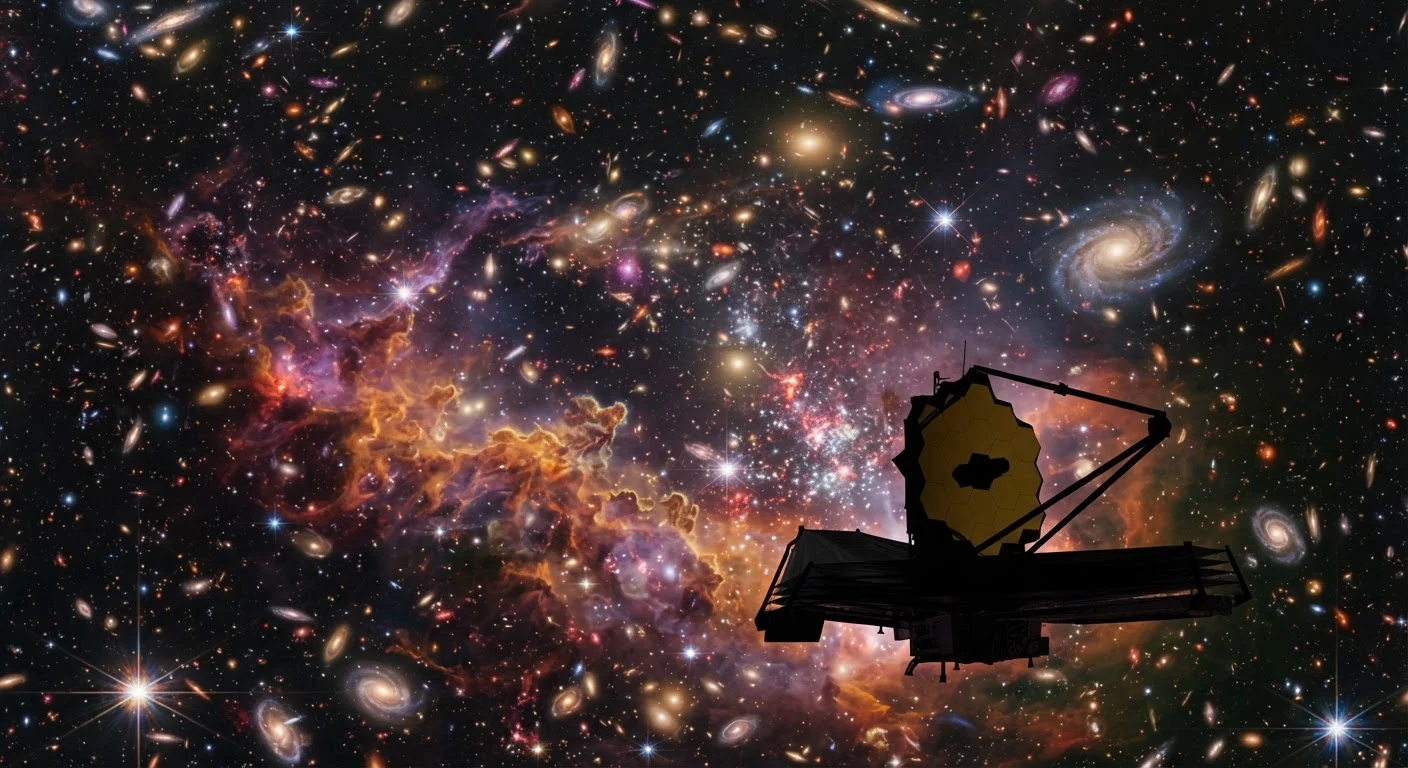
JWST's instruments are engineered to detect these faint, stretched signals. Its entire optical system - mirrors, sunshield, and detectors - is cooled to temperatures near absolute zero to prevent the telescope's own heat from overwhelming the signals it seeks to measure.
“Webb is not just a successor to Hubble - it's a fundamentally different kind of observatory, designed to answer questions we couldn't even properly frame before we had it.”
— John Mather, Nobel Prize-winning astrophysicist and JWST Senior Project Scientist at NASA
What JWST Has Already Discovered
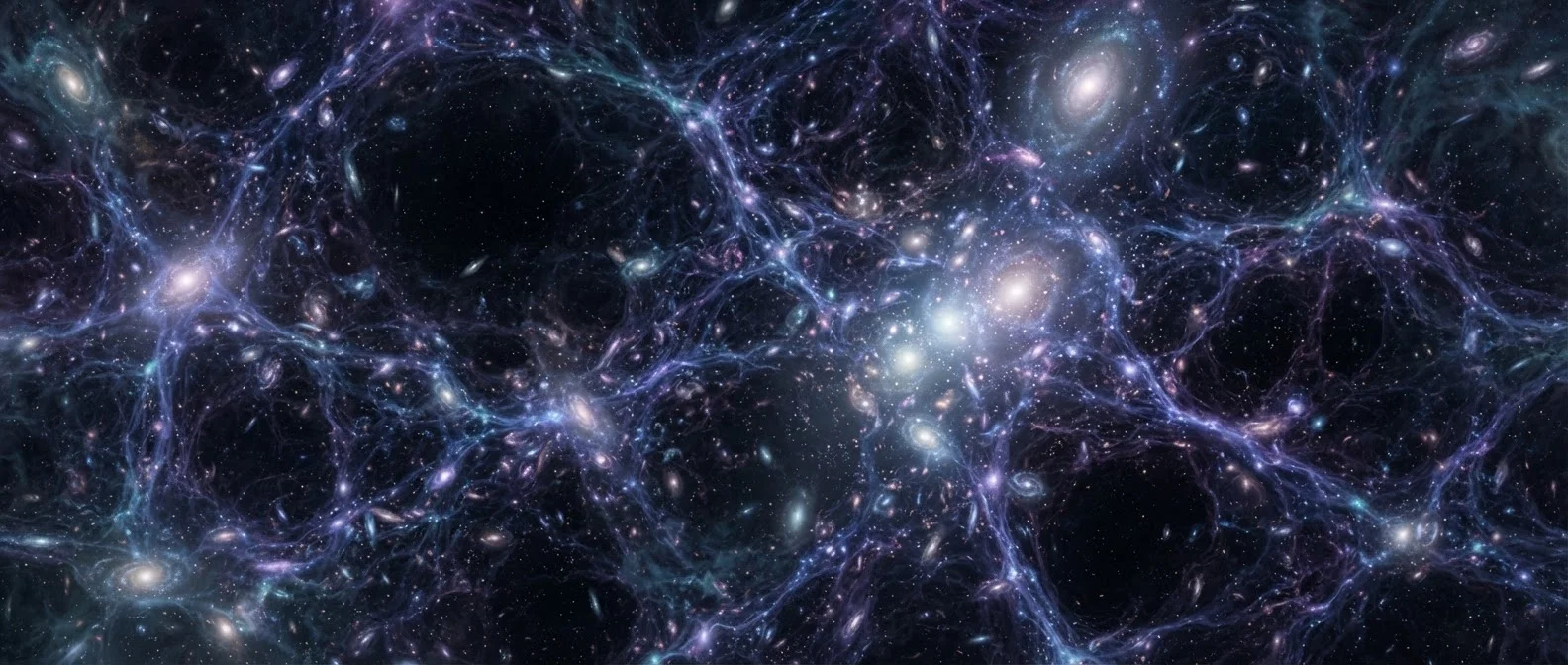
Within its first year of full science operations, JWST reshaped several assumptions that astronomers held with confidence. Among the most significant: the telescope imaged large, mature galaxies existing just a few hundred million years after the Big Bang - far earlier than standard cosmological models predicted. These findings have prompted scientists to revisit and refine models of how galaxies form and grow.
JWST has also transformed exoplanet science. Using a technique called transmission spectroscopy - analyzing starlight filtered through a planet's atmosphere as it passes in front of its star - the telescope has detected carbon dioxide, methane, and water vapor in the atmospheres of distant worlds. While none of these detections alone confirms habitability, they represent the most detailed atmospheric profiles ever obtained for planets outside our solar system.
Closer to home, JWST has produced unprecedented images of objects within our own solar system, including detailed views of Jupiter's auroras and the fine structure of Neptune's rings.
13.4B
Light-years to the most distant galaxies JWST has observed
JWST has imaged galaxy candidates formed just a few hundred million years after the Big Bang, which occurred approximately 13.8 billion years ago.
6.5m
Diameter of JWST's primary mirror
This gives JWST roughly 6.25 times the light-collecting area of the Hubble Space Telescope's 2.4-meter mirror.
~1M miles
Distance from Earth at JWST's orbital position
JWST orbits the Sun at the second Lagrange point (L2), maintained there by the gravitational balance between Earth and the Sun.
$10B
Approximate total program cost
According to NASA, the JWST program involved more than 300 universities, organizations, and companies across 29 countries over roughly two decades of development.
How the Telescope Actually Works
JWST operates through four main scientific instruments, each designed for a specific observational task. The Near Infrared Camera (NIRCam) captures the iconic deep-field images that show thousands of galaxies in a patch of sky no larger than a grain of sand held at arm's length. The Near Infrared Spectrograph (NIRSpec) can simultaneously measure the chemical fingerprints of up to 100 objects at once - a capacity that dramatically accelerates survey science.
The Mid-Infrared Instrument (MIRI), the coldest of the four, observes longer infrared wavelengths and is particularly effective at imaging dusty star-forming regions and the earliest galaxies. Finally, the Fine Guidance Sensor / Near InfraRed Imager and Slitless Spectrograph (FGS/NIRISS) helps stabilize the telescope's pointing while also performing its own observations.
Together, these instruments give JWST a versatility that no single predecessor could match - capable of imaging, spectroscopy, and coronagraphy (blocking starlight to reveal faint nearby objects like planets) in a single mission.
Why These Discoveries Matter for All of Us
The discoveries JWST is producing are not merely academic. Understanding how the first stars and galaxies formed helps answer foundational questions about why the universe looks the way it does today - and why Earth exists at all. The heavy elements that make up our bodies, our planet, and the air we breathe were forged in stellar interiors and scattered by supernova explosions. Tracing those early cosmic events tells us something profound about our own origins.
The telescope's exoplanet research carries equally deep implications. If JWST identifies a world with an atmospheric chemistry consistent with biological processes - a challenging but not impossible detection - it would be the strongest evidence yet that life is not unique to Earth. Even the absence of such signatures would help scientists narrow the conditions under which life might arise elsewhere.
JWST represents one of the most complex scientific instruments humanity has ever constructed and deployed. Its findings, shared publicly and freely through NASA's data archives, are advancing knowledge across dozens of scientific subfields simultaneously. For anyone who has looked up at a clear night sky and wondered what lies beyond - this telescope is providing answers.