Two Fundamentally Different Kinds of World
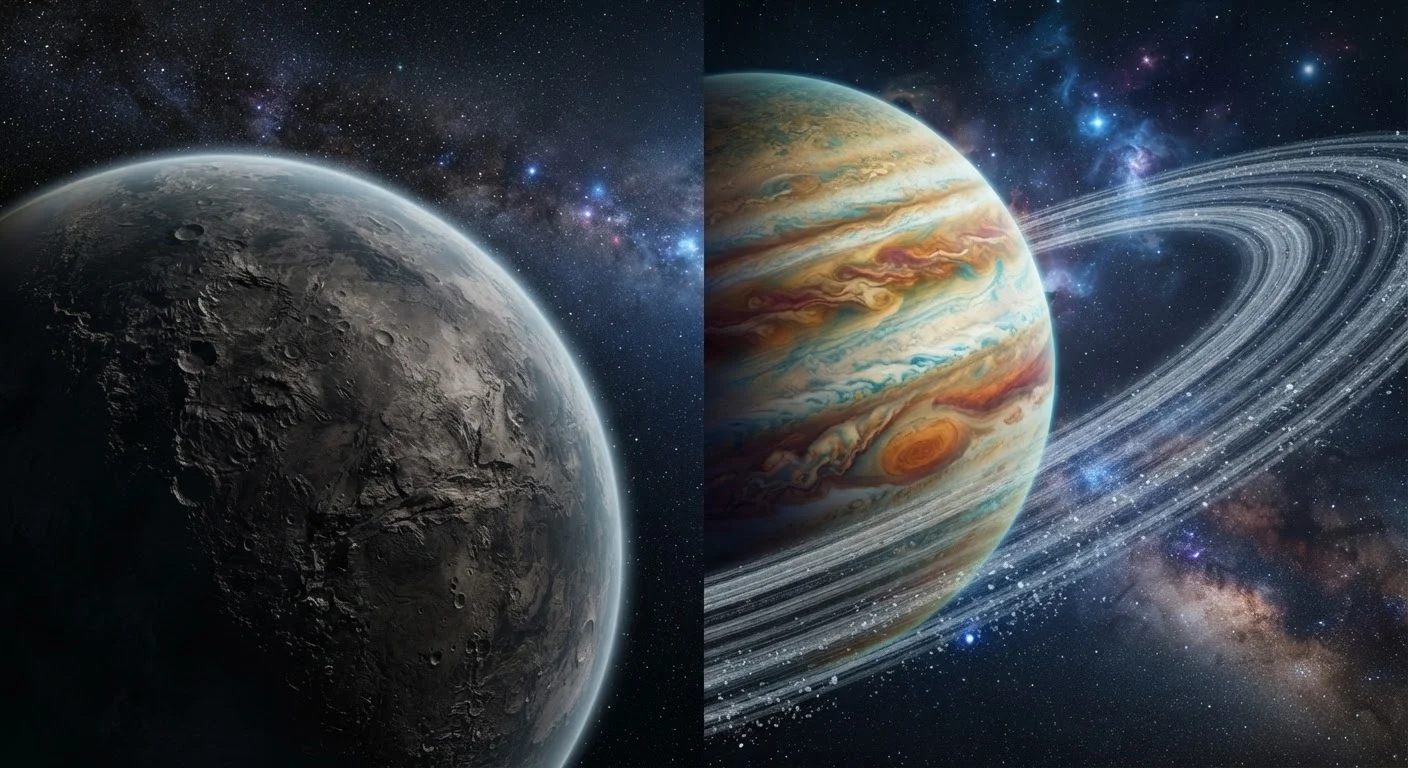
When astronomers sort the planets of our solar system into categories, the division between rocky planets and gas giants isn't just a matter of size - it reflects entirely different compositions, formation histories, and physical behaviors. Mercury, Venus, Earth, and Mars are terrestrial planets: dense, compact bodies with solid surfaces made primarily of silicate rock and iron. Jupiter, Saturn, Uranus, and Neptune are giant planets: enormous worlds dominated by thick envelopes of gas and, in some cases, ice.
The contrast is stark. Earth's diameter is roughly 12,700 kilometers. Jupiter's is more than 140,000 kilometers - about 11 times wider. More telling than size, however, is density. Earth averages about 5.5 grams per cubic centimeter, largely because of its iron core. Jupiter averages just 1.3 grams per cubic centimeter, slightly denser than water, because its bulk is hydrogen and helium.
| Criterion | Rocky Planets | Gas Giants |
|---|---|---|
| Primary composition | Silicate rock and iron | Hydrogen and helium gas |
| Solid surface | Yes | No |
| Size (diameter) | ~5,000-12,700 km | ~50,000-140,000 km |
| Average density | ~4-5.5 g/cm³ | ~0.7-1.6 g/cm³ |
| Location in solar system | Inner solar system | Outer solar system |
| Number of moons | 0-1 large moon | Dozens to 100+ |
| Ring systems | None | Common (Saturn, Uranus, Jupiter, Neptune) |
| Magnetic field strength | Weak to moderate | Extremely powerful |
How Each Type Forms
Planetary type is largely determined by where in a solar system a planet forms. Close to a young star, intense radiation and heat prevent volatile compounds - water, methane, ammonia - from condensing. Only metals and silicates survive in solid form. These materials clump together through a process called accretion, building the cores of terrestrial planets over millions of years.
Farther out, beyond what planetary scientists call the frost line (or snow line), temperatures drop enough for ices to solidify. This dramatically increases the amount of solid material available, allowing planetary cores to grow rapidly. Once a core reaches roughly 10 Earth masses, its gravity becomes strong enough to gravitationally capture the surrounding hydrogen and helium gas from the protoplanetary disk - producing a gas giant. This process, known as core accretion, must happen quickly, before the parent star's solar wind disperses the disk.
Uranus and Neptune, sometimes classified separately as ice giants, represent an intermediate case: they captured gas but not in the enormous quantities Jupiter and Saturn did, leaving them with higher proportions of water, methane, and ammonia ices in their deep interiors.
Composition, Structure, and Atmosphere
Rocky planets have a layered internal structure: a metallic core, a silicate mantle, and a thin crust. Their atmospheres, where they exist, are secondary - meaning they formed after the planet itself, through volcanic outgassing and, in Earth's case, biological activity. Mars and Mercury have extremely thin atmospheres; Venus has a dense one, but it's composed mostly of carbon dioxide.
Gas giants have no well-defined solid surface. Descending into Jupiter, hydrogen gas gradually transitions under immense pressure into a liquid, and then into a bizarre state called metallic hydrogen - a phase in which hydrogen conducts electricity like a metal. This metallic hydrogen layer is thought to generate Jupiter's extraordinarily powerful magnetic field. At the very center, there may be a dense rocky or icy core, but it accounts for only a small fraction of the planet's total mass.
Gas giants also drive some of the solar system's most dramatic weather. Jupiter's Great Red Spot is a storm system larger than Earth that has persisted for centuries. Saturn's hexagonal polar vortex and its rings - composed mainly of ice particles - add further complexity to what these worlds can produce.
Moons, Rings, and the Bigger Picture
Rocky planets are relatively moon-poor. Earth has one large moon; Mars has two tiny captured asteroids. Mercury and Venus have none. Gas giants, by contrast, are surrounded by extensive moon systems - Jupiter has at least 95 confirmed moons, Saturn at least 146. Many of these moons are scientifically fascinating: Europa harbors a subsurface liquid water ocean beneath its icy crust, and Titan (Saturn's largest moon) has lakes of liquid methane and a thick nitrogen atmosphere.
Beyond our solar system, astronomers have detected thousands of exoplanets, and both terrestrial and giant varieties appear throughout the galaxy. Hot Jupiters - gas giants orbiting extremely close to their host stars - were among the first exoplanets discovered and challenged early assumptions about planetary formation. Meanwhile, the search for rocky, Earth-sized worlds in habitable zones continues to drive some of the most exciting research in modern astronomy.
Together, rocky planets and gas giants illustrate that planet formation is not a single process but a spectrum of outcomes shaped by chemistry, distance, timing, and chance - each producing worlds that are profoundly different from one another.