
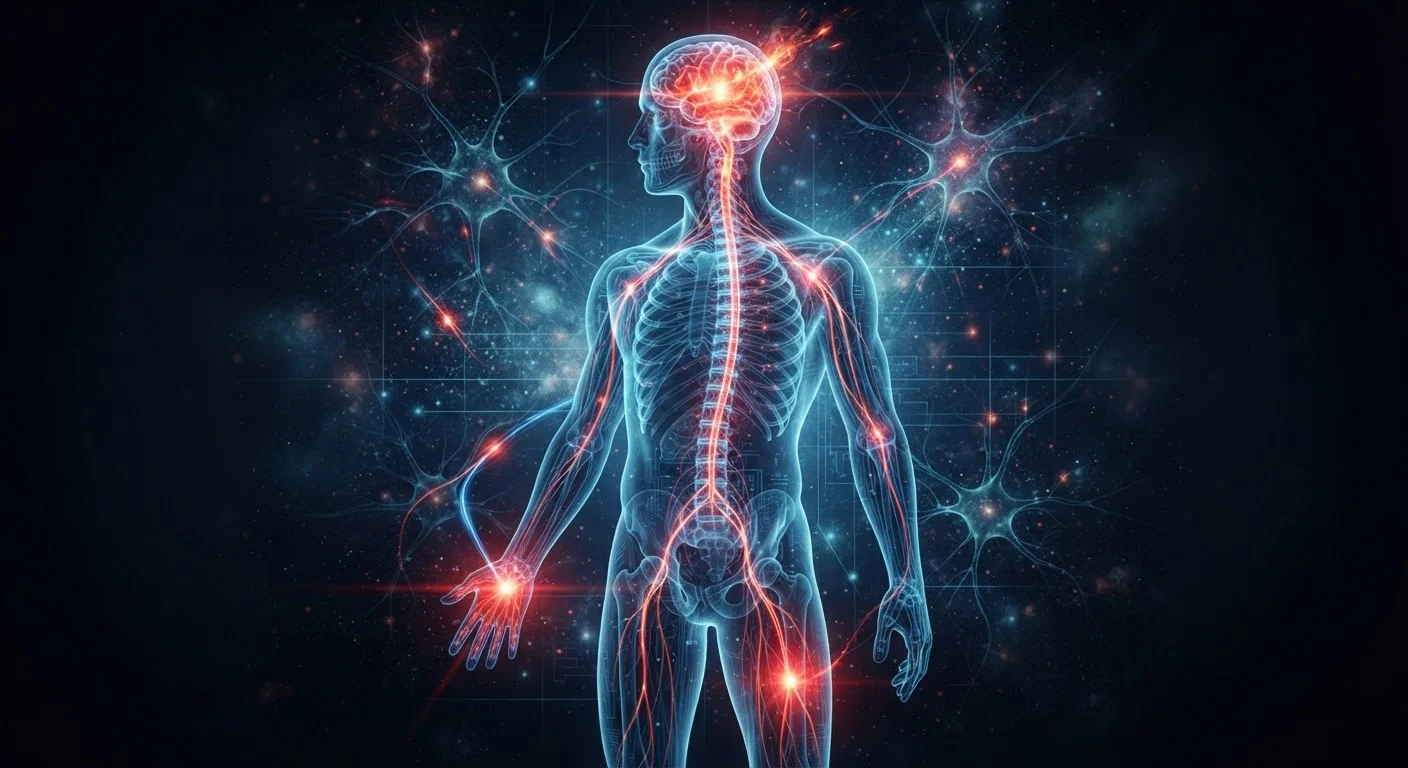
The Brain Builds Pain - It Doesn't Just Receive It
Most people think of pain as a straightforward alarm: tissue gets damaged, a signal travels up the spine, and the brain rings a bell. The reality is far more complex. Pain is not passively received - it is actively constructed by the brain using sensory data as just one ingredient among many.
Neuroscientists describe this through a framework called the neuromatrix theory of pain, which recognizes that the brain integrates signals from the body with context, emotion, memory, and expectation before producing the sensation we experience. This is why soldiers in combat sometimes report feeling no pain from serious wounds until after the battle ends - the brain assessed the situation and deprioritized the pain signal in favor of survival.
The practical implication is significant: two people with identical injuries can have profoundly different pain experiences, and both are real.
“Pain is not in the tissue. Pain is in the brain. It's an output of the brain designed to protect you, not a measure of how much damage has occurred.”
— Lorimer Moseley, Clinical neuroscientist and pain researcher, University of South Australia
Why Location Changes Everything
The part of the body that hurts matters enormously, and the explanation lies in nerve anatomy. Different body regions have vastly different concentrations of nociceptors - the sensory receptors that detect potentially harmful stimuli. Fingertips, lips, and the cornea of the eye are densely packed with these receptors, which is why injuries in these areas feel disproportionately intense compared to, say, the back or thigh.
The spinal pathway also plays a role. Pain signals from the face travel through the trigeminal nerve, a distinct and heavily myelinated pathway that delivers signals to the brain with particular speed and clarity. Headaches and dental pain feel sharp and consuming partly for this reason.
Internal organs, by contrast, have sparse nociceptor coverage and lack the precise spatial mapping that skin enjoys. This is why visceral pain - pain from organs - tends to feel diffuse, cramping, and hard to localize. The brain sometimes misattributes it entirely, producing referred pain: the classic example is a heart attack causing pain felt in the left arm or jaw rather than the chest.
20%
Adults living with chronic pain in the U.S.
According to the CDC's National Center for Health Statistics, roughly 1 in 5 American adults reports experiencing chronic pain.
~10x
More nerve endings in fingertips vs. back skin
Sensory receptor density in fingertip skin is estimated to be roughly 10 times higher than in the skin of the upper back, explaining dramatic differences in pain sensitivity by location.
42%
Increased pain sensitivity after sleep deprivation
Research published in the Journal of Sleep Research found that even partial sleep restriction significantly elevates pain sensitivity and reduces pain tolerance in healthy adults.
Why Timing Affects Pain Sensitivity
Pain doesn't arrive in a vacuum - it arrives in a body with a circadian rhythm, a stress history, and a sleep account that is either full or overdrawn. Research consistently shows that pain sensitivity follows a daily pattern governed by the body's internal clock.
Cortisol, the body's primary stress hormone, peaks in the early morning and has natural anti-inflammatory properties. As cortisol drops through the afternoon and evening, many people report that chronic pain conditions - including arthritis and fibromyalgia - feel worse. Studies have found that pain thresholds tend to be lowest in the late afternoon and evening hours for many individuals, though individual variation is considerable.
Sleep deprivation compounds this significantly. Even one night of poor sleep has been shown to lower pain thresholds and reduce activity in the brain regions responsible for descending pain modulation - the neural system that the brain uses to dampen incoming pain signals. Chronic sleep loss essentially turns down the brain's natural pain-relief system.
Emotion, Memory, and the Pain We Carry
Anxiety and fear are potent pain amplifiers. When the brain perceives threat, it increases vigilance across all sensory channels - including nociception. This is an adaptive response: a threatened animal needs to be more aware of injury. But in everyday human life, chronic stress means chronic amplification, which contributes to conditions where pain persists beyond expected healing.
Memory shapes pain too. Past experiences with a specific type of pain create predictive models in the brain. A person who has had a severe dental procedure may experience heightened anticipatory pain at subsequent appointments - not because their teeth are more sensitive, but because the brain has learned to expect and prepare for that pain, sometimes generating it before any stimulus arrives.
This is not imagined or invented pain. It is the brain operating precisely as designed - trying to protect the body using every tool available, including pattern recognition. Understanding this mechanism is the foundation for many non-pharmacological pain therapies, from cognitive behavioral approaches to mindfulness-based interventions, which work by modifying the brain's predictions and responses rather than blocking nerve signals directly.
This article is for general informational and educational purposes only and does not constitute medical advice. If you are experiencing pain - especially persistent or severe pain - consult a qualified healthcare professional for an accurate diagnosis and personalized guidance.