
What They Are and Where They Come From
Your body runs on chemical communication. Two of its most important signaling systems - hormones and neurotransmitters - carry messages that control nearly everything you do, feel, and experience. Despite some overlap, they are fundamentally different in origin, delivery, and effect.
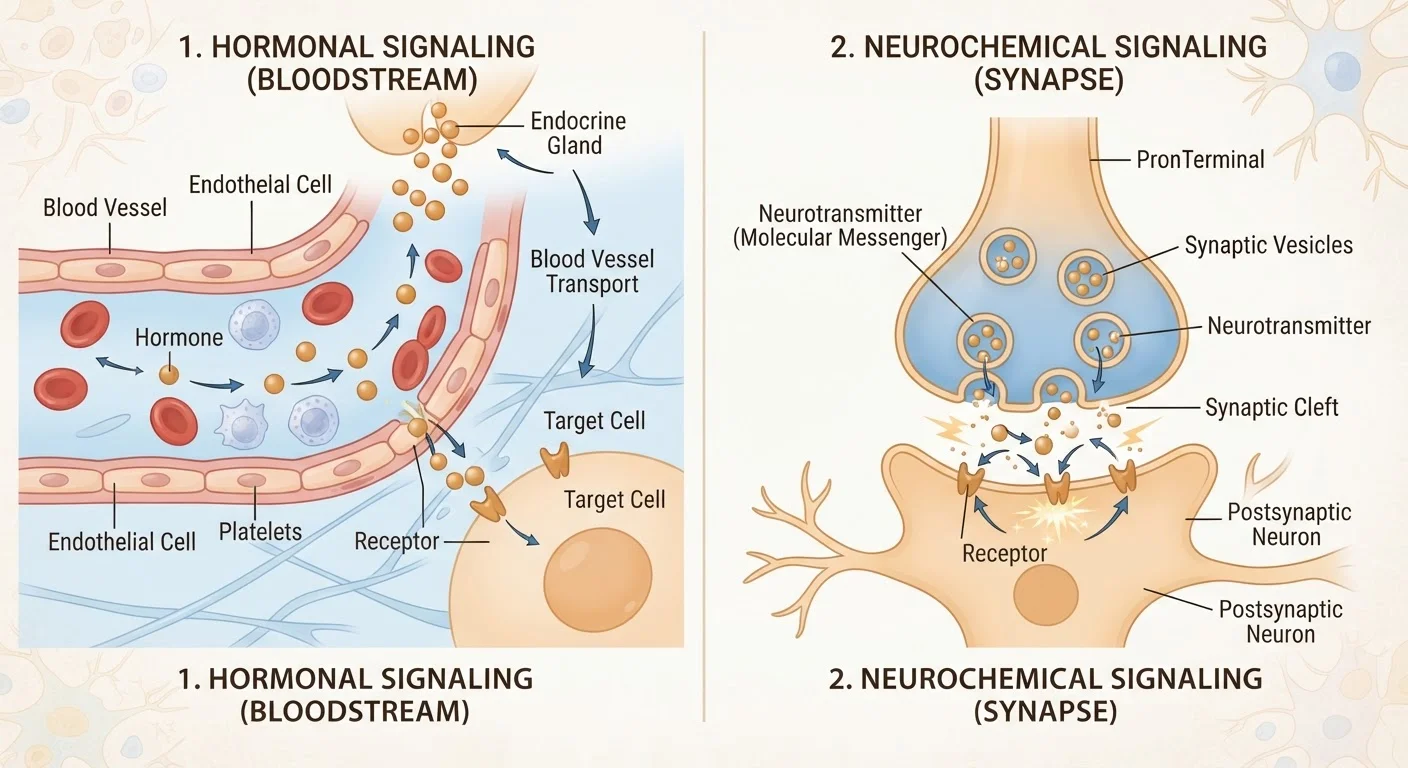
Hormones are produced by specialized glands - the pancreas, thyroid, adrenal glands, ovaries, testes, and others - collectively forming the endocrine system. Once secreted, they enter the bloodstream and circulate to distant target organs anywhere in the body. Insulin, cortisol, estrogen, and testosterone are classic examples.
Neurotransmitters originate in neurons (nerve cells) and are released into the synapse - the microscopic gap between one neuron and the next, or between a neuron and a muscle cell. They don't travel far. Their job is local, precise, and extraordinarily fast. Serotonin, dopamine, acetylcholine, and glutamate are among the most studied.
Speed, Range, and Duration: The Key Differences
The most revealing way to contrast these two messenger types is through three dimensions: how fast they act, how far they reach, and how long their effects last.
| Criterion | Hormones | Neurotransmitters |
|---|---|---|
| Origin | Endocrine glands (e.g., thyroid, pancreas) | Neurons (nerve cells) |
| Travel route | Bloodstream | Across a synapse (gap between cells) |
| Range of action | Body-wide (distant organs) | Highly local (adjacent cells only) |
| Speed of effect | Minutes to hours | Milliseconds |
| Duration of effect | Hours to days | Milliseconds to seconds |
| Examples | Insulin, cortisol, estrogen | Serotonin, dopamine, glutamate |
| Regulatory system | Endocrine system | Nervous system |
Hormones typically take minutes to hours to produce measurable effects - sometimes longer. Cortisol released during stress, for example, continues influencing immune function, blood sugar, and cognition for hours after the initial trigger. This slow, sustained action suits their role in regulating large-scale bodily states.
Neurotransmitters operate on a millisecond timescale. When a neuron fires, neurotransmitters flood the synapse, bind to receptors on the receiving cell, and are either broken down or reabsorbed almost immediately. This brevity is a feature, not a flaw - it allows the nervous system to encode rapid, specific information with remarkable precision.
When the Same Molecule Does Both Jobs
One of the most instructive nuances in this comparison is that some molecules serve as both hormones and neurotransmitters, depending on context. Dopamine is produced in the adrenal glands and released into the bloodstream (acting as a hormone), but it also functions as a critical neurotransmitter in brain circuits governing motivation and reward. Similarly, epinephrine (adrenaline) acts as both a hormonal stress signal from the adrenal medulla and a neurotransmitter in the sympathetic nervous system.
The Dual-Role Molecules: A Useful Caveat
Dopamine and epinephrine are the clearest examples of molecules that blur the hormone-neurotransmitter boundary. Both are classified as catecholamines - a chemical family derived from the amino acid tyrosine. When released from adrenal glands into the blood, they function as hormones; when released at a synapse in the brain or peripheral nervous system, they function as neurotransmitters. Researchers and clinicians account for this dual role when studying conditions that involve both the endocrine and nervous systems.
This dual identity underscores an important principle: what defines a messenger is not the molecule itself, but where it acts and how it gets there. Chemistry alone doesn't draw the line - physiology does.
Why the Distinction Matters for Health
Understanding which system is involved in a condition has direct implications for how it is studied and managed. Disorders rooted in hormonal dysfunction - such as hypothyroidism, Addison's disease, or polycystic ovary syndrome - typically involve gland output or receptor sensitivity across the body. Conditions more tied to neurotransmitter signaling - including major depression, schizophrenia, and Parkinson's disease - reflect disruptions in specific brain circuits and synaptic chemistry.
Many therapeutic agents work by targeting one system or the other. Selective serotonin reuptake inhibitors (SSRIs), for example, increase serotonin availability in synapses. Hormone replacement therapies, by contrast, supplement circulating blood levels of specific hormones. Neither approach crosses neatly into the other's territory.
This article is for general informational and educational purposes only and is not a substitute for professional medical advice, diagnosis, or treatment. Always consult a qualified healthcare provider regarding any medical condition or health questions.