
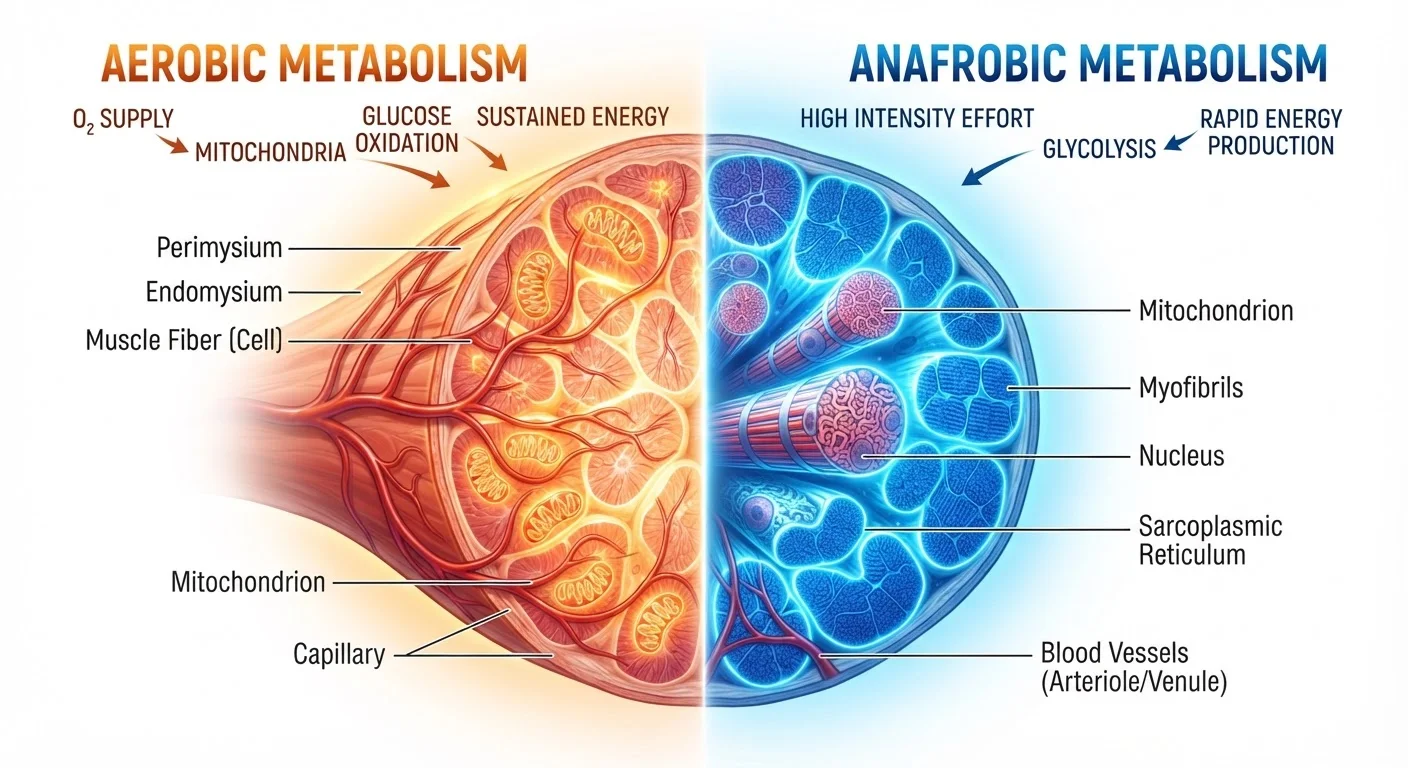
The Fundamental Difference: Oxygen as the Deciding Factor
Every movement your body makes requires energy in the form of adenosine triphosphate (ATP - the molecule cells use as fuel). The question isn't whether ATP is involved; it's how your muscles produce it quickly enough to match the demand you're placing on them.
Aerobic metabolism produces ATP using oxygen. Inside specialized structures in muscle cells called mitochondria, oxygen helps break down glucose and fat through a multi-step process, yielding large amounts of ATP along with carbon dioxide and water as byproducts. This is an efficient, sustainable process - but it's not instantaneous.
Anaerobic metabolism skips the oxygen requirement entirely. When intensity spikes and oxygen delivery falls behind energy demand, muscles shift to a faster but less efficient pathway. Glucose is broken down in the cellular fluid (the cytoplasm) without oxygen, producing ATP quickly. The trade-off is a smaller ATP yield and the production of lactate - a molecule that, at high concentrations, contributes to that familiar burning sensation in overworked muscles.
| Criterion | Aerobic Energy | Anaerobic Energy |
|---|---|---|
| Oxygen required? | Yes | No |
| ATP yield per glucose | High (~30-32 ATP) | Low (~2 ATP) |
| Speed of energy production | Slower, sustained | Rapid, short-lived |
| Primary fuel sources | Glucose and fat | Glucose only |
| Main byproducts | CO₂ and water | Lactate |
| Dominant during | Low to moderate intensity | High intensity bursts |
| Sustainability | Minutes to hours | Seconds to ~2 minutes |
What Actually Triggers the Switch
Your muscles don't flip a clean switch between systems. Both pathways run simultaneously at all times; intensity determines the ratio between them. At rest or during light activity, aerobic metabolism handles virtually all energy production. As intensity climbs, the anaerobic contribution grows.
The key concept here is the lactate threshold - the exercise intensity at which lactate accumulates in the blood faster than the body can clear it. Below this threshold, your aerobic system can keep up. Above it, anaerobic metabolism increasingly dominates, and lactate builds.
This threshold isn't fixed. Endurance training raises it, meaning a trained athlete can sustain higher intensities while remaining predominantly aerobic. That's one reason trained runners can hold a pace that would push an untrained person into breathless anaerobic territory.
~30-32
ATP molecules produced per glucose aerobically
Aerobic glycolysis followed by the citric acid cycle and oxidative phosphorylation yields far more energy per glucose molecule than anaerobic pathways.
~2
ATP molecules produced per glucose anaerobically
Anaerobic glycolysis produces ATP roughly 15 times faster than aerobic metabolism, but at a significant efficiency cost.
~55-85%
VO₂ max range where lactate threshold occurs in trained athletes
Research consistently shows that endurance training pushes the lactate threshold to a higher percentage of maximal oxygen uptake, improving sustainable performance.
What This Means for How You Feel During Exercise
The shift toward anaerobic metabolism has tangible, real-time effects. That sensation of heavy legs, burning muscles, and labored breathing during a hard sprint or intense interval isn't a sign that something is wrong - it's your body communicating that energy demand is outpacing oxygen supply.
Lactate itself has been somewhat misunderstood historically. For decades it was cast as the villain behind muscle fatigue, but current research paints a more nuanced picture. Lactate can actually be shuttled to neighboring muscle cells and even the heart to be used as fuel. The fatigue associated with high-intensity effort involves multiple factors beyond lactate, including ion imbalances and reduced pH in muscle tissue.
Recovery after anaerobic effort also takes longer precisely because the body must restore balance - clearing metabolic byproducts, replenishing phosphocreatine stores (the rapid-fire energy reserve that kicks in first during intense bursts), and reestablishing normal muscle chemistry.
This article is for informational purposes only and is not a substitute for professional medical or fitness advice. Consult a qualified healthcare or exercise professional before starting or significantly changing a physical activity program, especially if you have an existing health condition.