Before the Page: The World Oral Tradition Built
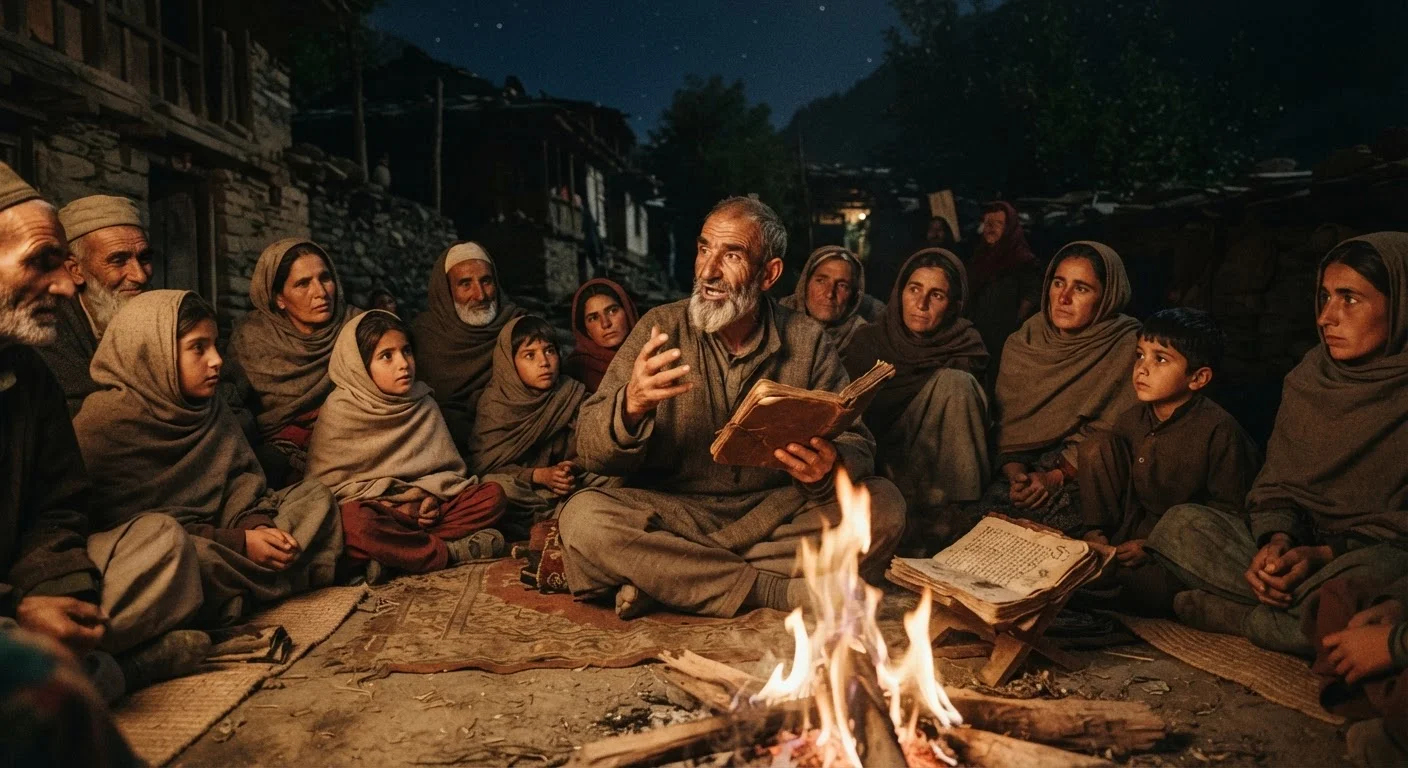
Long before anyone pressed a reed into clay or dipped a quill into ink, human beings were already sophisticated storytellers. Oral tradition - the practice of passing stories, histories, laws, and cosmologies from mouth to ear across generations - is estimated to predate writing by tens of thousands of years. Entire civilizations ran on it. The Iliad and the Odyssey were performed by traveling bards called rhapsodes for centuries before they were ever committed to writing. West African griots carried genealogies and communal histories that spanned hundreds of years, held entirely in memory and voice.
What makes oral tradition so durable is also what makes it dynamic. Each performance is a negotiation between the story and its audience. A skilled oral storyteller - whether a griot, a Indigenous elder, or a Homeric bard - doesn't simply recite; they read the room, adjust emphasis, and keep the narrative alive for the people in front of them. This is storytelling as a communal act, not a solitary one. As scholars of folklore like Walter Ong have argued, oral cultures organize knowledge differently from literate ones: thought tends to be situational, participatory, and deeply tied to memory-friendly patterns like repetition, rhythm, and formula.
That adaptability, though, carries a risk. Oral stories are only as durable as the human chain preserving them. When communities are scattered - by colonization, displacement, or the death of the last keeper of a tradition - those stories can vanish with devastating speed. To learn more about how indigenous oral practices have shaped and been shaped by American literary culture, see Indigenous Storytelling Traditions and Their Place in American Literature.
The Power - and the Limits - of Writing Things Down
The invention of writing systems - cuneiform in Mesopotamia around 3200 BCE, hieroglyphs in Egypt, logographic scripts in China - transformed how cultures stored and transmitted knowledge. Writing made it possible to fix a story in a form that could outlast any single speaker. It enabled laws to be codified, science to be cumulative, and literature to travel across centuries with its original words largely intact.
Written literature introduced something oral tradition structurally cannot: the possibility of solitary reading. When a reader opens a novel alone at midnight, they are having a private conversation with an author who may have died two hundred years ago. That intimacy - between a fixed text and an individual reader - is one of written literature's great gifts. It is also, critics have noted, a kind of rupture. The text no longer belongs to a community; it belongs to whoever holds the book.
| Criterion | Oral Tradition | Written Literature |
|---|---|---|
| Primary medium | Voice, memory, performance | Text on a physical or digital surface |
| Stability of content | Flexible - adapts with each retelling | Fixed - words remain largely unchanged |
| Community role | Communal, participatory experience | Often a solitary, individual experience |
| Risk of loss | High - depends on living keepers | Lower - but vulnerable to destruction or decontextualization |
| Geographic reach | Limited by proximity and travel | Global - via copying and translation |
| Temporal reach | Generational - requires active transmission | Centuries - texts can outlast their cultures |
| Famous examples | Griot traditions, Homeric epics (pre-text), Dreamtime stories | The Iliad (written form), Canterbury Tales, Moby-Dick |
Written literature also carries its own vulnerabilities. A manuscript can be burned, a language can become dead, and a text can lose its meaning entirely when stripped of the cultural context that originally gave it life. Translation - a process that is itself a form of interpretation - attempts to bridge this gap, but always at a cost. As our editors explore in Why Translation Is One of Literature's Most Underappreciated Art Forms, carrying a story from one language to another requires navigating impossible choices about what to keep and what to surrender.
Two Systems, One Conversation
The most honest framing isn't oral tradition versus written literature - it's oral tradition and written literature as complementary technologies, each developed to solve different problems of cultural memory. Many of the texts we now read as written literature began as oral compositions. Homer's epics bear the fingerprints of oral formulaic composition: repeated epithets, stock scenes, and rhythmic patterns designed to help a performer hold thousands of lines in memory. The same is true of the Sanskrit epics, the Norse sagas, and significant portions of the Hebrew Bible.
Contemporary authors continue to weave oral aesthetics into written form. Writers like Toni Morrison, Leslie Marmon Silko, and Chinua Achebe have each described their work as an attempt to put an oral voice on the page - to make written fiction feel like it is being told to you rather than simply read. This blending reflects something important: the two traditions are not opposites. They are in dialogue, and always have been.
When the Two Traditions Overlap
The boundary between oral and written literature is far blurrier than most textbooks suggest. Many written texts were composed to be read aloud - from medieval romances to Victorian serialized novels. Conversely, oral traditions often develop alongside writing systems, using literacy for record-keeping while keeping ceremonial stories in oral form. Neither tradition is inherently superior; they evolved to serve different purposes within different communities.
For readers interested in how narrative structure itself shifts across cultural contexts - and how oral and written traditions organize story differently - The Shapes Stories Take: Narrative Structure Across Cultures offers a rich exploration. And if you are curious about how these questions of tradition and innovation play out in fiction more broadly, our comparison of Classic Literature vs. Contemporary Fiction traces a related tension between preservation and reinvention.