
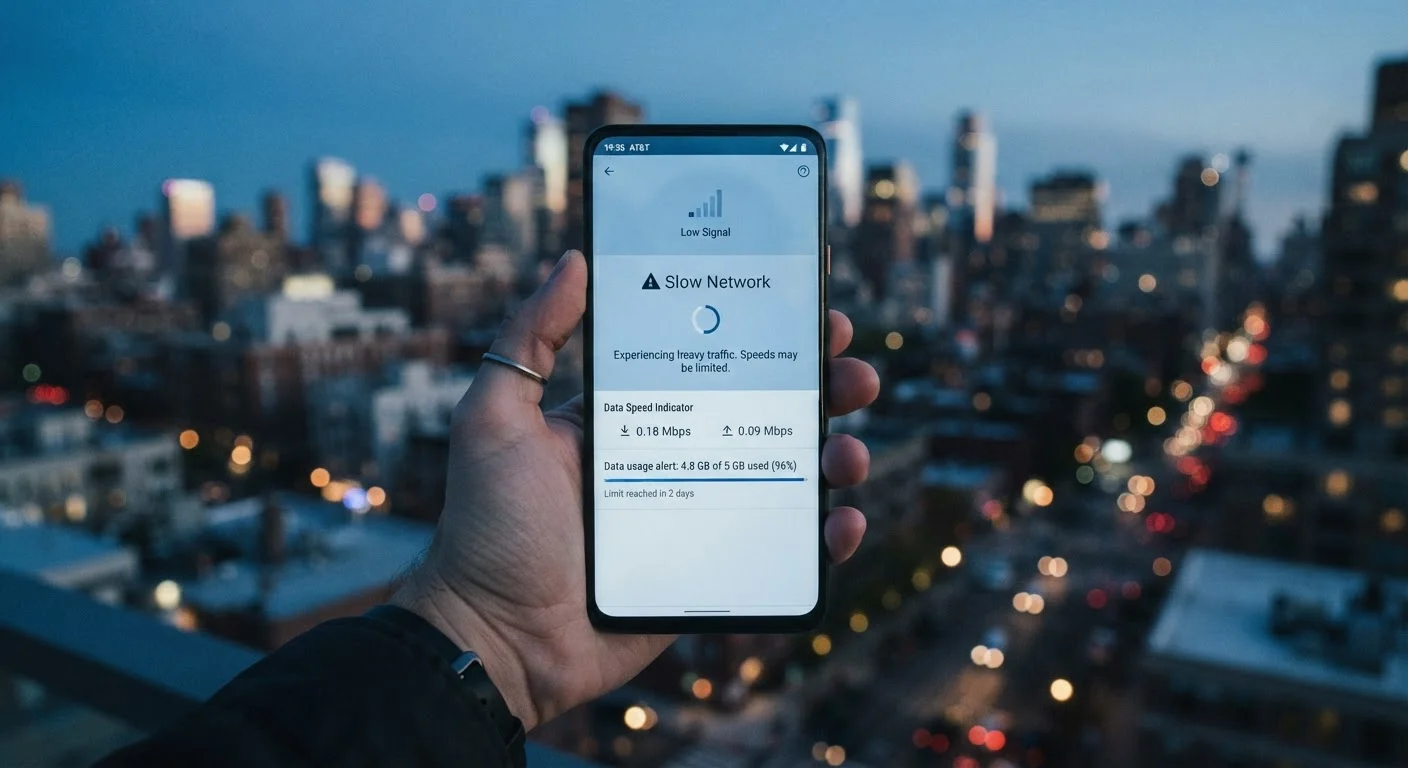
Three Different Ways Carriers Slow Your Data
If you've ever noticed your phone crawling through a video buffer or a web page taking forever to load, a speed limit imposed by your carrier may be the culprit. Carriers use three distinct mechanisms to manage data usage: throttling, deprioritization, and hard caps. Each works differently, and each has different implications for your daily experience.
This distinction matters because carriers don't always make it obvious which policy applies to you - and the marketing language around 'unlimited' plans makes it even harder to tell. See our article on what carriers don't spell out when you sign up for a broader look at plan fine print.
The Word 'Unlimited' Has Limits
Carriers are permitted to call a plan 'unlimited' even when it includes deprioritization thresholds or video speed caps. The term refers to the absence of a hard data cutoff - not the absence of any speed management. Reading the full plan terms, not just the marketing summary, is the only way to know exactly what you're getting.
Throttling: A Fixed Speed Reduction
Throttling is the most straightforward of the three. Once you've consumed a set amount of high-speed data - say, 15GB - your carrier automatically drops your connection speed for the remainder of the billing cycle. That reduced speed stays in place whether the network is empty at 3 a.m. or jammed during rush hour. Common throttled speeds are around 1.5 Mbps, which is slow enough to make HD video nearly impossible but still workable for basic messaging or light browsing.
Throttling is most often found on mid-tier plans that advertise a specific high-speed data allotment. Once that allotment is gone, the speed cap is automatic and doesn't reset until your next billing cycle. Some carriers also throttle specific types of traffic - video streaming, for example - regardless of how much data you've used.
1.5 Mbps
Typical throttled speed on many US plans
This speed is commonly used as the post-threshold cap on mid-tier plans, enough for basic browsing but insufficient for HD video streaming.
~50%
US unlimited plans that include deprioritization thresholds
Industry analyses of US carrier plan terms consistently find that most unlimited plans include a premium data cap beyond which deprioritization applies.
480p
Common video throttle ceiling on base unlimited tiers
Many entry-level unlimited plans cap video resolution at standard definition regardless of total data usage, a form of traffic-specific throttling.
Deprioritization: Conditional and Temporary
Deprioritization works differently. Instead of a permanent speed reduction, it only applies when a cell tower you're connected to is experiencing high demand. At that moment, your data packets are placed lower in the queue behind users who haven't hit their threshold. When traffic eases, your speeds recover - sometimes within minutes.
This is common on unlimited plans that advertise a 'premium data' allotment. Once you exceed that allotment, you aren't throttled outright; you're simply lower priority during busy periods. In a rural area with light network load, you might never notice it. In a dense city during an event, the slowdown could be significant. To understand why congestion affects speeds the way it does, see our explainer on how network congestion works.
Hard Caps: When Data Just Stops
A hard cap is the most absolute form of data control. Once you hit the limit built into your plan, mobile data stops functioning entirely - no slower speeds, just no data. Hard caps are most common on prepaid plans or legacy tiered plans where you pay for a specific bucket of data (such as 5GB or 10GB per month).
At that point, your options are typically to purchase an add-on, wait for the billing cycle to reset, or rely on Wi-Fi. Hard caps give carriers and customers alike a predictable boundary, but they can be jarring if you don't monitor usage closely. If your household is weighing plan types, the trade-offs covered in shared vs. individual data plans are worth reviewing.
Track Your Usage Before Mid-Month
Most carriers provide a usage tracker in their app or via a short dial code. Checking your data usage at the midpoint of your billing cycle gives you time to adjust behavior - cutting back on streaming or switching to Wi-Fi - before hitting any threshold. It's a simple habit that prevents most month-end surprises.
Why This Matters When Choosing a Plan
The mechanism your carrier uses to manage your data has a real effect on your day-to-day experience. Throttling is predictable but frustrating. Deprioritization is tolerable in many areas but unpredictable in others. Hard caps are blunt but transparent.
Before signing up for any plan, look carefully at the data policy section - not just the headline data number. Ask specifically: Is there a speed reduction after a set usage threshold? Is that reduction permanent or congestion-based? Is there a point at which data stops entirely? The answers will tell you far more than the plan name. Our full plan evaluation checklist walks through exactly what to look for before committing. These policies also apply abroad - international roaming speeds are often subject to their own throttling rules.