
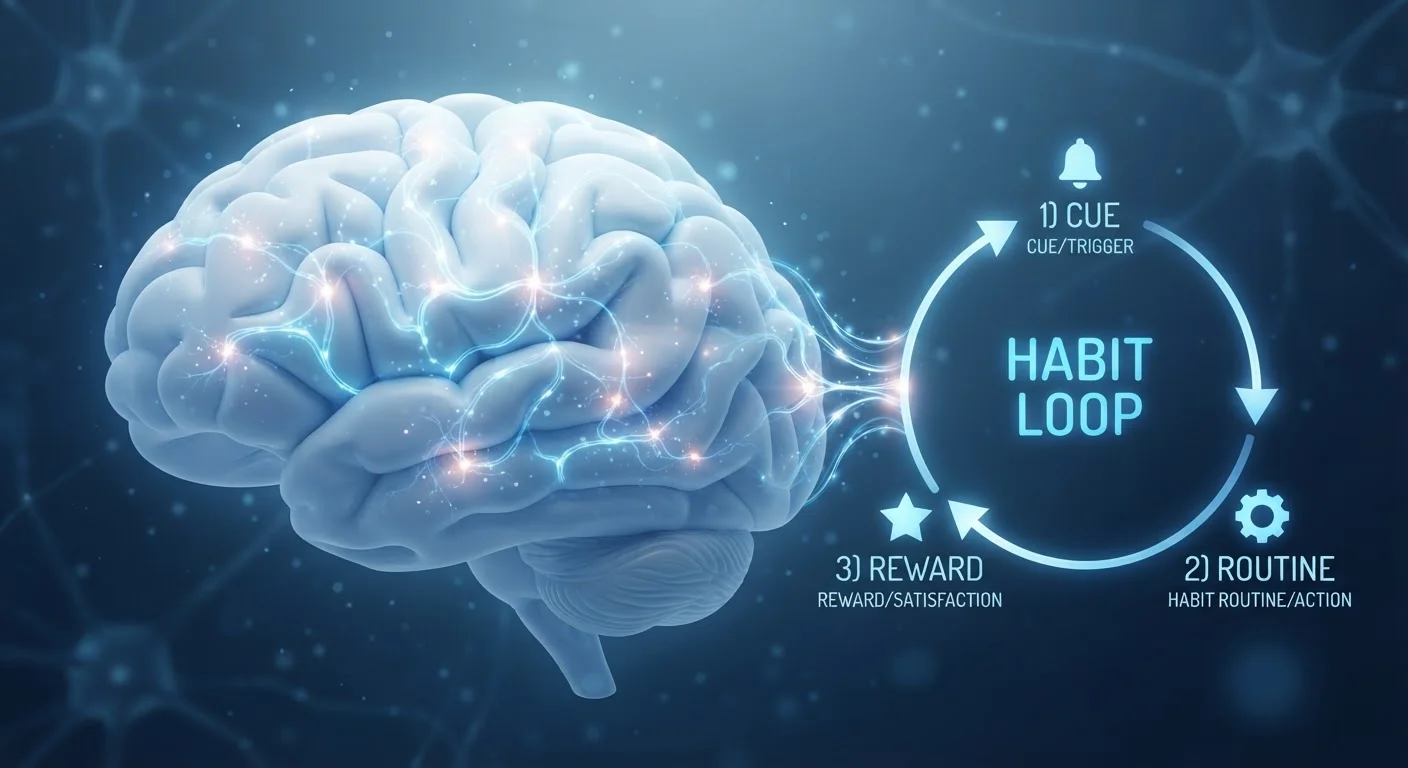
The Neurological Loop Behind Every Habit
Every habit - whether it's morning coffee, late-night scrolling, or a daily walk - runs on the same underlying neurological architecture. Researchers describe this as the habit loop: a three-stage cycle of cue, routine, and reward.
The cue is a trigger that tells the brain to initiate a behavior. It might be a time of day, a location, an emotional state, or the completion of another action. The routine is the behavior itself. The reward is what the brain receives - a feeling of pleasure, relief, or satisfaction - that reinforces the loop and increases the likelihood the behavior will repeat.
Over time, the brain begins to anticipate the reward the moment it detects the cue. This anticipation - driven by the neurotransmitter dopamine - is what transforms a deliberate choice into an automatic response. The basal ganglia essentially takes over from the prefrontal cortex, chunking the behavior into a single efficient unit. That's why experienced drivers barely think about shifting lanes, or why checking your phone in a quiet moment feels reflexive rather than intentional.
The Brain Doesn't Delete Old Habits
Once a habit loop is encoded, the neural pathway doesn't disappear when you stop the behavior - it becomes dormant. This is why people often find old habits resurface during stressful periods, even years after they were abandoned. Building a replacement habit is more effective than simply trying to stop an old one.
Why Good Intentions Aren't Enough
Most failed routines share a common flaw: they rely almost entirely on motivation and willpower rather than on the mechanics the brain actually uses to build habits. Motivation is inherently variable - it peaks after a decision is made and erodes quickly when discomfort or inconvenience appears.
The structural problem is that many people set vague goals ("eat healthier," "exercise more") without defining a reliable cue or a genuinely satisfying reward. Without a consistent trigger, the brain has no signal to initiate the routine. Without a real reward, there's nothing to reinforce the loop.
Environmental friction also plays a significant role. If a desired behavior requires extra steps - driving to a gym, preparing ingredients, finding equipment - those friction points compete with the pull of easier, already-established habits. The brain tends to default to the path of least resistance.
For a deeper look at where behavioral change commonly breaks down, see where people go wrong when building healthier habits.
Evidence-Backed Strategies That Actually Work
The research on behavior change points to several practical strategies that work with the brain's habit architecture rather than against it.
- Start absurdly small. Behaviors that require minimal effort are easier to initiate and repeat. A two-minute version of a habit - a single push-up, one page of reading - lowers the activation threshold enough for the brain to begin encoding it as routine.
- Use habit stacking. Attach a new behavior to one you already perform reliably. Linking a new habit to an existing cue (like stretching right after waking up) borrows the established trigger. This is one of the most robust techniques in behavioral science.
- Design your environment. Make desired behaviors easier to access and undesired ones harder. Placing a water bottle on your desk or keeping healthy food at eye level in the fridge reduces decision-making friction significantly.
- Make the reward immediate. Because the brain's reward system works on short time horizons, pairing a new habit with an immediate positive experience - enjoyable music during a workout, a pleasant drink after journaling - accelerates reinforcement.
These principles apply across health domains. Whether you're working on grocery shopping habits that support better nutrition or small daily habits that support mood stability, the underlying mechanics are the same.
Building Routines That Last
Sustainable habit change is less about discipline and more about design. The most durable routines tend to share three qualities: they are specific (tied to a defined cue and context), simple enough to repeat on difficult days, and connected to an outcome the person genuinely values.
Consistency matters more than perfection. Missing one day does not erase a forming habit - research suggests that occasional lapses have minimal impact on long-term automaticity, as long as the behavior resumes promptly. The danger is treating a single miss as a failure and abandoning the routine entirely.
For those interested in applying these principles to reading, the same framework holds - building a rewarding reading life benefits from cue-based scheduling and small, achievable daily targets rather than ambitious but unsustainable goals.
This article is for informational and educational purposes only and does not constitute medical or psychological advice. If you have concerns about your health or behavior, please consult a qualified healthcare professional.