The Commute Is Just the Beginning
Most people frame the remote vs. in-office debate around commuting. That's understandable - cutting out a daily hour-plus round trip has obvious lifestyle value. But the commute is really just the surface. The deeper differences show up in how you communicate, how visible you are to leadership, and how your career develops over time.
This isn't a question with one right answer. Remote work has proven to be genuinely productive for many roles and workers. In-office work continues to offer real advantages that don't always get their due in the cultural conversation. Understanding both honestly is what lets you make a deliberate choice - or advocate for the arrangement that actually fits your situation.
How Each Setting Shapes Daily Communication
In an office, much of your communication happens informally - a quick question at someone's desk, a hallway conversation, overhearing context from a nearby meeting. This ambient information flow is easy to underestimate until it's gone. Remote workers have to intentionally replace it with structured check-ins, clear written updates, and proactive outreach.
That shift isn't inherently bad. Remote work tends to push teams toward clearer, more documented communication, which can reduce misunderstandings. But it also raises the bar on self-advocacy. If you're working from home, nobody notices when you're heads-down on a difficult problem - you have to surface that context yourself.
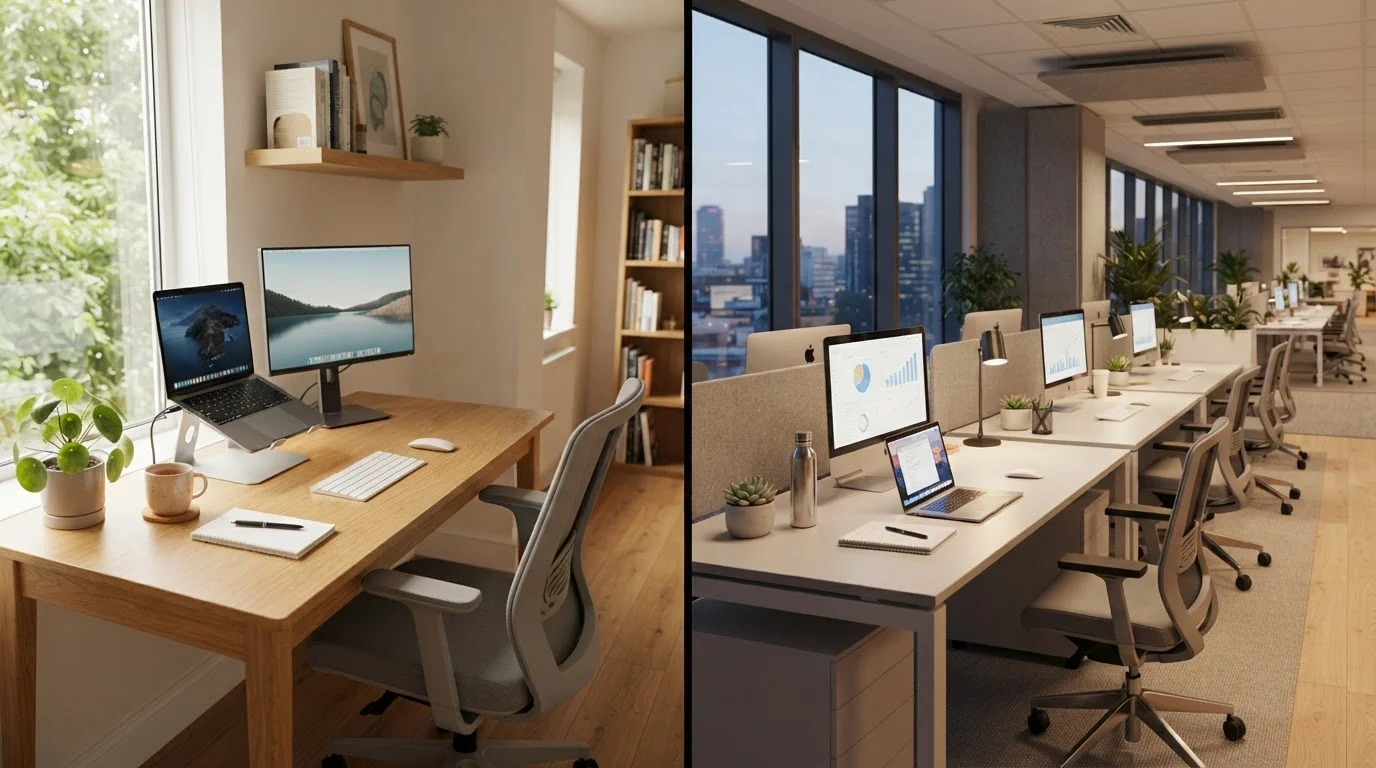
| Remote Work | In-Office Work | |
|---|---|---|
| Daily commute | None (major time/cost saving) | Required; adds to daily schedule |
| Communication style | Structured, written, asynchronous | Spontaneous, verbal, real-time |
| Visibility to leadership | Requires deliberate effort | More naturally organic |
| Informal mentorship | Limited; must be intentionally sought | Easier through proximity |
| Focus and deep work | High potential (environment permitting) | More interruptions typical |
| Work-life separation | Boundaries can blur easily | Physical separation built-in |
| Social connection | Isolation risk over time | Regular in-person interaction |
| Schedule autonomy | Generally higher flexibility | More fixed hours and structure |
In-office environments also make it easier to read the room. Tone, urgency, and interpersonal dynamics are harder to decode over video or Slack. If navigating office dynamics is part of your day-to-day, proximity gives you more data to work with.
Visibility, Mentorship, and Career Advancement
Research on remote work has consistently flagged one concern: workers who are less physically visible tend to receive fewer spontaneous opportunities - stretch assignments, introductions to senior leaders, informal coaching. This isn't a personal failing; it's a structural feature of how most organizations still operate.
Early-career professionals in particular may feel this gap. In an office, you pick up an enormous amount just by proximity - how a senior colleague handles a difficult client call, how decisions actually get made in a meeting room, what the unwritten norms of your industry look like in practice. That informal apprenticeship is harder to replicate through a screen.
That said, in-office proximity is not a substitute for intentional career management. Remote workers who proactively build relationships, document their contributions, and communicate results clearly can advance effectively. The path just requires more deliberate effort. For a broader look at advancement strategies, see career growth in the modern workplace.
Focus, Autonomy, and Work-Life Boundaries
Remote work genuinely excels at enabling deep, uninterrupted focus - when the home environment cooperates. Without open-plan interruptions, impromptu meetings, or office noise, many workers report higher output on complex individual tasks. The autonomy to structure your own day can also reduce stress and improve job satisfaction for workers who prefer that kind of control.
The trade-off is boundary erosion. When your office is your home, working hours can expand without a clear end signal. Remote workers often report difficulty fully disconnecting, and isolation can accumulate over time in ways that aren't obvious at first. Those considering the full spectrum of flexible work options - including independent contracting - will find a related comparison in freelancing vs. full-time employment.
Set a Hard End-of-Day Signal When Working Remotely
One of the most effective practices remote workers report is creating a consistent end-of-workday ritual - closing the laptop, a short walk, or a specific time-block for non-work activity. Without a commute to signal the transition, building your own boundary cue helps prevent the workday from quietly expanding into evenings and weekends. Small, consistent habits tend to matter more than rigid schedules.
In-office settings provide external structure - a commute that bookends the workday, colleagues who signal when the day is winding down, a physical separation between work and personal space. For workers who struggle with self-regulation or feel more energized by social environments, that structure is genuinely valuable, not just a constraint.
Making a Deliberate Choice
The arrangement that serves you best depends on your role, your career stage, and your working style. A collaborative product role at an early stage of your career looks very different from a heads-down analytical role with a decade of experience behind you.
If you're evaluating a job offer or advocating to your employer for a different arrangement, focus on specifics: What does collaboration actually require in this role? How does this organization typically identify and develop talent? What does your personal track record tell you about where you do your best work?
For workers still building their professional networks, it's also worth noting that physical proximity to colleagues isn't the only path to relationship-building. Tools like informational conversations and structured networking - explored in depth in job boards vs. networking - can complement remote work effectively. And regardless of arrangement, your long-term trajectory depends on choices about growth and visibility covered in vertical vs. lateral career moves.