Science Fiction Is Not One Genre - It's Many
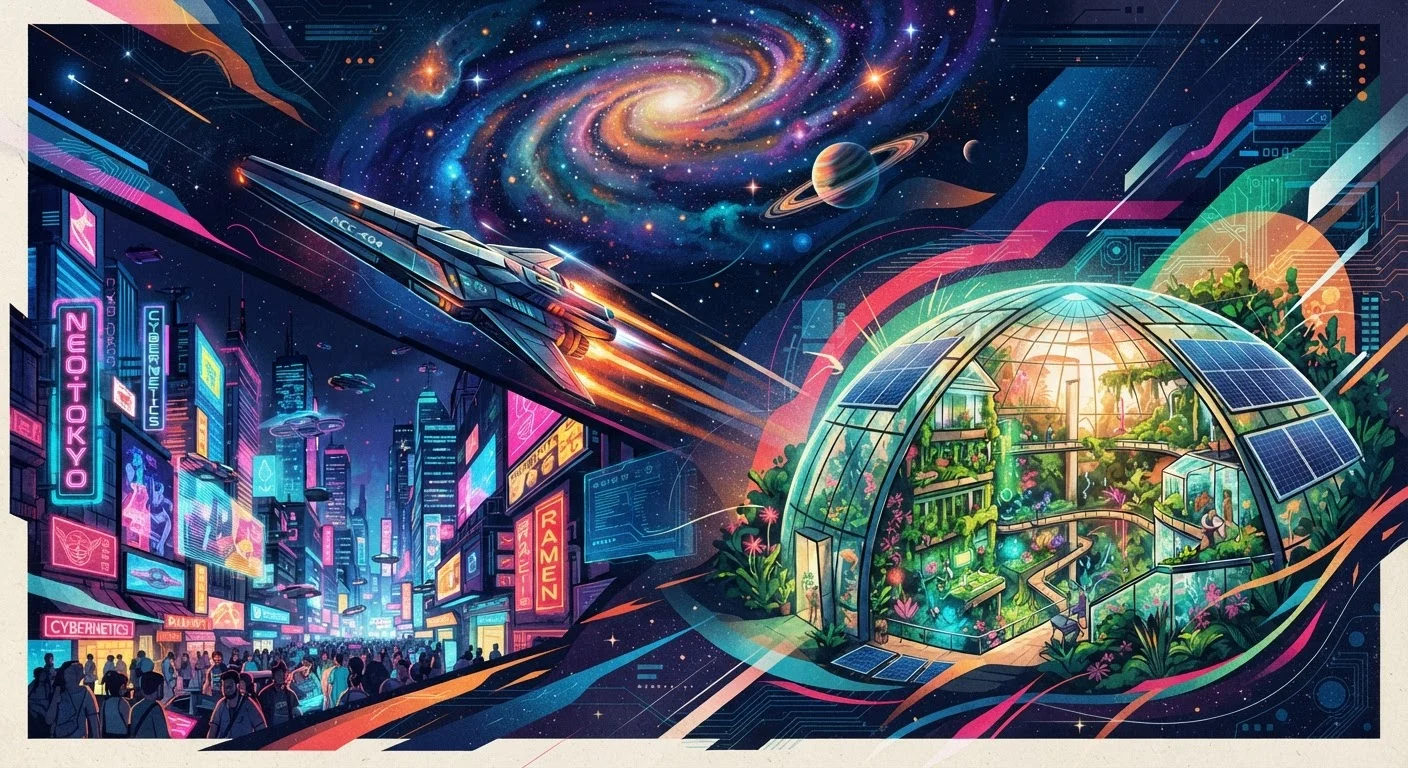
Ask ten readers to describe science fiction and you'll get ten different answers. One pictures chrome spaceships and intergalactic empires. Another thinks of rain-slicked streets, hacker slang, and corporate surveillance. A third imagines solar-powered utopias threaded with ecological hope. All of them are right - because science fiction is less a single genre than a sprawling family of subgenres, each with its own rules, preoccupations, and emotional register.
Understanding those subgenres isn't just a matter of literary trivia. It's practical knowledge for any reader who has ever picked up a book labeled "sci-fi" and found it nothing like what they expected. If you know which corner of the genre speaks to you, you're far more likely to land on a book you'll actually finish. For a broader genre map, see The Major Book Genres at a Glance.
Hard Science Fiction
A subgenre that adheres closely to scientific accuracy and plausibility, grounding its speculative elements in real or rigorously extrapolated science. Technical detail and logical problem-solving are central to the story.
Space Opera
Large-scale science fiction set across interstellar distances, featuring epic adventures, political conflict, and sweeping world-building. Scientific realism is secondary to narrative scope and emotional drama.
Cyberpunk
A subgenre defined by high technology and social inequality, typically set in dystopian near-futures dominated by corporations and surveillance. Protagonists usually operate outside or against power structures.
Solarpunk
An optimistic speculative subgenre imagining ecologically sustainable, community-centered futures. It arose partly as a counterpoint to cyberpunk's bleaker visions and emphasizes cooperation and green technology.
Biopunk
Science fiction focused on genetic engineering, synthetic biology, and biotechnology - often exploring the ethical and social consequences of manipulating life itself.
Climate Fiction (Cli-Fi)
Speculative fiction centered on climate change, environmental collapse, or ecological adaptation. It uses narrative to explore both the causes and consequences of planetary-scale environmental shifts.
A Field Guide to the Major Subgenres
The subgenres below represent the most recognized categories readers and critics use today. They overlap frequently - a single novel can be both hard sci-fi and a space opera - but understanding each archetype helps you navigate the genre with confidence.
| Oldest Recognized Subgenre | Scientific romance / proto-hard sci-fi (late 19th century) (Associated with works by H.G. Wells and Jules Verne) |
| Cyberpunk's Origin Decade | 1980s (Popularized by authors including William Gibson) |
| Solarpunk Emergence | Early 2010s (Grew from online speculative communities and anthologies) |
| Cli-Fi Mainstream Visibility | 2010s-present (Term widely adopted by literary critics and publishers) |
| Most Common Subgenre Overlap | Space opera + military sci-fi (Frequently combined in bestselling series fiction) |
Hard Science Fiction
Hard sci-fi prioritizes scientific accuracy and logical extrapolation above all else. The speculation is grounded in real physics, biology, or engineering, and the narrative often hinges on solving technical problems. Readers who enjoy puzzle-like plots and rigorous world-building tend to gravitate here.
Space Opera
Scale is everything in space opera. These stories unfold across star systems, civilizations, and centuries, pairing grand adventure with political intrigue and emotional stakes. The science is looser than hard sci-fi, but the sense of wonder is immense. Think epic fantasy, but in orbit.
Cyberpunk
Cyberpunk places technology and power in direct tension. Its worlds are hyper-connected but deeply unequal - cities of neon and surveillance, where megacorporations outrank governments and protagonists survive in the margins. The genre asks hard questions about identity, autonomy, and who controls information.
Solarpunk
Where cyberpunk diagnoses dystopia, solarpunk imagines alternatives. It envisions societies organized around ecological sustainability, mutual aid, and community ingenuity. The aesthetic is lush and optimistic - a deliberate counterweight to bleak futures. Solarpunk is arguably one of the fastest-growing subgenres of the past decade.
Military Science Fiction
This subgenre puts armed conflict at its center, examining the culture, ethics, and psychology of warfare in speculative settings. It ranges from action-driven adventure to sober meditations on duty and trauma. The best examples don't just celebrate combat - they interrogate it.
Biopunk and Cli-Fi
Biopunk explores biotechnology and genetic engineering run amok or run wild, often in near-future settings. Climate fiction - commonly abbreviated as cli-fi - uses speculative frameworks to explore environmental collapse and adaptation. Both subgenres are deeply entangled with contemporary anxieties and are increasingly visible on bestseller lists.
For readers curious about how sci-fi relates to its closest neighbor on the shelf, Science Fiction and Fantasy: Neighboring Worlds With Different Rules breaks down how these two speculative traditions diverge despite appearing so similar.
Picking the Subgenre That Fits Your Reading Style
Genre labels exist to serve readers, not restrict them. If you're drawn to ideas and intellectual challenge, hard sci-fi and biopunk reward the curious mind. If you want sweeping narrative and emotional epic, space opera delivers. If you're politically engaged and skeptical of corporate power, cyberpunk will feel like recognition. And if you're exhausted by apocalypse and hungry for possibility, solarpunk is worth your time.
Many books blur these lines deliberately - and that cross-genre energy is its own pleasure. Genre Blending: What Happens When a Book Refuses to Fit One Category explores how hybrid fiction forms and why it often produces some of the most surprising reading experiences. And if any of this is entirely new territory, Genre Conventions Readers Should Know Before Picking Up a New Category offers a useful orientation before you dive in.
The universe of science fiction is genuinely enormous - and the best subgenre for you is the one that makes you want to keep reading past midnight.